
Google Ads Match Types: What Are Keyword Match Types?
When bidding on a keyword in your PPC campaigns, you need to choose a keyword match type, which tells Google how aggressively or restrictively you want it to match your advertisements to user queries. There are three different keyword match types to choose from when advertising with Google Ads:
- Broad match
- Phrase match
- Exact match
In this quick tutorial, you’ll learn the three keyword match types available in Google advertising and how they differ, as well as why keyword match types are important to the success of your PPC ad campaigns.
What are the keyword match types?
When creating a text ad in your PPC campaign, you can select broad match, phrase match, or exact match for your keyword match type. Each match type in your Google Ads account has its advantages and disadvantages.
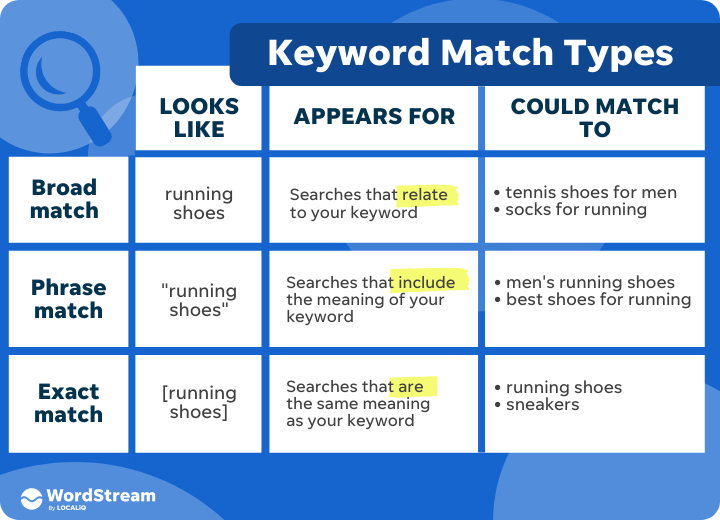
Broad match type
Broad match is the default match type and the one that reaches the widest audience. When using broad match, your ad is eligible to appear whenever a user’s search query includes any word in your key phrase, in any order, as well as any word that relates to your keyword.
For example, if you use broad match on “luxury car,” your ad might be displayed if a user types “luxury cars,” “fast cars,” or “luxury apartments,” as well as “expensive vehicles” which doesn’t include any of the terms in your keyword.
Again, since broad match is the default match type, it’s important to be very careful. Broad match keywords are a great way to drive lots of clicks, but advertisers need to keep a close eye on their search query reports to ensure that they’re not paying for irrelevant traffic that doesn’t convert.
You can set up negative keywords to help prevent your ad from showing on searches that aren’t related to your business. For more information on negative keywords, get our free Guide to Controlling Costs with Negative Keywords.
🔍 Find the best keywords for your ads with our easy Free Keyword Tool.
Phrase match type
Phrase match offers some of the versatility of broad match, but with a higher level of control. Your ad will only appear when a user queries your key phrase using your keywords in the exact order you enter them, but there might be other words either before or after that phrase.
In 2019, Google expanded phrase match to include queries containing synonyms, plurals, or close variants of your keyword. So if you are targeting “lawn mowing service” as your key phrase, in addition to showing for lawn mowing service prices, it could now also show for grass cutting services near me. And in addition to showing for seasonal lawn mowing service rates, it could now also show for local lawn cutting services.

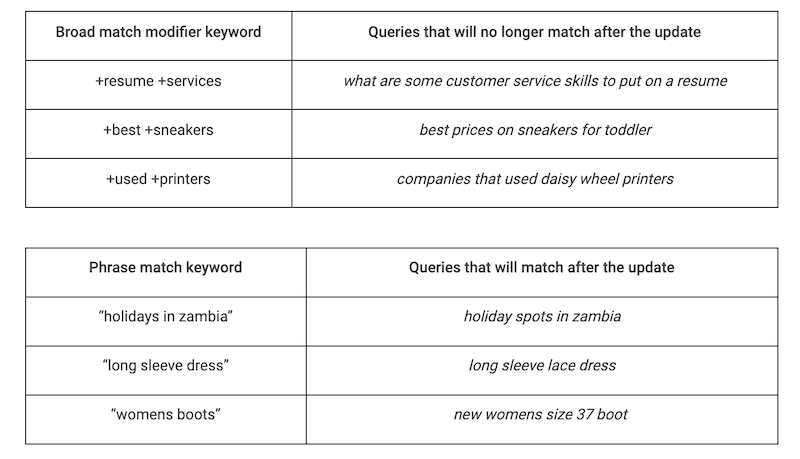
In 2021, Google retired modified broad match and absorbed it into phrase match. This means that phrase match keywords will match to more queries. So if your phrase match keyword is “holidays in zambia,” your ad could show for holiday spots in zambia. Here are some examples Google provides:
Exact match type
Exact match is the most specific and restrictive of the keyword match types. In previous years, with this match type, users would only see your ad when they typed your exact keyword phrase by itself. For example, if your keyword phrase was “black cocktail dress,” your ad would only be eligible to show up when a user searched for “black cocktail dress” (those words in that exact order) and not for “cocktail dress,” “black dress” or “expensive black cocktail dress.”
However, Google has recently made changes to the exact match type so that even when using exact match keywords, your ads might match to searches containing synonyms, plurals, or other variations on your keyword. Learn more about these changes in this article.
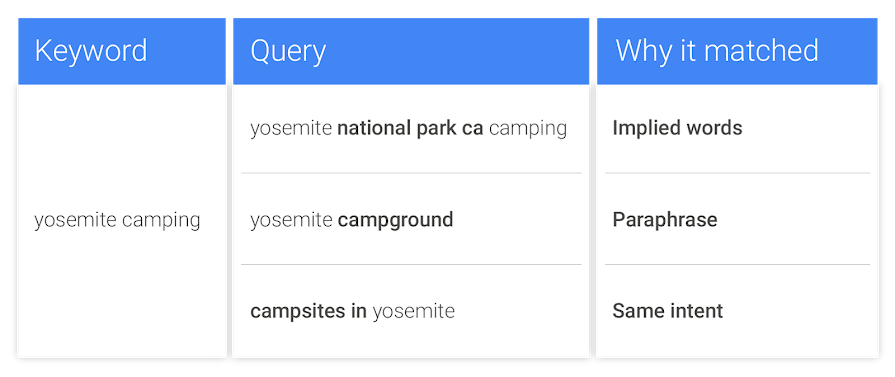
On the plus side, users who click on your ad when searching for that exact phrase are more likely to be interested in your product or service, so using exact match can reduce unwanted costs and keep conversion rates high. On the down side, you will have less traffic as a result of your restrictions, because these more specific search queries have lower search volume, and you won’t get as many overall impressions. Like phrase match, exact match has also been updated to include synonyms and close variants, so you do have a bit more flexibility now with this match type.
How do match types affect your search ad results?
Match types can have a major impact on your account’s performance: they’re the control you use to determine exactly which search queries you’re bidding on. As you determine which match types to use for each keyword, there are a few key components to consider:
- Performance to date — How a keyword or similar keywords have performed can give you insights into which match type will provide the best return on your investment.
- Competitors — How your competitors bid on certain terms and structure their own accounts, as well as how their accounts have performed historically will all impact the return you see from certain match types.
- Bids — Cost per click and cost per conversion are heavily impacted by bids – often advertisers employ various methodologies for manipulating bids and frequently bid more or less aggressively based on the match type – this can strongly influence which match type is most appropriate.
- Ad text & account structure — Many advertisers will break out a “money” keyword and run it on broad, phrase and exact match types – perhaps even segmenting those match types out and writing specific ads for each. The way an advertiser structures an account can also have a massive impact on performance for different match types.
Choosing the right match types is crucial because it allows you to reach your target audience while avoiding unnecessary spend on irrelevant clicks.
The first step, of course, is to have relevant keywords to begin with! Use our Free Keyword Tool to find the best keywords to target with your ads.
