
Cost Per Click (CPC): Learn What Cost Per Click Means for PPC
Cost Per Click (CPC) refers to the actual price you pay for each click in your pay-per-click (PPC) marketing campaigns. In this lesson, you’ll learn:
- A more thorough definition of cost per click.
- Why CPC is important to you and your PPC campaigns.
- How to lower your cost per click while maintaining (or even improving) traffic and conversion levels.
What Is CPC?
Cost per click, or CPC, is the amount you pay for each click on one of your PPC ads in platforms such as Google Ads or Microsoft Ads.
A “click” on one of your PPC text ads or display ads represents a visit, or an interaction with your company’s product or service offering. Every click in a PPC campaign represents attention from a person who is searching for something that you offer. This attention is what you’re buying, as an advertiser, so it’s important to note two factors:
- What type of attention you’re going after, and
- How much you’re paying for it.
How Is Cost Per Click Calculated?
Your cost per click is the Ad Rank of the ad below you, divided by your Quality Score, plus one cent.
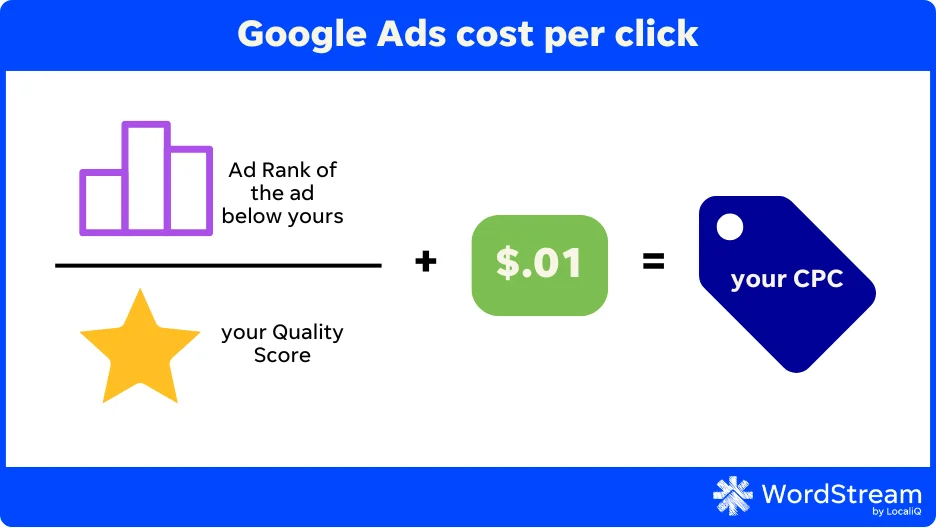
As an advertiser, your cost per click will always be less than or equal to your maximum bid, as it is an average of bids against a series of competitors over a period of time. Because of how Google’s ad auction works, your actual cost per click is heavily influenced by both you and your closest competitor’s ad rank, maximum bid, and Quality Score.

The Google Ads Auction: Max Bid, Quality Score, and Ad Rank all affect CPC
What Is The Average Cost Per Click in Google Ads?
Your Google Ads ROI is determined by how much you are paying for clicks and the quality of the traffic you get from those clicks. You don’t just want traffic at any price; you want affordable traffic that drives meaningful value for your business.
Average cost per click varies depending on your industry, your business type, and what networks you’re advertising on.More competitive industries and industries with higher-priced conversions (such as enterprise software, industrial equipment, or expensive services in the law and financial industries) tend to have more expensive costs per click. But, the average CPC across industries for search ads is $5.26.
Check out the graph below to see CPC search ads benchmarks across 20 common industries:
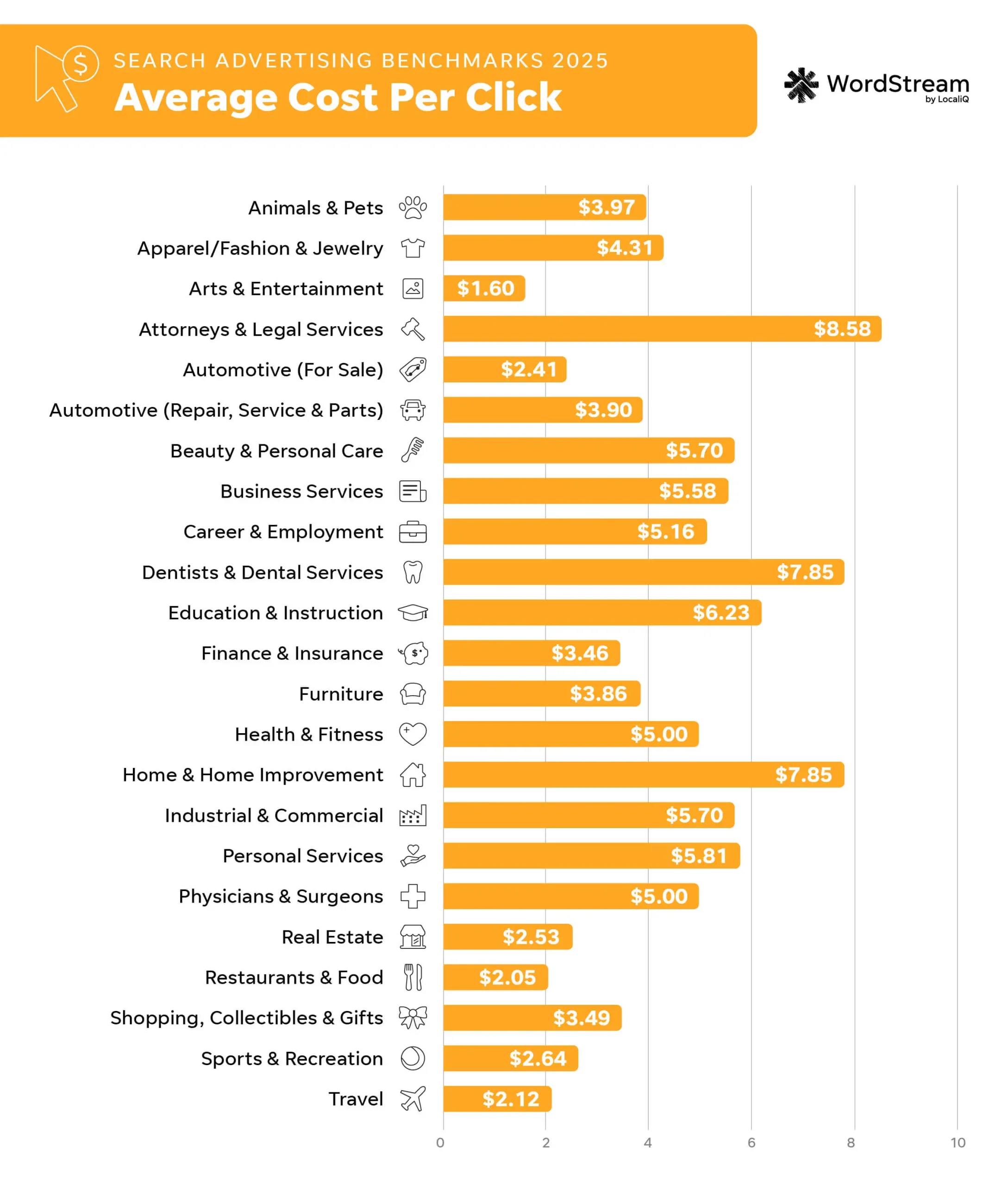
Google Ads Industry Benchmarks: CPC Across Industries (via WordStream)
If your average cost per click is higher than these benchmarks, you’re probably paying too much. Enter your CPC into the tool below to quickly see where you stand compared to other advertisers in your industry:
Could you be saving costs in Google Ads? Use our Free Google Ads Performance Grader to find out.
The Importance of Cost Per Click in Search Advertising
Cost-per-click is important because it is the number that is going to determine the financial success of your paid search campaigns, and how much Google Ads will cost for you.
Your return on investment, whether you’re over- or underpaying for each action, will be determined by how much you are paying for clicks, and by what kind of quality you are getting for that investment.
Since the overall ROI of your campaigns is determined by how much you’re paying for clicks and the quality of traffic they’re bringing in, it is important to think about cost per click in terms of both cost and value. You want to identify and target clicks that are both inexpensive and valuable. Learn more about CPC and 28 other PPC metrics here.
Lowering CPC While Maintaining Value
So how do you go about lowering the price you’re paying for each click, while sustaining (or even improving upon) the value of your visits? Two key paths of action come into play here:
Raise Your Quality Score
Google has created an automated system that offers pricing discounts to well-managed PPC campaigns with high Quality Scores. Currently, accounts with quality scores of 6 or higher (the average score today is 5) are granted a 16-50% decrease in CPC, whereas accounts with a 4 or lower Quality Score see a 25-400% increase in CPC!
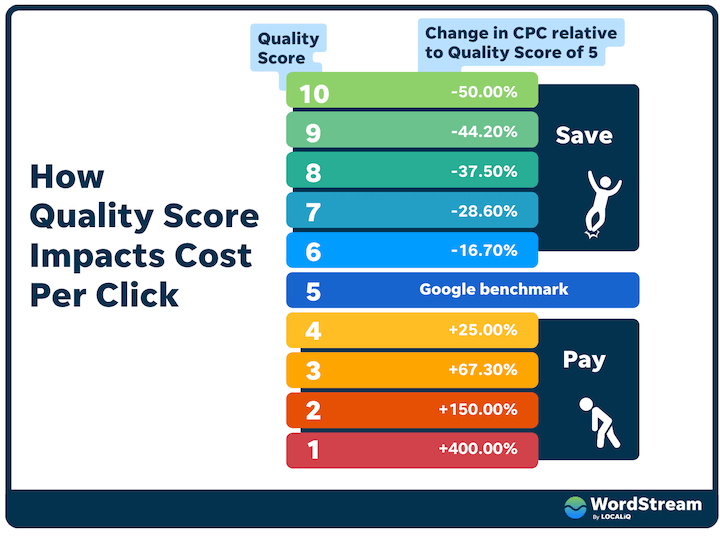
Higher Quality Score = Lower CPC, Lower CPA
Boost your chances of a drastically discounted cost per click by adhering to Quality Score best practices:
- Increase click-through rates (CTR) by creating compelling, relevant ads.
- Build out closely related ad groups.
- Optimize ad text and landing pages that speak to individual search intent.
Expand Your Reach
By discovering new, relevant and valuable clicks, the distribution of your budget will be improved substantially. To do this, you’ll have to find new PPC keywords and search advertising opportunities. But you can’t just expand without also paring back–you need to simultaneously eliminate irrelevant or overpriced clicks from your campaigns.
Refine Your Reach
Continually designating negative keywords in your Google Ads account helps to control your average CPC by filtering out traffic from searchers that are highly unlikely to convert. So as you add new keywords to your Google Ads account, be sure to eliminate the losers. When you target only keywords that perform well and are relevant to your business, it ensures that:
- Your spend is protected – Lowering your cost per click isn’t useful if you’re paying low prices for irrelevant clicks. Negative keywords tell your PPC campaigns which terms not to target, therefore reserving your budget for relevant terms only.
- Your Quality Score improves – If your keywords are clearly related to your ad text, landing pages, and offering, your click-through rate and other Quality Score factors will be positively affected. This gets you more cost-efficient clicks (remember, up to a 50% decrease in CPC!), and on search terms that are more likely to convert.
A low cost per click is key to PPC success because it ultimately translates into your cost per conversion.
You can learn more about cost per click and how it relates to other PPC metrics in our PPC 101 guide.

Meet The Author
Kristen McCormick
Kristen is the Head of Marketing at Hatch, a customer communication platform for service-based businesses. She was previously the Senior Managing Editor at WordStream. Her cat Arnold has double paws on every paw, and she finds life to be exponentially more delightful on a bicycle.
