
SEO Keywords: How Better Keyword Research Gets You Better Results
What Are SEO Keywords?
Your SEO keywords are the keywords and phrases in your web content that make it possible for people to find your site via search engines. A website that is well optimized for search engines “speaks the same language” as its potential visitor base with keywords for SEO that help connect searchers to your site. Keywords are one of the main elements of SEO.
In other words, you need to know how people are looking for the products, services or information that you offer, in order to make it easy for them to find you—otherwise, they’ll land on one of the many other pages in the Google results. Implementing keyword SEO will help your site rank above your competitors.
This is why developing a list of keywords is one of the first and most important steps in any search engine optimization initiative. Keywords and SEO are directly connected when it comes to running a winning search marketing campaign. Because keywords are foundational for all your other SEO efforts, it’s well worth the time and investment to ensure your SEO keywords are highly relevant to your audience and effectively organized for action.

Settling on the right SEO keywords is a delicate process involving both trial and error, but the basics are easy to understand. Here we’ll walk you through researching what your customers are looking for, discovering those keywords that will help you rank on a search engine results page (SERP), and putting them to work in your online content.
Finding Your Best Keywords for SEO
Most beginning search marketers make the same mistakes when it comes to SEO keyword research:
- Only doing SEO keyword research once,
- Not bothering to update and expand their SEO keyword list, or
- Targeting keywords that are too popular, meaning they’re way too competitive.
Basically, SEO keyword research should be an ongoing and ever-evolving part of your job as a marketer. Old keywords need to be reevaluated periodically, and high-volume, competitive keywords (or “head” keywords, as opposed to long-tailed keywords) can often be usefully replaced or augmented with longer, more specific phrases designed not to bring in just any visitor but exactly the right visitors. (Who visits your site – particularly if they’re people who are actively looking for your services – is at least as important as how many people visit.)
And you’ve got to diversify. Here’s a tongue-twister that’s absolutely true: diversity is a key word in the keyword world. You’re not going to stand out if you find yourself using all of the same keywords as your competitors. Not only should you try new keyword search tools and keep track of the results, but you should feel free to experiment based on your own research – who else uses your keywords? And how do you make yourself stand out? By providing great content that truly answers the questions your prospective customers are asking with their keyword searches.
Using Our Free Keyword Tool
WordStream’s Free SEO Keyword Research Tool helps you find your best, most relevant keywords—keywords that will drive ongoing web traffic and conversions on your site.
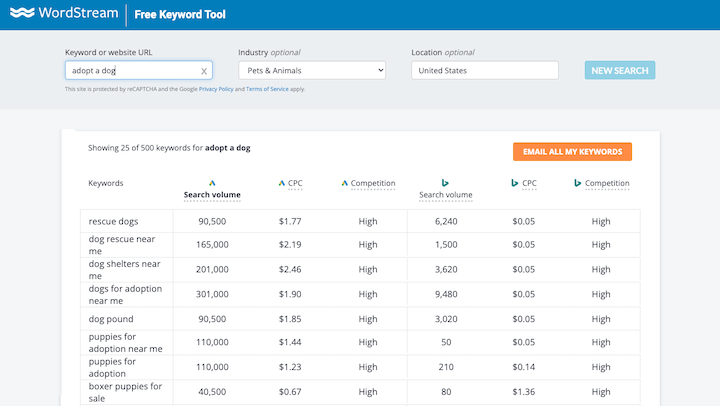
Benefits of using WordStream’s keyword tools, including the Free Keyword Tool, for better SEO include:
- More SEO Keywords – Get FREE access to thousands of keywords plus keyword search volume data, mailed right to your inbox.
- Targeted SEO Keywords – Filter your keyword results by industry or country so you can focus on the keywords that will really work for your account.
- Grouping SEO Keywords – Learn how to organize your new SEO keywords into actionable segments using effective keyword grouping.
WordStream’s keyword toolset is also hugely valuable for PPC marketing – use the Keyword Niche Finder to identify new ad groups for your Google Ads (formerly known as AdWords) campaigns, and use the free Negative Keyword Tool to find negative keywords that will reduce wasteful clicks and save you money.
Making Your SEO Keywords Work for You
Now that you’ve found the best keywords, you need to put them to work in order to get SEO results (search-driven traffic, conversions, and all that good stuff).
So: how to proceed? On the one hand, SEO best practices recommend that you include relevant keywords in a number of high-attention areas on your site, everywhere from the titles and body text of your pages to your URLs to your meta tags to your image file names. On the other hand, successfully optimized websites tend to have thousands or even millions of keywords. You can’t very well craft a single, unique page for every one of your keywords; at the same time, you can’t try to cram everything onto a handful of pages with keyword stuffing and expect to rank for every individual keyword. It just doesn’t work that way.
So how does it work? The answer is keyword grouping and organization. By dividing your keywords into small, manageable groups of related keywords, you’ll cut down on your workload (significantly), while still creating targeted, specific pages.
For example, let’s say you were running the website of an online pet store. You might be wise to create one keyword grouping for all your dog-related products, then one for all of your parakeet-related projects, etc. The next step would be to segment each individual group into smaller subgroups (parakeet cages, parakeet toys, parakeet snacks) and then even smaller groups for each type of product (low-fat parakeet snacks, luxury parakeet snacks… you get the idea). Now your pet store can create individual pages optimized for each small keyword group.
A marketer attempting to optimize a web page for the “gourmet parakeet snacks” keyword group should consider doing most if not all of the following:
- Using the keyword in the title of the page
- Using the keyword in the URL (e.g., online-petstore.com/parakeets/snacks/gourmet)
- Using the keyword, and variations (e.g., “gourmet parakeet snacks”), throughout the page copy
- Using the keyword in the meta tags, especially the meta description
- Using the keyword in any image file paths and in the images’ alt text
- Using the keyword as the anchor text in links back to the page from elsewhere on the site
When optimizing your web pages, keep in mind that keyword relevance is more important than keyword density in SEO.
Need Help Finding SEO Keywords?
Try our Free Keyword Tool today. And, to make the most of your keyword research, be sure to check out our resources on keyword grouping and keyword niches.
