About the Author


AI tools don’t magically absorb your brand’s personality the way a human team member does after spending a few weeks immersed in your business. They need explicit, detailed context that’s way more than a one-line prompt like “write in a conversational tone.”
The fix? A brand voice and tone guide built specifically for AI use. Think of it as a cheat sheet that tells AI tools exactly how your brand sounds, what words you use (and avoid), and what your content should feel like tone-wise.
I’ve been teaching my clients how to do this so they get better content outputs that require less editing. And I’m sharing my secrets with you here!
Contents
- Getting started with a brand voice and tone document
- Exactly what to include in your AI-ready brand voice guide
- How to actually use this guide with AI tools for better results
- A ready-to-use AI brand guidelines checklist so you can start building yours today
Start with a brand voice and tone document
You might already have some loose guidelines you could call a “brand style guide.” This often includes something your designer put together with your logo specs, color palette, and a few notes about the brand voice and tone. Or maybe you don’t have anything formally documented yet.
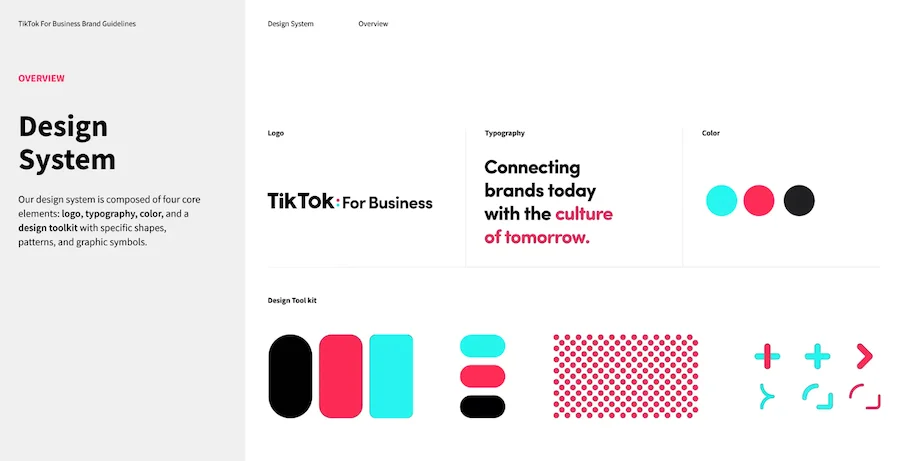
An example from TikTok’s brand guidelines document.
This approach works well when you’re just sharing with other humans because you can talk through the nuances and context of your brand voice person-to-person.
However, AI tools don’t have that luxury.
When a human writer sees “our tone is friendly and approachable,” they can infer a lot: shorter sentences, contractions, maybe a joke here and there. An AI tool takes that instruction far more literally and fills in the gaps with its default patterns, which tend to be bland, overly formal, and riddled with phrases like “in today’s digital landscape.”
A brand voice guide built for AI needs to be more explicit, more example-heavy, and more specific than what you’d hand to a human writer. Instead of describing your voice in abstract terms, you’re showing the AI exactly what good looks like (and what doesn’t).
The fix: create a “voice and tone snapshot” document that distills your full brand guide into two to three pages of the most critical, actionable elements. This becomes your go-to reference document for every AI writing session, so you can produce things like quality blog posts, emails, and LinkedIn updates in far less time.
🤖 Want to use AI the right way? Free download >> The Complete Guide to AI for Marketing
What to include in your AI-ready brand guidelines
Here’s where we get tactical. Below are the sections I’d recommend including, along with examples to help you fill them in for your own business.
1. Core voice attributes (with definitions)
Don’t just list adjectives. Define what each one actually means for your brand. AI tools thrive on specificity, so instead of saying “our voice is conversational,” tell the tool what conversational looks like in practice.
For example:
| ✅ Do this | ❌ Not this |
| “Conversational means we write like we’re explaining something to a friend over coffee, not presenting to a board of directors.” | “Our voice is conversational.” |
| “Authoritative means we cite specific data and real examples, not vague claims.” | “Our voice is authoritative.” |
See the difference? The left column gives the AI a concrete mental model to work with. The right column leaves it guessing.
2. Your brand’s personality
If your brand were a person, who would they be? This might sound like a fluffy branding exercise, but it’s surprisingly useful for AI tools. Giving the tool a persona to embody helps it make consistent choices about word selection, humor, and formality.
Wendy’s is a great example of a brand with a strong voice and personality.
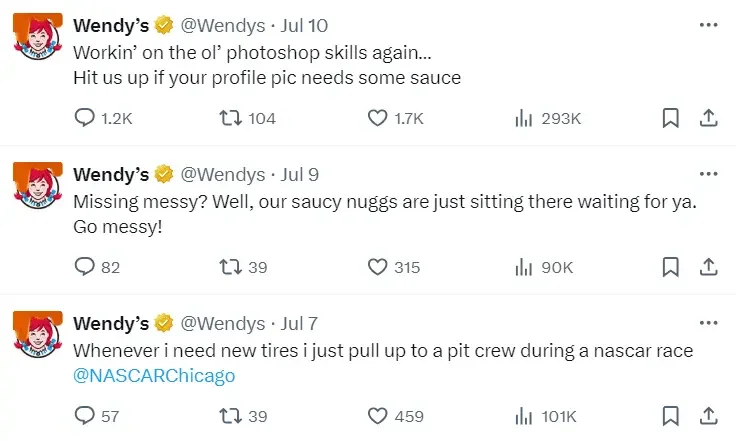
See how they use a very informal, slang-ridden tone on platforms like Twitter? This voice carries across all their social channels to create a brand personality that’s fun, conversational, and laid back.
For a neighborhood bakery, that persona might be: “We’re the enthusiastic friend who just pulled a perfect sourdough out of the oven and can’t wait to tell you about it. We’re warm, a little nerdy about our craft, and never pretentious.”
For an accounting firm, it might be: “We’re the calm, approachable advisor who makes complicated tax stuff feel manageable. We’re clear, reassuring, and respectful of your time.”
🎉 Need help articulating what makes your business special? Get the guide >> How to Create a Unique Value Proposition From the Ground Up
3. “Do this, not that” examples
This is the single most valuable section of your entire guide. AI tools learn best from concrete comparisons, and this is where you train the tool on the difference between on-brand and off-brand writing.
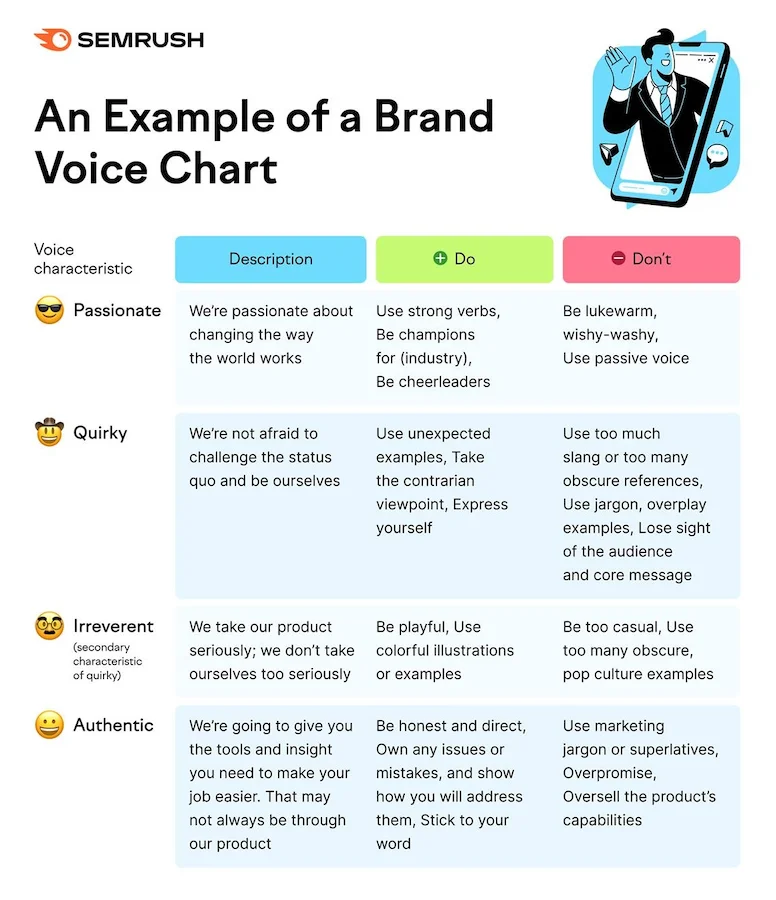
Cover three key areas:
- Word choice: List specific swaps. For example, we say “helps you” not “enables you to.” We say “complicated,” not “complex.” We say “figure out,” not “ascertain.” And list words you never want to see, like “leverage,” “synergy,” “utilize,” or “best-in-class.”
- Sentence structure: Show a good version and a bad version side by side. For instance: “You can automate this in three simple steps” vs. “Automation of this process can be achieved through a three-step methodology.” Same information, completely different energy.
- Tone by context: Your brand might sound slightly different when explaining a technical concept, addressing a customer pain point, or making a pitch. Write two-to-three sentence examples for each scenario so the AI can calibrate.
4. Sentence length and formatting preferences
This is the kind of detail that humans can intuit, but AI needs spelled out. These small details add up fast. When an AI tool knows you prefer em dashes over parentheses and contractions over formal phrasing, the output immediately feels more “you.”
Include guidelines like:
- Average sentence length (e.g., 15–20 words).
- Whether you use short sentences for emphasis. Like this.
- Punctuation preferences (em dashes vs. parentheses, Oxford commas, contractions).
- Formatting preferences (bold for emphasis vs. italics, sentence case vs. title case for headers).
- Whether you use emojis, and if so, where (social posts? blog content? emails?).
5. Themes and points of view
Every brand has a handful of recurring themes, including core beliefs and perspectives that appear across its content. Documenting these gives AI tools the confidence to write with a strong point of view rather than producing wishy-washy, fence-sitting content.
Take a look at the values for brands you already know, like Nike, Google, and National Geographic, to see what this looks like in action. Nike leans hard on determination, Google leans into innovation, and National Geographic focuses on adventure and exploration.
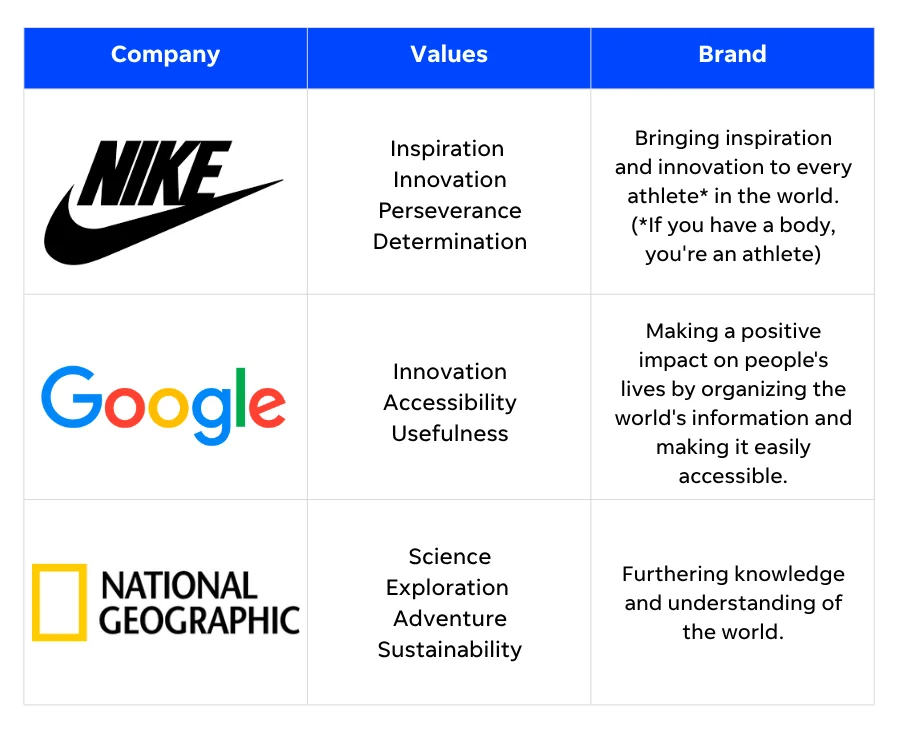
Now let’s scale this down to a small business context. For a small marketing agency, those themes might include: “We believe small businesses deserve the same quality marketing as big brands,” or “We think most marketing advice is overcomplicated for no reason.”
For a local gym: “We believe consistency beats intensity every time” or “Fitness should fit into your life, not take over it.”
Bonus: If there are industry debates where your brand takes a clear side, note those too. This helps AI tools write with the kind of authentic perspective that makes content actually interesting to read.
6. Language guidelines
This is a quick but important section. Cover things like the lingo you use and avoid (e.g., “sales rep” instead of “salesman”), and your general policy on industry jargon.
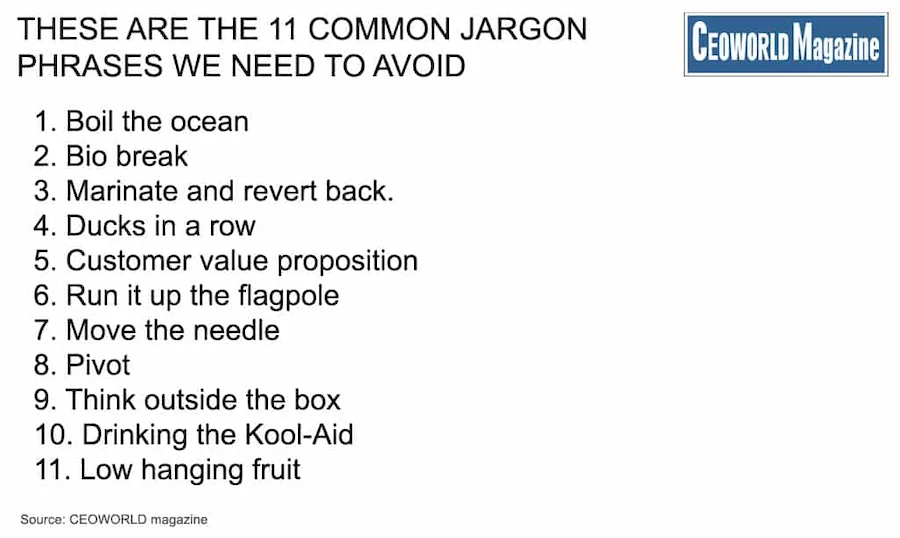
For jargon specifically, it helps to break these into three buckets and list out the specific words for each:
- Jargon we use freely (terms our audience already knows).
- Jargon we avoid entirely (and why).
- Jargon we use but always define on first mention (with a brief explanation or analogy).
7. Content structure preferences
Tell the AI how you like your content organized. This is especially helpful for blog posts, emails, and landing pages where structure directly impacts readability.
Include guidance like:
- Start with a hook (a question, a surprising stat, or a bold statement).
- Get to the point within the first 100 words.
- Use subheadings every 200–300 words.
- Include at least one specific example per major section.
- End with a clear, actionable takeaway, not a generic “in conclusion” wrap-up.
8. Hard boundaries (the “never do this” list)
Be explicit about your non-negotiables. AI tools are surprisingly good at respecting hard rules when you state them clearly. Some examples:
- Never start a sentence with “So,” or “Well.”
- Never use phrases like “in today’s digital landscape” or “in an increasingly competitive market.”
- Never include generic inspirational quotes.
- Never use exclamation points in blog content (social posts are fine).
Your list will be unique to your brand. The point is to catch the AI’s most common bad habits before they show up in your first draft.
9. Full comparison examples
This is the most powerful training tool of them all. Write two to three full paragraphs in different styles and label them clearly:
- ✅ This is our voice
- ❌ Too formal/corporate
- ❌ Too casual/sloppy
- ❌ Too generic/AI-sounding
This gives the AI a clear reference point for calibration. It’s the difference between telling someone what your house looks like and actually showing them a photo.
10. Audience context
Finally, tell the AI who you’re writing for, and be specific. Don’t just say “small business owners.” Get granular with something like: “Owners of local service businesses (plumbers, landscapers, dentists) with 5–25 employees. They’re busy, skeptical of marketing jargon, and want practical advice they can act on this week, not abstract strategy.”
Also include what your audience already knows (so the AI doesn’t over-explain basics) and what they need from your content (tactical how-to advice vs. big-picture strategy, specific tool recommendations vs. general frameworks).
🕵️♀️ Want to understand who you should be targeting with your marketing? Download the guide >> How to Find Your Target Audience [Simple Steps!]
How to actually use your guide with AI tools
Creating the guide is step one. Using it effectively is where the real magic happens. Here’s how to put it to work.
Upload it and reference it explicitly
Most AI tools let you upload documents as context. But don’t just attach the file and start prompting. Tell the tool to use it. Try something like: “I’ve uploaded our brand voice and tone guide. Review it carefully, then draft an email campaign about [topic] that follows these voice principles.”
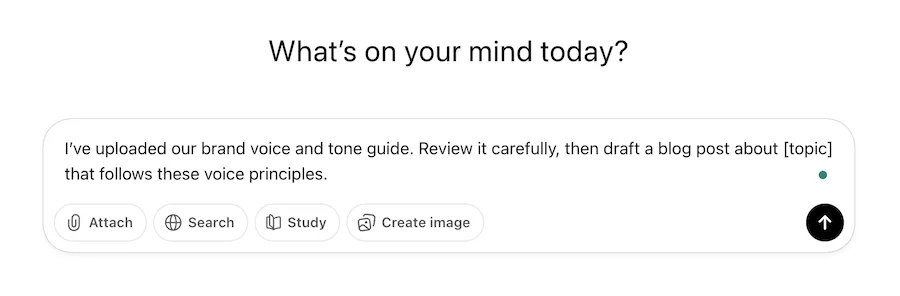
The explicit instruction makes a meaningful difference in output quality.
🚨 Get ready-to-use AI prompts for email marketing, social media, content creation, and more >> 200+ Best AI Prompts Any Business Can Use
Build a library of your best examples
Beyond your style guide, nothing trains an AI tool better than showing it real examples of your strongest content. Curate a small library of 10–15 pieces that showcase your brand voice at its best: blog posts, emails, social captions, landing pages, whatever formats you create most often.
Choose the pieces that performed well with your audience and best represent how you want your brand to sound. The more relevant the example is to the task at hand, the better your output will be.
Pro tip: If you don’t have a voice guide yet, you can reverse-engineer one from your best content. Upload your top-performing pieces and use a prompt like: “Analyze the voice, structure, and style of these pieces, then summarize those patterns into key points I can use as a brand voice guide.” It’s a surprisingly effective shortcut.
Front-load your context
Before asking for any content, give the AI as much relevant background as possible. This might include detailed audience information, competitor articles you want to differentiate from, or internal knowledge like customer research, case study data, or product documentation.
The more specific and proprietary the information you share, the more differentiated your content will be. Generic inputs will always produce generic outputs.
Treat it as a living document
Your AI brand voice guide isn’t something you create once and file away. As your brand evolves, your audience shifts, and you learn what works (and what doesn’t) with AI tools, your guide should evolve too.
A few maintenance habits that make a real difference:
- Update your examples library monthly with new top performers.
- Revise your guidelines when you notice the AI consistently missing the mark on new voice elements.
- Keep your audience personas and product positioning current.
- Save your most effective prompts, so you’re not reinventing the wheel every time.
The bottom line: Specificity is everything
Here’s the thing about AI writing tools: they’re genuinely useful. They can produce strong content outputs that need only light editing rather than complete rewrites. But only if they have the context they need to do good work.
The key to getting AI content that actually sounds like your brand comes down to one word: specificity. Instead of telling an AI tool to “be conversational,” show it exactly what conversational looks like for your brand, with real before-and-after examples. Instead of listing adjectives, define what those adjectives mean in practice.
The upfront investment of building this guide pays for itself many times over. Every blog post, email, social caption, and landing page you create with AI tools will be better for it—and you’ll spend a lot less time editing.
Your brand voice guide checklist
Ready to build your AI-ready brand voice guide? Use this checklist to make sure you’ve covered all the essentials.
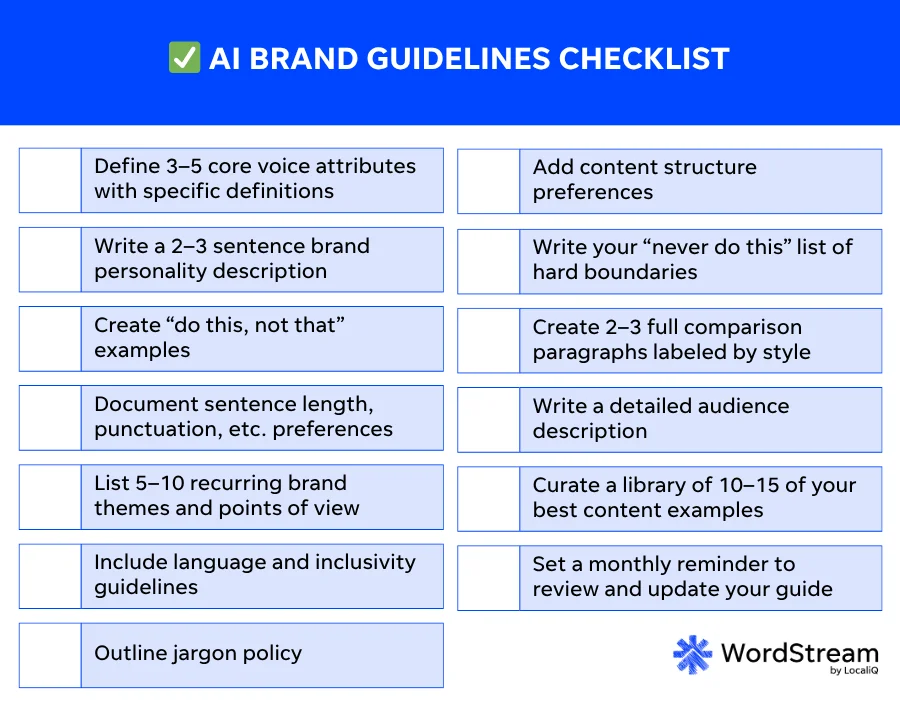
- Define 3–5 core voice attributes with specific definitions (not just adjectives).
- Write a 2–3 sentence brand personality description (“If our brand were a person…”).
- Create “do this, not that” examples for word choice, sentence structure, and tone.
- Document sentence length, punctuation, and formatting preferences.
- List 5–10 recurring brand themes and points of view.
- Include language and inclusivity guidelines.
- Outline jargon policy (embrace, avoid, or define-on-first-use).
- Add content structure preferences (hooks, subheading frequency, CTAs).
- Write your “never do this” list of hard boundaries.
- Create 2–3 full comparison paragraphs labeled by style.
- Write a detailed audience description with knowledge level and needs.
- Curate a library of 10–15 of your best content examples.
- Set a monthly reminder to review and update your guide.
Make AI work for you with an AI brand guideline
The more work you put into your AI brand voice guide upfront, the less time you’ll spend wrestling with AI outputs that don’t sound like you. And that’s the whole point: making AI tools work for your brand, not the other way around.
About the WordStream Blog
We've been a trusted source of data, news, and strategy for over 15 years. All of our content is written and reviewed by real people: a dedicated team of professionals with decades of combined experience in marketing and advertising for businesses of all sizes.


Add us as a preferred source on Google
Are you wasting money in Google Ads?

Meet The Author
Kaleigh Moore
Kaleigh Moore is a freelance writer for SaaS companies and a retail contributor for Forbes. She frequently speaks on topics related to ecommerce and small businesses and is the occasional podcast host, too. Learn more about her at her website.
Recommended for you