About the Author


At first, TikTok was a platform that seemed to be for viral dance trends geared toward a Gen-Z audience. But that’s just not the case anymore. Today, TikTok is one of the most effective advertising platforms for small and medium-sized businesses looking to reach new customers. The platform has more than a billion active users, an algorithm designed to help great content get discovered, and targeting options that help small businesses get real results without a massive budget.
Here, I’m breaking down exactly how to run TikTok ads. In this guide, I’ll be covering what TikTok Ads are, how to track your TikTok ad performance, TikTok ad creation tips, and common TikTok ad FAQs, as well as mistakes to avoid. Let’s get to it!
Contents
- What are TikTok ads?
- The benefits of TikTok ads for small businesses
- How to run TikTok ads: Step-by-step
- Best practices for your TikTok ad creative
- How to measure TikTok ad performance
- TikTok ads FAQs
What are TikTok ads?
TikTok ads are paid promotions that appear throughout the TikTok app and allow brands or content creators to advertise products, services, or content through vertical content. Like other social media ads, TikTok ads can be used to help businesses increase brand awareness, drive website traffic, generate leads, or even make sales directly.
TikTok’s advertising platform is the TikTok Ads Manager. It follows a three-level structure, which is similar to other social media platforms: campaign, ad group, and ad. We’ll also go through step-by-step how to set these up.
Types of TikTok ad formats
There are a few different TikTok ad formats:
- In-feed ads
- TopReach ads
- Branded mission ads
- Branded hashtag campaign
- Branded effects
- Logo takeover ads
- Carousel ads
- Spark ads
- Catalog ads
- Prime time ads
- Pulse ads
The most common of these ad formats is the In-feed ad, which appears directly on the For You Page feed for your targeted users. This ad format also looks really similar to organic content, and it typically makes the most sense in terms of TikTok ad cost. I’ll cover a more thorough breakdown of the type of TikTok ads later in our TikTok ads FAQs section.
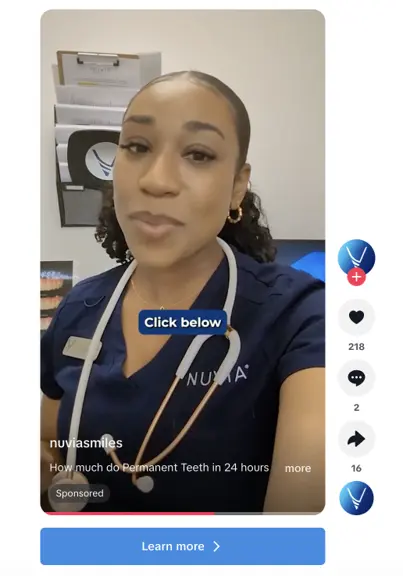
An in-feed ad from Nuvia Smiles.
⚡ Learn how to best take advantage of powerful social media platforms in our complete guide to social media marketing (simplified!)
The benefits of TikTok ads for small businesses
Now that we’ve established what TikTok ads are, let’s make sure it’s clear why these can work for your business. If you’re marketing a small business, you might be skeptical of adding another marketing channel. It requires investment—budget, sure, but also your attention and time. All limited resources. But TikTok is particularly effective for SMBs for a few reasons:
- You can reach new customers at scale. TikTok’s recommendation algorithm prioritizes content relevance over follower count. This means your brand can reach thousands of potential customers without necessarily having a big, established audience. Unlike other platforms, TikTok regularly surfaces content from newer creators and brands. This also means a viral moment is possible—nothing to count on, but possible.
- You can reach highly engaged audiences. TikTok users spend a significant amount of time on the platform and actively engage with content through likes, comments, shares, and follows. Getting in front of people who are active and interested in consuming content sets you up for success.
- You will have better luck with authentic content. TikTok doesn’t require polished, high-budget videos. In fact, lower-budget content often performs better, which means you can create it more easily. Many successful TikTok ads are customer testimonials, product demos, educational tips, and even user-generated content.
- You can target local customers. TikTok can seem like it’s only for ecommerce brands, but that’s not the case (even though they do well on the platform). TikTok lets you target by location, and that can help you promote special events, increase foot traffic, book appointments, and build community awareness. This is great for restaurants, home service companies, gyms, and salons.
- You can work with a small budget. This is a big benefit. You can get started advertising on TikTok with a relatively modest daily budget. The platform allows you to use that investment to test different audiences, experiment with creative formats, and figure out which campaigns work for you so that you can scale gradually and make the most of your funds.
How to advertise on TikTok: Step-by-step
Here’s how to advertise on TikTok in six steps.
Step 1: Create your TikTok ads account
The first step is simple. Head to TikTok for business and click on “Get Started.” On that screen, you’ll be prompted to add your business name, industry, website URL, current monthly ad spend, and phone number.
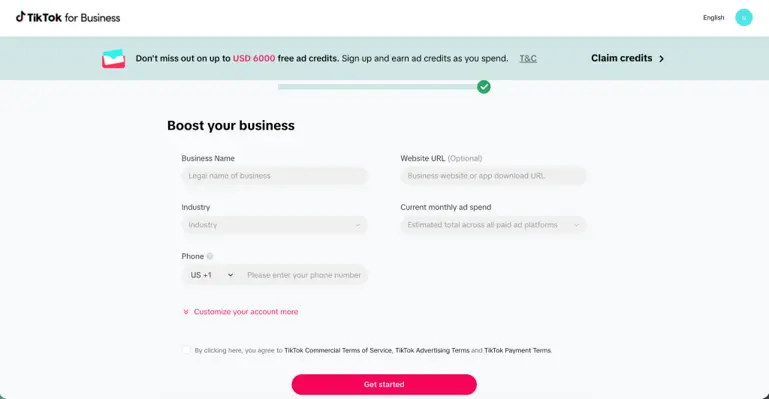
After this, you’ll verify your email address and complete the initial process.
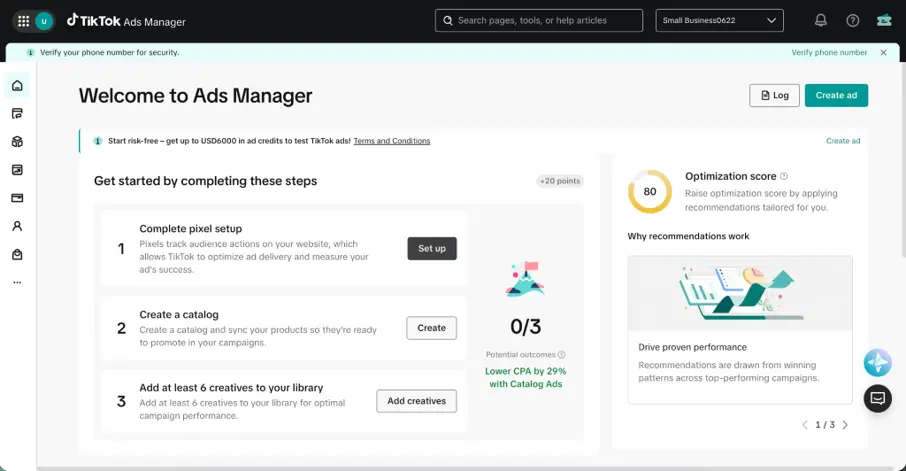
While you could be done for now, it’s best if you finish the recommended setup steps: verifying your phone number, completing your Pixel setup for better targeting, and creating a catalog of your products. The final step is to add creative, but you can always do this later on, too.
Step 2: Choose a campaign objective
Now that your account is set up, you’re ready to determine your campaign objective. First, you’ll select brand awareness, sales, or lead generation.
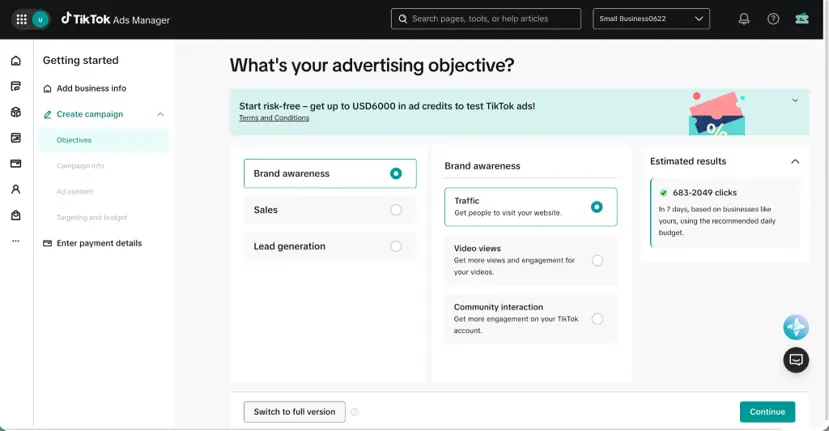
It’s worth noting that this is the simplified view. You will have more options—and more to do—if you switch to the full version of the TikTok Ads Manager.
For each of these, you’ll need to drill down on a further goal selection:
- Brand awareness: Traffic, video views, or community interaction.
- Sales: Website conversion or TikTok shop conversion.
- Lead generation: Website form, TikTok form, or direct messages/phone calls.
Then, TikTok will ask for the campaign info. Here, you’ll name the campaign, review the objectives, and then confirm the placement selections.
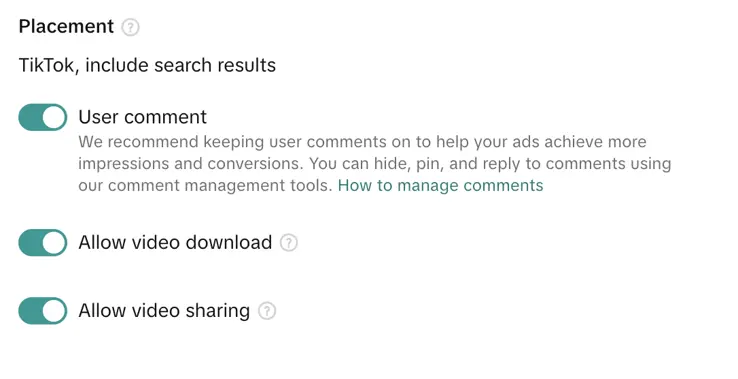
Step 3: Create your ad creative
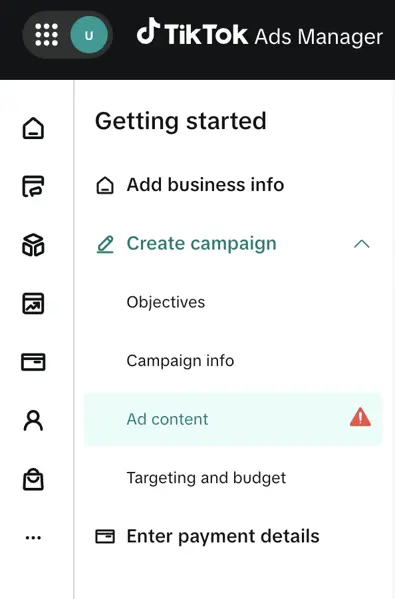
On the next screen, TikTok prompts you to select your ad content.
You’ll need to connect your TikTok advertising account to your TikTok account. Then, select your ad creative from existing content or upload a new video. (We’ll talk more about best practices in creating your ads below.)
Step 4: Build your target audience
The next step is to determine your targeting strategy. In the simplified mode, you have the choice between automatic and custom for targeting.
If you opt to customize your targeting, you can determine the age, gender identity, location, and language preferences of your ideal audience.
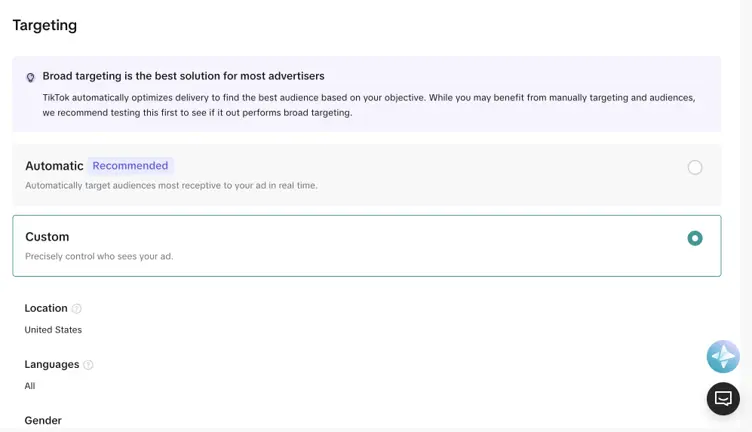
It’s worth noting here that you do sacrifice some options for ease with the streamlined, simple mode. If you need more targeting options—think demographics, interests, behaviors—you can use the advanced mode of TikTok ads manager and access the full suite of targeting options.
Step 5: Set your campaign budget and schedule
On the same screen, you’ll also set your campaign budget and your schedule.
First, you need to input your custom budget amount. You’ll select a daily limit or a lifetime limit. For a daily budget, the minimum spend is $20 USD, which means you’ll spend a maximum of $25 daily. For a lifetime, the minimum spend is $140 USD for the campaign.
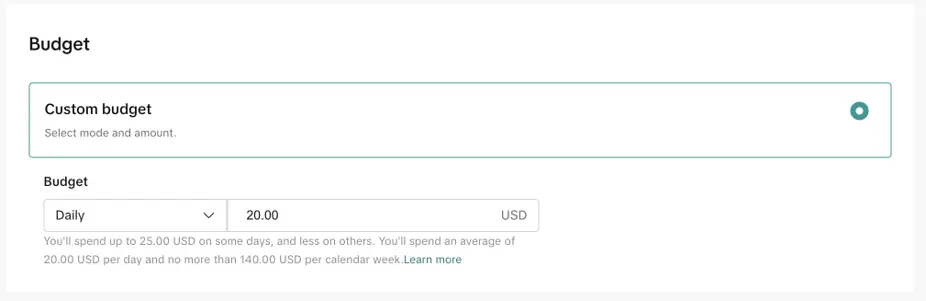
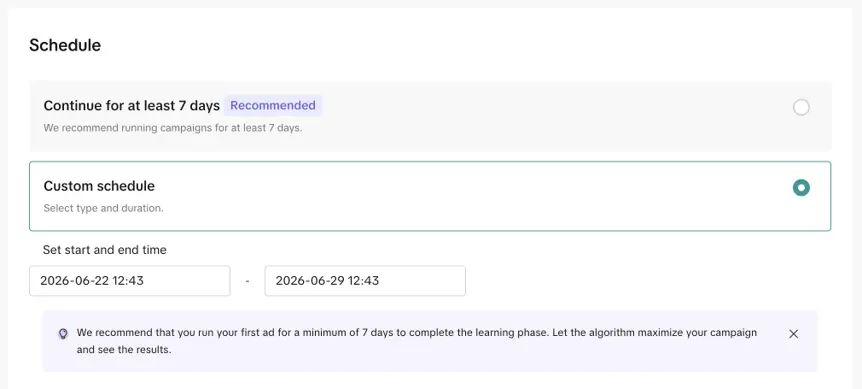
After you set the budget, you need to finalize the schedule. TikTok recommends continuing the campaign for at least seven days. The other option is to set a custom schedule, and you can input the start and end dates.
Then, on the next screen, input your payment details.
Step 6: Launch your campaign
Finally, you’re ready to launch your campaign. Your ad won’t go live immediately because the ad creative goes through a review process that typically takes one day. Be sure to check back in to monitor results and ensure it’s live.
💡 Use AI to scale your TikTok campaigns with help from our free guide on 14 no-brainer ways to use AI for social media, complete with over 20 copy-and-paste prompts!
5 best practices for your TikTok ads
Creating a TikTok ad isn’t the same as creating a Facebook ad or a traditional commercial. Users come to TikTok for entertainment, education, and authentic content—not polished sales pitches. The most successful TikTok ads feel native to the platform while still guiding viewers toward a specific action. Use the following best practices to create ads that capture attention, drive engagement, and generate results.
1. Focus on the first three seconds
There’s a commonly held belief that the first three seconds of a social media video need to be packed with information or a compelling cliffhanger because that’s all the attention you get from most viewers. But recent research from that suggests this might not be the case. According to The Drum, the study found that packing too much information in the first few seconds can harm, noting 17% lower engagement.
Instead of throwing as much as possible at your audience right away, focus on capturing attention in those first few seconds with a solid, compelling hook. You want to give them a reason to stop scrolling, to watch, to engage, and—even better—to act.
So avoid lengthy introductions, logos, graphics, broad opening statements, and, yes, millennial pauses.
2. Leverage user-generated content (UGC)
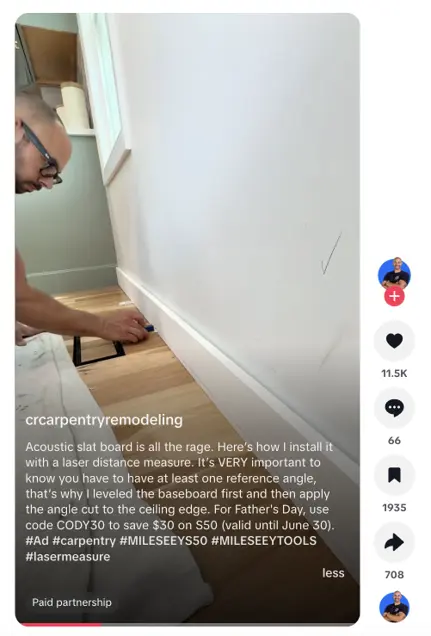
We said this earlier, but it’s worth repeating: User-generated content consistently outperforms highly polished advertisements on TikTok. That’s because this type of content feels more casual, more authentic, and more trustworthy.
UGC can include customer testimonials, product reviews, unboxing videos, before-and-after transformations, or content created by influencers and brand advocates.
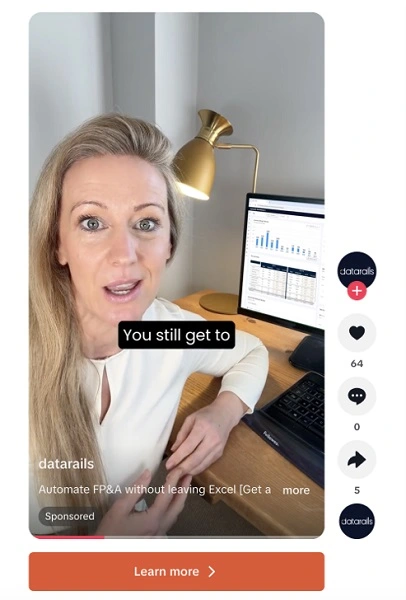
A super simple talking-to-the-camera testimonial ad from Datarails.
And even if you don’t have customers creating content yet, you can still replicate the UGC style by filming simple videos on a smartphone. Instead of focusing on perfect production quality, prioritize natural moments for connection and off-the-cuff experiences.
3. Create content for TikTok
We are all about repurposing content, but you still need to be mindful of the conventions of the platform. Your ads will perform better if they look like native TikTok videos. That means vertical, fast-paced videos that aren’t too polished.
Plus, be sure to use TikTok features, including audio and captions. Captions are particularly important, as they improve accessibility. Up to 75% of viewers watch TikTok videos without sound. With this in mind, use text overlays to highlight important points, product benefits, pricing information, or calls-to-action.
@charlesandivyWe’ve been working on something behind the scenes 👀♬ How You Like Me Now – The Heavy
A great example of a low-production investment, high-impact announcement from home and garden store Charles & Ivy.
And pay attention to trends. Whether it’s trending audio, current editing styles, or event video formats. The best TikTok ads will feel like all the other videos in the feed—and encourage similar engagement.
4. Use strong calls-to-action
You need to tell your audience what you want them to do. That’s why every TikTok ad should include a clear and specific call-to-action that aligns with your campaign objective.
TikTok lets you customize the appearance of the CTA button, including choosing from static text or dynamic CTAs based on the audience.
In general, though, you want to make your CTA strong and specific. Instead of generic phrases like “Learn More,” consider using action-oriented language such as “Book Your Free Consultation,” “Get Your Quote Today,” “Shop the Collection,” or even “Claim Your Discount.”
Remember, your CTA should clearly communicate the next step you want the viewer to take.
Try our call-to-action generator to get a quick start:
 / CTA Generator
Write a CTA that actually converts — in seconds.
Tell us what you're promoting and the tone you want. We'll generate six best-practice CTA ideas you can use as CTA inspiration for your landing page or email.
The 4 principles behind every CTA we generate
- Anchor the CTA to an outcome. Don't tell people what to do — tell them what they'll get. "Reduce foot pain" beats "Click here."
- Use value words. More than half of top-ranked Google Ads include at least one power word like free, now, or quality.
- Match CTA strength to intent. Cold audiences get low-commitment asks. Pricing-page visitors get "Get a quote" or "Start your free trial."
- Add microcopy to kill hesitation. One short line under the button — "No credit card required," "Takes 2 minutes" — quietly saves conversions.
5. Test multiple creative variations
Once you’re up and running, make sure to start testing your TikTok ad creative. This is one of the fastest ways to improve TikTok advertising performance. Focus on one ad, but create multiple variations that test different hooks, visuals, captions, offers, and CTAs.
These small changes can produce significant improvements in video watch time, click-through rates, and even conversions. You may find that one opening hook dramatically outperforms another or that a customer testimonial generates more sales than a product demonstration. Just be sure to test one variation at a time so that you can confidently identify what works for your audience—and then double down to keep improving.
How to measure TikTok ad performance
Once your campaign is up and running, you need to measure performance.
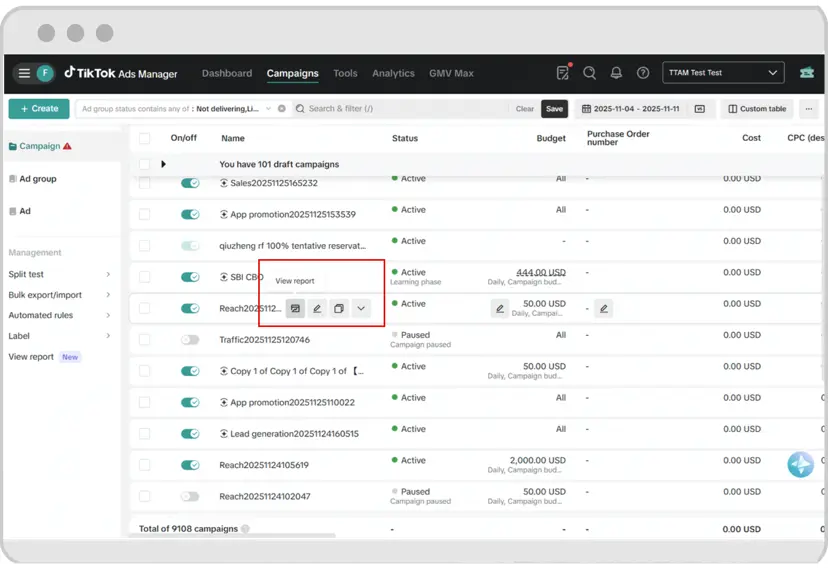
TikTok ads manager offers reporting and analytics that provide some great insight into performance, plus recommendations from the platform. To view the performance of your campaign, head to the dashboard. You’ll be able to see an overview of metrics, the status of ad groups, as well as recommendations and insights.
If you want to look at specific campaigns, head to the campaigns tab. If you have lots of ads or campaigns, use the search function to find the one you’re looking for. Then, you can click on the name to see the full report.
These are the metrics supported by TikTok Ads Manager:
- Attribution metrics: These will help you determine the actions people take after they see your ads.
- In-app events: This lets you track the interactions with your app after people saw your ad.
- Page event metrics: This will let you track the interactions with your website after people saw your TikTok ad.
- Video play metrics: This will help you measure how people interact with your in-feed video ads.
- Onsite events metrics: This lets you track user behavior on-site.
TikTok ads FAQs
Here are the answers to some of the most frequently asked questions about TikTok advertising.
1. Are TikTok ads worth it for small businesses?
Yes. You don’t have to be a giant corporation to find success on the platform. TikTok ads can be incredibly effective for small or medium-sized businesses, especially if you’re looking to increase brand awareness, generate leads, or drive online sales. In fact, 88% of small businesses report increased sales after promoting via TikTok, and 74% even say they sold out of a product tied to TikTok activity.
Unlike some advertising platforms that require polished creative assets and large budgets, TikTok rewards authentic, engaging content—regardless of the appearance. Small businesses that create relatable videos often compete successfully with larger brands. You just need to understand your audience and make sure your content feels native to TikTok.
2. Which type of TikTok ad is best for my business?
The answer to this TikTok advertising FAQ will vary depending on your business goals, so there isn’t necessarily one best TikTok ad format you should default to. Each of the different types of TikTok ads can be effective in promoting your business. In fact, you’ll probably want to have a few different TikTok ad formats running for a well-rounded approach to TikTok advertising. Here is the complete comparison chart for all 11 TikTok ad types.
| Ad format | Primary goal | Best for | Cost level | User interaction |
| In-feed ads | Conversions, traffic, sales | Most advertisers | ✅ Lower | ✅ Likes, comments, shares |
| TopReach ads | Reach and awareness | Maximum visibility | ❌ Premium | ⚠️ Limited |
| Branded mission ads | User-generated content | Creator partnerships | ❌ High (minimum $10K) | ✅ Creator participation |
| Branded hashtag campaigns | Engagement and awareness | Viral campaigns | ❌ Very high (often $100K+) | ✅ High |
| Branded effects | Brand awareness | Interactive experiences | ⚠️ Moderate to high | ✅ High |
| Logo takeover ads | Mass awareness | Major launches and announcements | ❌ Premium | ⚠️ Limited |
| Carousel ads | Product discovery | Showcasing multiple products or features | ✅ Moderate | ✅ Users swipe through cards |
| Spark ads | Engagement, trust, conversions | Boosting organic content | ✅ Flexible | ✅ Retains existing engagement |
| Catalog ads | Shopping and sales | Ecommerce businesses | ✅ Flexible | ⚠️ Primarily product-focused |
| Prime time ads | Storytelling and awareness | Sequential brand messaging | ❌ Premium | ⚠️ Limited |
| Pulse ads | Contextual awareness | Brand-safe content alignment | ⚠️ Moderate to high | ⚠️ Depends on placement |
3. How much should I spend on TikTok ads?
Your ideal budget will be specific to your business, since it depends on your goals, industry, audience size, as well as your advertising plans and budget on other platforms. Many small businesses start with $20–$50 per day to test different audiences and ad creatives before scaling. For lead generation or ecommerce campaigns, it’s common to gradually increase spending once you identify ads that deliver strong results.
4. Do TikTok ads work for local businesses?
Absolutely. TikTok’s targeting capabilities allow local businesses to reach users within specific geographic areas. Restaurants, gyms, salons, real estate agents, home service providers, and healthcare practices can all use TikTok ads to attract nearby customers.
Local businesses often see the best results when they combine geographic targeting with videos showcasing their location, staff, services, or customer experiences.
5. Can I run TikTok ads without a website?
Yes. Having a website isn’t required, even though it gives you more conversion opportunities. TikTok offers lead generation ads that collect customer information directly within the app, so you don’t need a separate site. You can also direct users to a phone number, app download page, TikTok profile, or messaging platform, depending on your objectives.
But that being said, we recommend getting a website up and running as a key part of setting up your business online.
6. How long should TikTok ads be?
Most high-performing ads on TikTok are between 15 and 30 seconds long.
Again, focus on the first few seconds and nail your hook. You want to provide value and encourage engagement—not overload your viewer with information. Your goal is to capture their attention immediately, delivering your message quickly, and ending with a clear call to action. If your content is highly engaging, longer videos can also perform well.
7. What’s the biggest difference between TikTok Ads, Facebook Ads, and Google Ads?
The biggest difference is user intent. Here’s the breakdown:
- TikTok ads are excellent for discovery. Users don’t need to be actively searching for products, but engaging content can introduce your brand to entirely new audiences.
- Facebook ads offer powerful targeting, and they often work well for lead generation, retargeting, and reaching established demographic segments.
- Google Ads are perfect for existing demand. Users are actively searching for products, services, or solutions, making Google particularly effective for high-intent conversions.
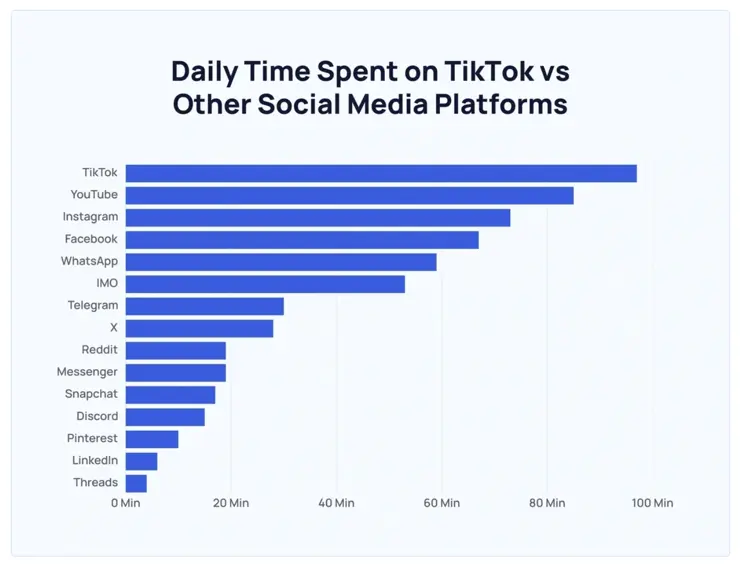
Users are spending the most time per day on TikTok.
Remember, most businesses see the best results by using all three platforms strategically: TikTok for awareness, Facebook for nurturing and retargeting, and Google for capturing ready-to-buy customers. These platforms should all be a part of your overall marketing strategy, not an either-or decision.
Start running ads on TikTok
There you have it: step-by-step directions for getting set up with a TikTok ad manager account and launching your first campaign on the platform. Plus, tips to keep improving. The only thing left for you to do is get started. For more help navigating your business’s TikTok advertising journey, check out our solutions!
About the WordStream Blog
We've been a trusted source of data, news, and strategy for over 15 years. All of our content is written and reviewed by real people: a dedicated team of professionals with decades of combined experience in marketing and advertising for businesses of all sizes.


Add us as a preferred source on Google


Meet The Author
Céillie Clark-Keane
Céillie is Head of Marketing for Building Ventures, a VC firm focused on funding and mentoring early-stage startups in the built environment space. Previously, Ceillie led content strategy for Unstack and managed the award-winning blog at WordStream.