About the Author


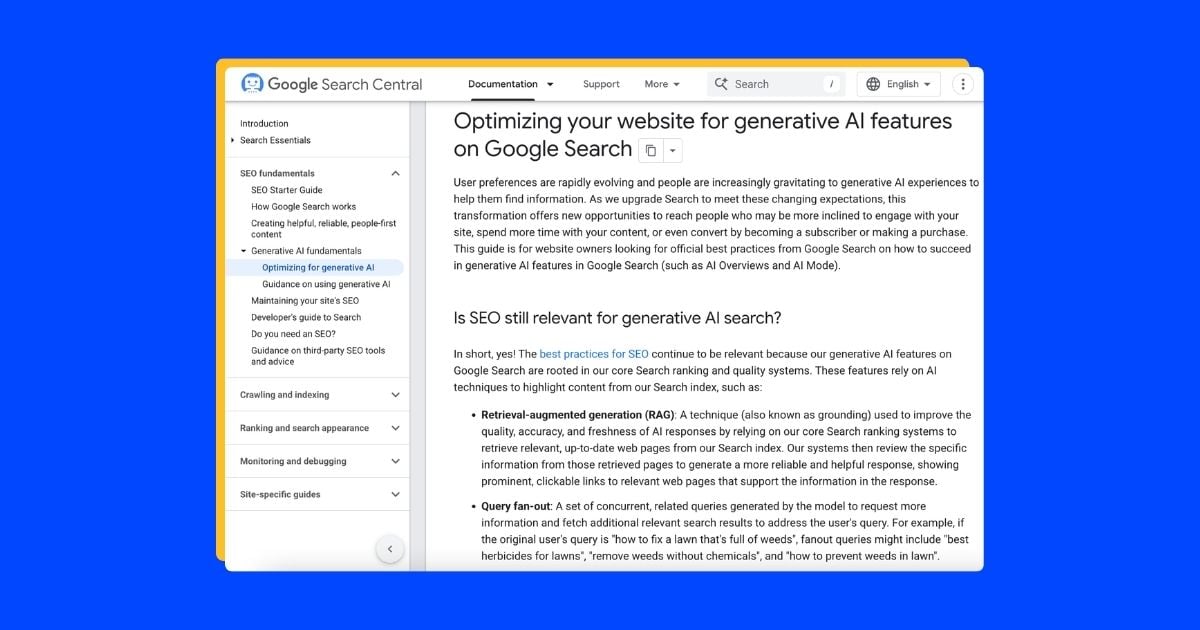
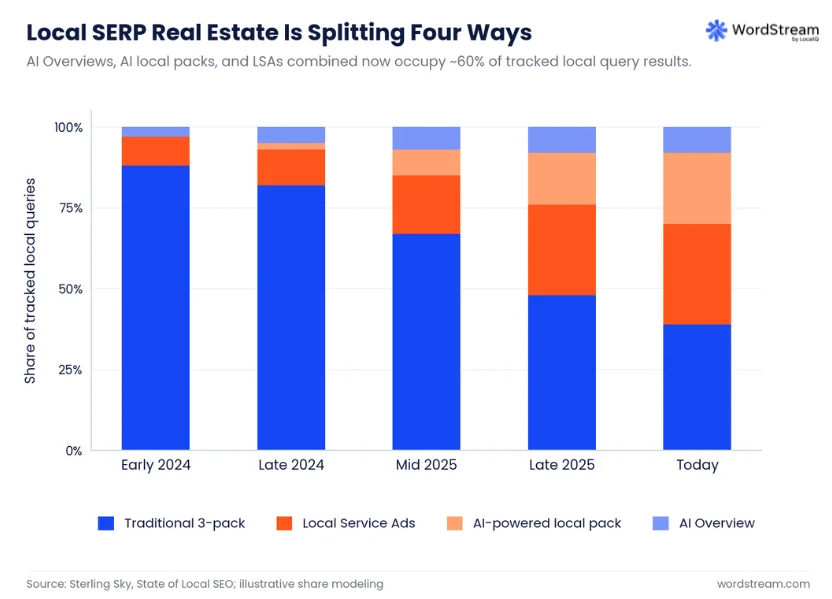
According to a Sterling Sky study, roughly 22% of tracked local queries now show an AI-powered local pack, and those AI-powered local packs feature 68% fewer businesses than the traditional three-pack. Plus, Local Services Ads have grown from 11% to 31% of tracked queries in a single year. And according to a study by Whitespark, AI Overviews are now showing on 57-80% of local searches.
That means there are fewer opportunities for a local business to get mentioned organically in Google results.
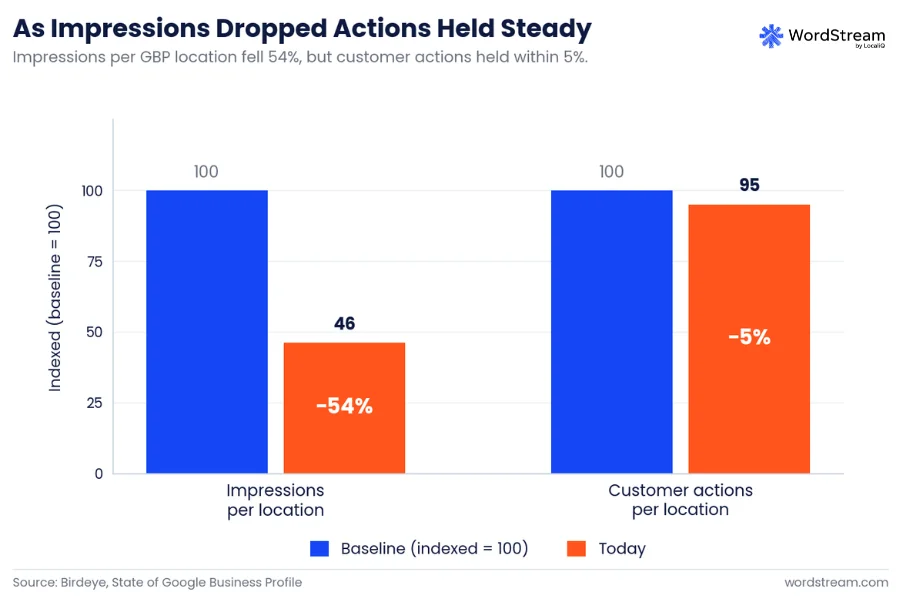
Here’s the good news. While AI features are squeezing out local business websites and profiles, a study by Birdeye found that despite a 54% reduction in impressions on Google Business Profiles, there was only a 5% drop in actions.
All of that is to say: local SEO has gotten harder, but it is still a great channel to drive leads and sales.
I’ve been doing SEO for over 15 years and am constantly analyzing search results. Below you’ll find my best tips for seeing real impact in local SEO in 2026 based on what’s actually working and important right now.
Contents
- 13 best local SEO tips that still work in 2026
- Nail the basics
- Build a process for consistent review volume
- Focus on review language and location
- Respond to your reviews
- Pick the right primary GBP category
- Implement hours properly
- Update your profile regularly
- Go beyond Google
- Increase branded search volume
- Add local links
- Build and update location pages
- Leverage LocalBusiness schema
- Encourage Google Maps direction requests
- Local SEO ROI calculator
- Local SEO FAQs
13 best local SEO tips that still work in 2026
A lot has changed in online search in just the last couple of years, especially now that many search users get answers from AI without clicking through to websites. But that hasn’t reduced the need for SEO. In fact, it’s increased it.
“Local SEO is still a foundational strategy because it drives trust and discoverability at multiple stages of the customer journey,” Dennis Wilson, VP of Product Management at LocaliQ, said.
“Even though AI is changing the interface of search, the underlying signals (authority, consistency, and relevance) still determine what businesses are recommended, and most importantly, which ones earn a customer’s consideration.”
These local SEO tips will help you rank higher on search engines and gain visibility on AI platforms.
1. Nail the basics
The most important local SEO “tip” is to focus on the core tactics that will drive most of your results in local SEO:
- Fill out your Google Business Profile (GBP) completely and accurately.
- Build citations for your business, and make sure the data across them is consistent across profiles.
- Build links (particularly local links) to your website.
- Get lots of reviews, and have processes in place to get them consistently.
There are a lot of other specific tactics and ongoing processes you can set up that will help you grow leads and sales, but if you focus on really nailing these four, you’ll be ahead of most of your competitors.
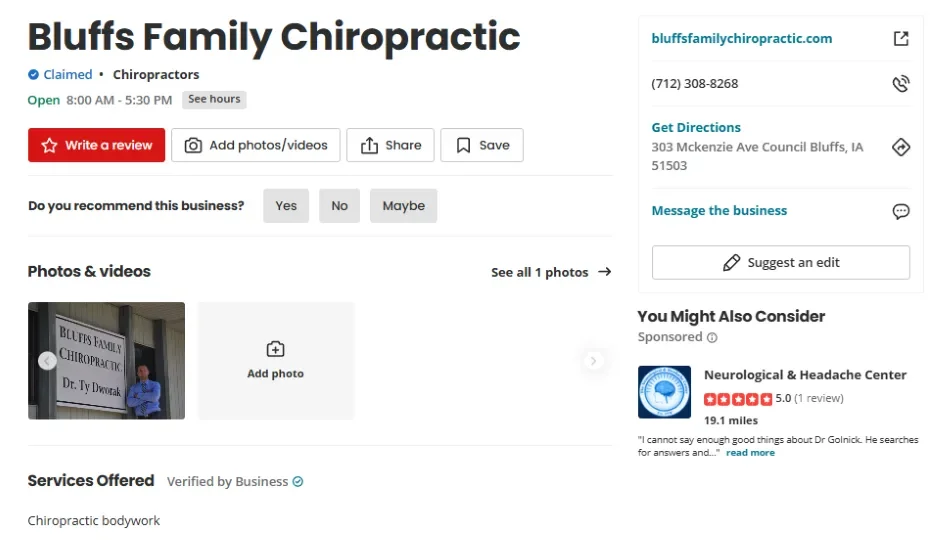
Get citations in as many relevant directories as possible.
👋 Want more search ranking tips? Get your copy of How to Do SEO Right—Right Now!
2. Build a process for consistent review volume
Having a large volume of good reviews is the only way to have your local business rank for competitive terms, and generally, getting more reviews is critical for growing local SEO traffic.
Beyond just total volume, having recent reviews is crucial for ranking consistently for competitive terms. As a result, you need to have a process in place for asking for these reviews:
- Make sure that technicians ask for the review at the end of a job: Have a tablet available and make the process for your customers to leave a review as easy as possible.
- If you’re a storefront, have the review information displayed prominently and make it easy there as well: Use a QR code so customers can quickly give you the review on their phone with minimal friction.
- Find ways to incentivize your employees: Make sure they’re asking happy customers for reviews.
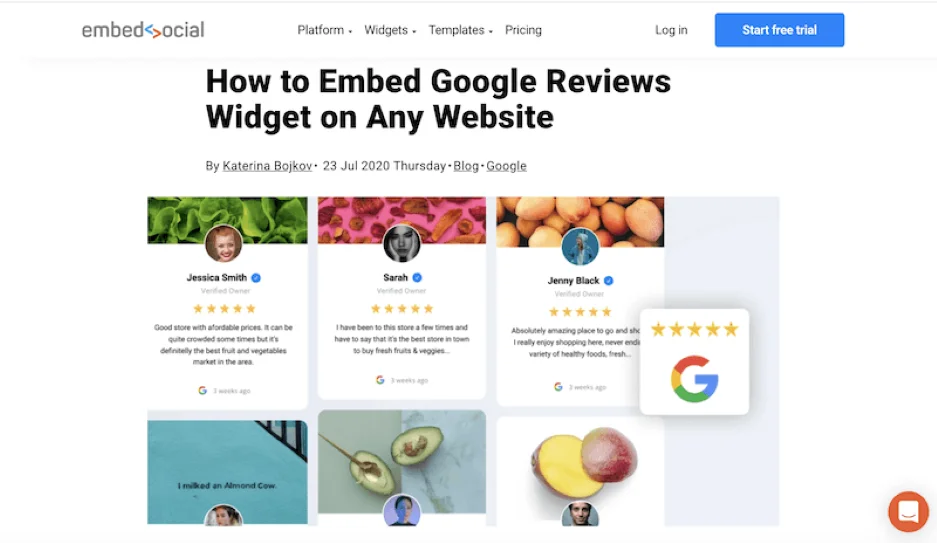
Try adding a page on your website that shows off and asks for Google reviews.
As always, be careful not to run afoul of Google’s guidelines (e.g., incentivizing customers to leave reviews).
3. Focus on review language and location
As you’re thinking through this process, you want to note that:
- The language customers use when leaving a review matters. Instead of leaving the customer to their own devices to leave a review like “Joe did a great job!” you might consider offering a simple template so that you get reviews like ”Joe’s Roofing came and replaced the roof on our house in Calamazoo. Joe and his team were professional and affordable and did a great job.”
- Where reviews are received matters. If you can get more of your reviews in your storefront, or in the actual area you want to get more leads from (like the actual site of the job you worked on), you’re more likely to rank well for queries in and about that specific area.
4. Respond to your reviews
Respond to every review as quickly as you can. Again, build in a process to have someone consistently responding to reviews as they come in on your GMB.
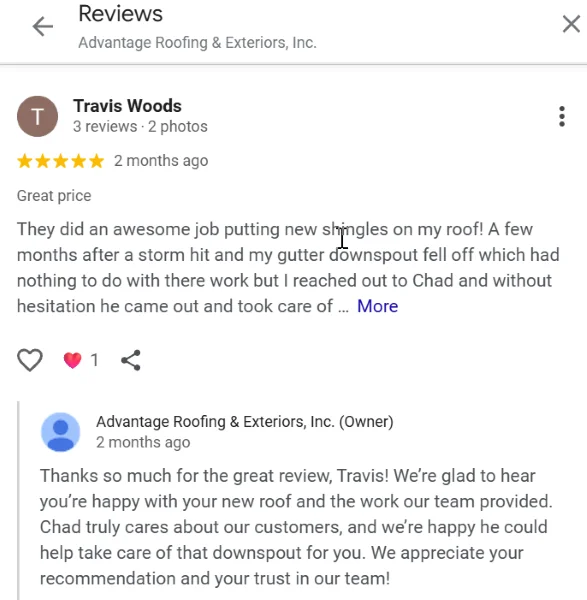
⭐ Keep those reviews rolling in! Download How to Get More Reviews: 8 Tips to Boost Ranking, Reputation, & Revenue
5. Pick the right primary GBP category
Being deliberate about your GBP category is a core local SEO tactic for getting the right kinds of rankings, traffic, and leads. Two key considerations:
- Pick a narrow, core category: If most of your revenue comes from roofing work and you also do general construction, demolition, skylight installation, and ice dam removal, your primary category should be roofing.
- Add relevant secondary categories: You can add secondary categories (up to nine) for any other work you’d want to get as leads. Don’t just add categories that are close to what you do that you don’t offer services for—you may get dissatisfied leads and dilute your ability to show up in search results.
- Bonus tip: you can easily see what services your competitors are listing by searching their name, clicking their GBP, and clicking to see their list of services:
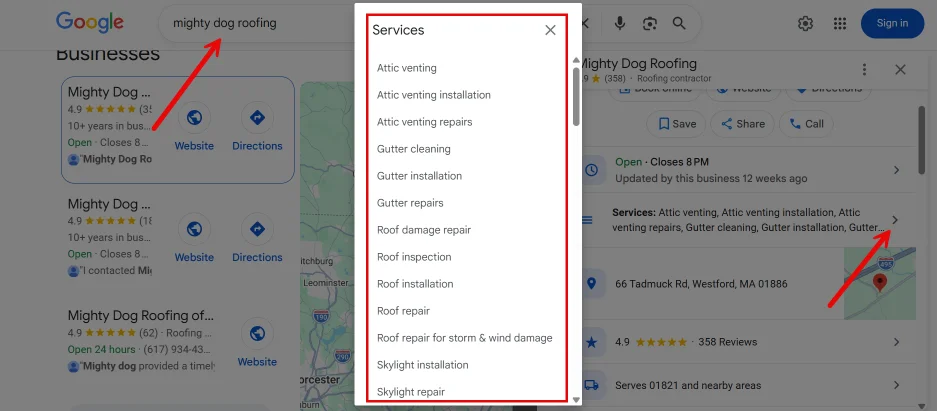
Again, you shouldn’t blindly copy these if you don’t actually offer the services, but it’s a great place to get ideas for services to list, particularly if you have a competitor who you know is driving a lot of leads through local search.
6. Implement hours properly
One of the core things Google considers when determining whether to return your business for a search is whether it’s open.
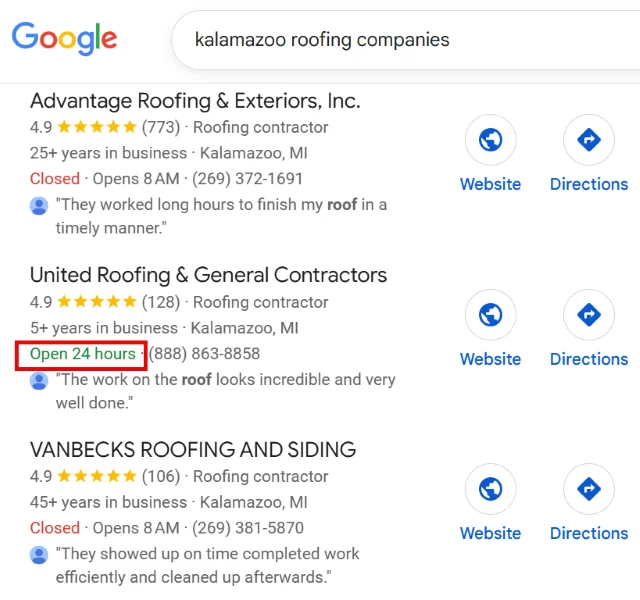
When thinking about your hours:
- Make sure that your hours, holiday hours, and special hours are accurate and up to date.
- If you’re a services business and you have an answering service, consider updating your hours to be the time frame you’re able to accept calls and book jobs, not just the time frame you may be in the office. This is particularly worth considering if you offer emergency services during off-hours.
7. Update your profile regularly
You can help boost visibility for your GBP and signal to prospects that your business is active by leveraging the repeatedly updated elements within your profile. Specifically:
- Consistently update your profile’s photos. This could be photos from a job your company completed, a cake your bakery made, or new photos of something that was added or updated at your property.
- Use posts to provide consistent updates about your business. Include new deals or offers you’re running, jobs you’re completing, findings you have from a specific project, etc.
- Seed the Q&A section with actual questions your customers are asking. Talk to your team and note what customers ask during the sales process. Add them ot you profile.
Weekly updates to these elements of your profile can help send freshness signals to both Google and potential customers.
8. Go beyond Google
Regardless of your business type, a (growing) percentage of your prospects are likely looking for services like yours on AI platforms like ChatGPT. ChatGPT specifically uses Bing data in response to these searches, so making sure your information is up to date and that you’re generating reviews on that platform is critical for increased AI visibility.
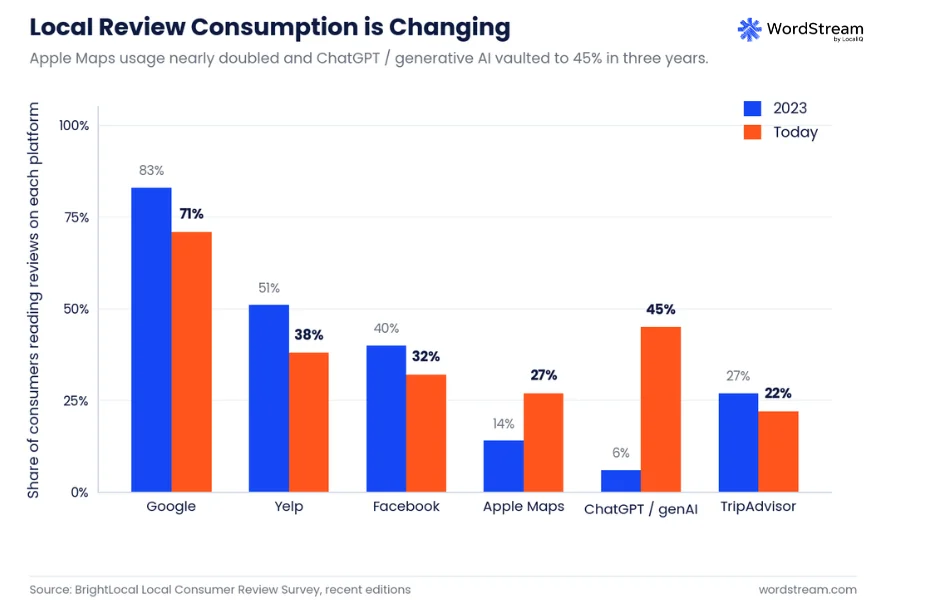
As you can see in the data above, many consumers are still looking at reviews on Google, but many are now also looking for information across multiple platforms. So having information on multiple platforms is increasingly important.
9. Increase branded search volume
Google patents and leaks have explicitly called out branded search volume (and how visitors navigate to and interact with your site) as factors in ranking your site in Google results. So getting people to search for your brand in Google can help drive overall local search traffic (and can help that traffic convert better when it does come to your site or when your map pack listing is viewed).
This isn’t a typical “local SEO hack” because a lot of the activity you can take to help drive branded traffic happens offline, such as:
- Billboard advertising
- Sponsoring local events
- Wrapping your trucks and having your staff wear branded shirts
- Leveraging yard signs, door hangers, and flyers
10. Add local links
While general link building and citation building are important, getting local links is particularly powerful in improving local SEO rankings.
There are lots of great ways to get links from locally focused sites:
- Partnerships with other local businesses (particularly those you already work closely with),
- Sponsorships of local events and organizations
- Local resource pages
- Local press and publications
If you’re not sure where to start here, check out the free local link idea generator we built below:

Local Backlink Idea Generator
Enter your city and vertical to get a categorized prospect list with the exact Google search to find each target, an outreach angle, and a difficulty tier.
11. Build and update location pages
Targeting {town/city} + {service/business type} with location pages for areas that you service (even if you aren’t located there) is very valuable. Again, vary the text you use on-page and with links, and look at all of your competitors who are creating similar pages and create something better than what they have.
For example, here are items you could include for an HVAC company:
- Multiple videos
- Information about costs
- Information about service types
- Information about HVAC size and efficiency in specific areas of the home
- Information about license requirements in Dallas
- Points of differentiation for your HVAC company
- Map embed
In general, look at your competitors on the first page of results and see which is the most comprehensive page (even if it’s not ranking first), you have a rough model and “bar” for your location pages.
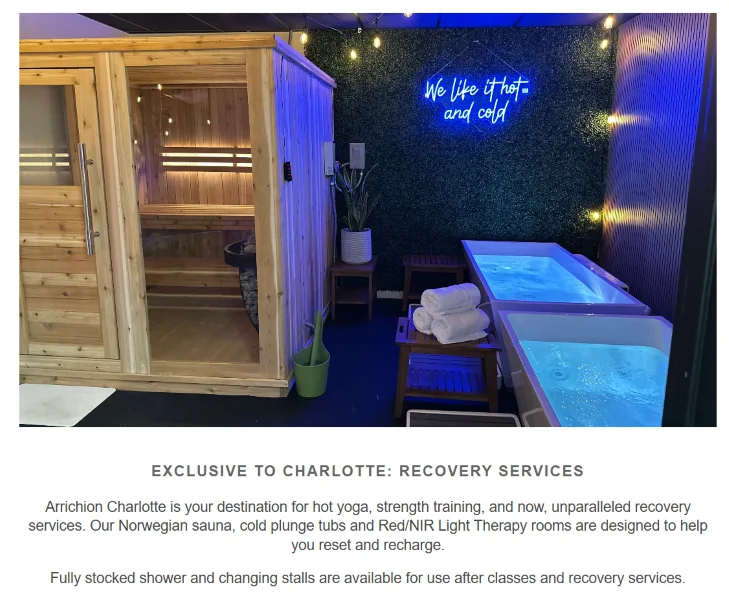
Include local keywords and service descriptions on your location pages to help them rank for hyper-local searches.
Note: Don’t just grab the first result here. It may be a site’s home page, or if it is a location page, it may be ranking for reasons other than how comprehensive the content is.
12. Leverage LocalBusiness schema
LocalBusiness schema allows you to give a lot of granular data about your business in a structured way. You can validate that you’ve structured the data properly using Google’s rich results tool, and to generate the actual schema, we’ve created a free tool you can use below:
Local Business Schema Generator
Pick the narrowest accurate sub-type, fill in the basics, and copy validated JSON-LD ready to paste into your page head.
<script type="application/ld+json">...</script> tag and paste it into your page's <head>.
In WordPress, use a header injection plugin (Insert Headers and Footers, Rank Math) or your theme's header. In Webflow, put it in Page Settings → Inside <head> tag. Validate at search.google.com/test/rich-results.
13. Encourage Google Maps direction requests
Another engagement metric Google uses to help rank Google Maps listings is driving direction requests to a specific business.
Here’s a fun way to increase your chances of showing up in Map searches. Every time you, your employees, your friends, or family members drive to you location, make sure you and they use Google Maps (even if they know the route by heart).
All that extra traffic tells Google that your business is busy and worth mentioning.
Every morning your employees drive past your competition, pull into your parking lot, and waste the easiest GOOGLE MAPS RANKING HACK that exists.
It takes 4 seconds. It costs you nothing. And it directly manipulates the algorithm that decides who shows up in the Map Pack.
I’m… pic.twitter.com/2Qjm6FAqWy
— Bodhi- Local SEO (@irentdumpsters) May 16, 2026
Local SEO ROI calculator
Not sure of the overall return on investment for leveraging these tips and seeing local SEO growth? You can get a rough sense of the ROI you can expect from improvements in your local SEO traffic with the free local SEO ROI calculator we built below:
Estimate what your current local rank is worth, what top-3 would unlock, and the 5-year compounded value of holding the position.
Local SEO & Map-Pack ROI Calculator
Local SEO FAQs
Let’s take a minute and review some of the most commonly asked questions about local SEO.
What are the most important local SEO ranking factors right now?
The most important local SEO ranking factors right now are Google Business Profile completeness (especially primary category accuracy), review volume plus recency, citation consistency across platforms, local backlinks, and on-page signals from optimized location pages.
How long does local SEO take to work?
Local SEO typically takes three to six months to produce meaningful traffic and lead movement. The fastest wins come from Google Business Profile changes and sometimes simple technical SEO or on-page fixes (like changing the title tag on your site’s home page), which can show within weeks. New domains, highly competitive markets, and businesses without an existing review base sit on the longer end of that range.
How do I rank #1 in the Google local 3-pack?
Ranking #1 in the Google local 3-pack depends on how competitive your market is, and broadly requires four things working together: a fully optimized Google Business Profile with the narrowest accurate primary category, a steady flow of recent reviews using location and service language, consistent NAP citations across platforms, and local backlinks. Map direction requests and branded search volume are the two engagement signals that separate the top spot from positions two and three.
Do citations still matter for local SEO?
Yes, local citations still matter for local SEO. A steady volume of local citations with consistent information across citations still has a significant local SEO impact.
Does branded search volume affect local SEO rankings?
Yes, branded search volume is a confirmed local SEO ranking factor, called out explicitly in Google patents and the 2024 Content Warehouse API leak. When prospects search your business name and click through to your site or Google Business Profile, that signals real demand to the algorithm. The biggest lever is offline activity: billboard ads, local event sponsorships, branded vehicle wraps, staff uniforms, yard signs, and door hangers all drive branded search.
How does AI Mode change local SEO?
AI Mode and AI Overviews now appear on 57% to 80% of local searches according to Whitespark, and AI-powered local packs show on roughly 22% of tracked queries per Sterling Sky. The practical implication: Google Business Profile completeness is still the highest-leverage input because AI systems pull heavily from it. ChatGPT uses Bing data for local recommendations, so claim your Bing Places listing and earn reviews across multiple platforms, not just Google.
How do I do local SEO for a service-area business with no storefront?
For a service-area business with no storefront, use the service area field on your GBP to list the cities and ZIP codes you serve. On your website, build dedicated location pages for each meaningful service area (city plus service type) with unique content per page covering local pricing, license requirements, embedded maps, and customer testimonials specific to that area. Avoid thin doorway pages with swapped city names.
What gets a Google Business Profile suspended?
Google Business Profile suspensions happen most often for: using a virtual office or mailbox address, claiming a location where you don’t physically operate, keyword-stuffing the business name, running multiple GBPs at the same physical address, review gating (asking only happy customers for reviews), incentivizing reviews in violation of Google’s policies, and operating in a category that violates Google’s prohibited content rules. Strict adherence to Google’s local guidelines is the fix.
Is local SEO worth it for a small business?
Yes, local SEO is still one of the highest-ROI marketing channels for any small business serving a defined geographic area.
Use these local SEO tips and get found on search
Yes, the available options to get linked in organic search results are shrinking. But the data shows there’s still plenty of benefit in ranking at the top.
The tips in this guide are based on the latest information about search algorithms and AI rules. Try them out and see which moves the needle fastest for your business.
For support in all of your digital marketing efforts, reach out.
About the WordStream Blog
We've been a trusted source of data, news, and strategy for over 15 years. All of our content is written and reviewed by real people: a dedicated team of professionals with decades of combined experience in marketing and advertising for businesses of all sizes.


Add us as a preferred source on Google
Are you wasting money in Google Ads?

Meet The Author
Tom Demers
Tom Demers is the co-founder and managing partner of Measured SEM. He has over a decade of experience helping businesses generate meaningful growth through SEO, PPC, content marketing, and online publishing. Formerly the Director of Marketing at WordStream, Tom has also worked as an in-house SEO specialist, SEO manager, agency consultant, and independent search marketing advisor. Through Measured SEM and his own publishing properties, he has driven millions of dollars in incremental pipeline and sales, generated millions of unique visitors, and built, monetized, and sold high-traffic sites. His insights have been featured in outlets including Search Engine Land, Search Engine Journal, USA Today, and Fox Business.