About the Author


Referral marketing is a customer acquisition strategy that rewards existing customers for introducing new customers to your business, formalizing word-of-mouth into a trackable program with unique links or codes, defined rewards, and measurable conversion data.
Referred customers are roughly 16% more valuable over their lifetime than customers acquired through other channels.
I’ve spent more than 15 years in demand marketing, and in that time, I’ve had a front-row seat to more referral programs than I can count. A handful of them compounded, but many others died quietly in a settings page nobody visited. In this guide, I’ll walk through the things that separate successful and unsuccessful campaigns.
Contents
- Why referral marketing works
- Referral vs. word-of-mouth vs. affiliate vs. influencer marketing
- 8 types of referral programs
- How to build a customer referral program in 8 steps
- 8 referral marketing examples worth copying
- How to promote a referral program
- Referral program metrics that matter
- Referral program software for SMBs in 2026
- When referral marketing does not work
- FTC disclosure and legal considerations
- Referral marketing FAQs
Why referral marketing works
Referral marketing works for three measurable reasons.
First, referred customers don’t just spend more; they recruit more. A 2024 Journal of Marketing Research study found that referred customers make 31% to 57% more referrals of their own than customers acquired through other channels, and that ignoring those downstream referrals causes firms to undervalue a single referral by 20% to 36%.
Second, referred customers cost less to acquire (typically 25-50% lower customer acquisition cost—CAC—than paid channels in vendor benchmarks).
And third, the trust transfer that happens when a customer recommends a brand to a friend is structurally stronger than any ad creative you can buy. The order is intentional. Lead with the math, end with the trust quote.
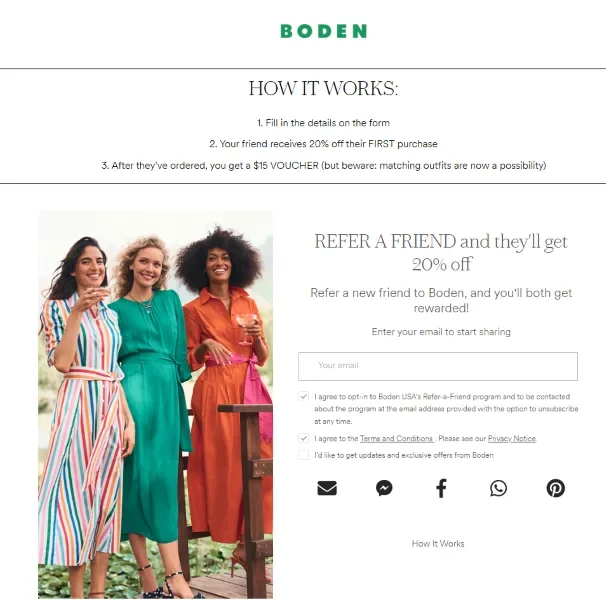
Referral programs help boost trust and customer spending while lowering the cost to acquire new customers.
Beyond these reasons, there are a couple of other beneficial factors to consider.
Referral economics
The previously mentioned Journal of Marketing study tracked about 10,000 customers of a German bank and found referred customers had a contribution margin about 25% higher than non-referred customers in year one, and a lifetime value about 16% higher across the full six-year horizon, after controlling for observable demographics.
Referred customers usually cost less to acquire than paid channels. You will see CAC-reduction figures across referral software vendors’ blogs, usually in the 25-50% range, and sometimes higher for subscription brands.
Generally speaking, you want to treat these kinds of statistics as a directional practitioner heuristic, not a sourced benchmark. They are vendor-aggregated, the methodology is almost never published, and the same numbers get recycled from blog to blog with no primary study underneath.
There is no peer-reviewed figure for referral CAC reduction the way there is for referred-customer value. So model your own: the ROI calculator below turns your real CAC, participation rate, and reward into a referral CAC you can benchmark and optimize against, and communicate these numbers to the C-suite.
💡 Want more ways to convert customers? Download 14 Super-Fast Ways to Boost Conversions
Referral psychology
Reciprocity, the principle Robert Cialdini popularized in his book Influence: The Psychology of Persuasion, makes the existing customer feel the program is fair. They share a reward; you give them a reward. That is why double-sided programs outperform single-sided ones in nearly every published test.
And, broadly, recommendations from people you know are the most trusted form of advertising. 88% of global respondents trust them more than any other channel, per Nielsen’s 2021 Trust in Advertising Study.
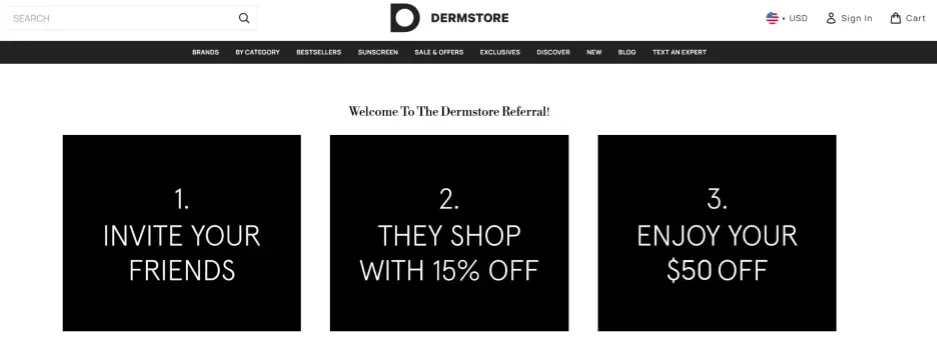
Reciprocity is a motivational force for your referral program.
Referral marketing ROI calculator
Use our free referral marketing calculator to see if it’s the right tactic for your business.

Referral Program ROI Calculator
Project new customers, referral CAC, payback period, and ROI multiple for a referral program. Edit the assumptions to match your business.
Referral vs. word-of-mouth vs. affiliate vs. influencer marketing
Four channels often get conflated, despite the fact that they have different incentive structures, different software, and different FTC obligations (I’ll get into those a little later).
Word-of-mouth is organic and untracked. Referral marketing rewards existing customers for one-to-one shares. Affiliate marketing pays third-party publishers (such as bloggers, deal sites, etc.) a commission for sending public traffic. Influencer marketing pays creators a fee for content reach.
Knowing which one you are running matters when you set a budget, when you pick software, and when you disclose under FTC rules.
Referral vs Word-of-Mouth vs Affiliate vs Influencer Marketing
Four channels, often confused, with different incentive structures and software categories.
| Channel | Who Refers | Reward Structure | Best For |
|---|---|---|---|
|
Organic
Word-of-Mouth
|
Anyone, unprompted | None. Untracked. | Brands customers genuinely love. Unbeatable at scale, impossible to engineer directly. |
|
Customer-Led
Referral Marketing
|
Existing customers, 1:1 share | Two-sided cash, credit, discount, or gift per conversion. Tracked. | Lowering blended CAC after PMF. Highest-ROI new-customer channel for most SMB programs. |
|
Publisher-Led
Affiliate Marketing
|
Third-party publishers, bloggers, deal sites | Commission per conversion (typically 5 to 30% of order value). | Scaling reach beyond your customer base. Works alongside referral, not instead of it. |
|
Creator-Led
Influencer Marketing
|
Paid creators with their own audiences | Flat fee + optional commission. Content-led, not link-led. | Awareness and brand lift. Lower direct ROI than referral but higher reach per campaign. |
Most SMBs should run both a referral program and an affiliate program, structured separately with different budgets. Word-of-mouth is the unmanaged channel underneath both.
Which you choose is heavily dependent on your niche. Find out which tactic is most likely to influence your ideal customers and how the economics work for your business.
8 types of referral programs
The eight common referral program structures are single-sided, double-sided, tiered or milestone, mystery, gamified, advocacy or VIP, charitable, and cash. Double-sided is the default and outperforms single-sided in nearly every published test, but each structure exists because it solves a specific business constraint.
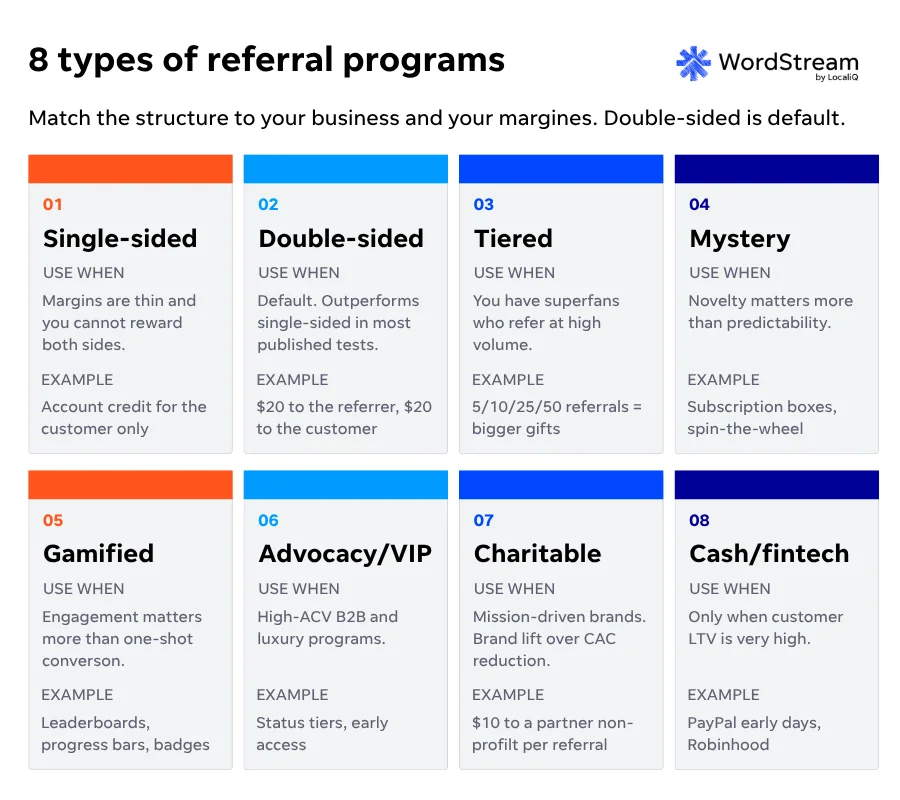
Here are some examples of each:
- Single-sided: Only the referrer is rewarded.
- Double-sided: Both the referrer and the referee get rewards. This is the most common setup for referral marketing.
- Tiered or milestone: Rewards scale with referral count. For instance, gifting company Harry’s pre-launch program used 5/10/25/50 referral tiers, with larger gifts at each step.
- Mystery rewards: Randomized reward (e.g., spin-the-wheel, scratch card).
- Gamified: Leaderboards, progress bars, badges.
- Advocacy or VIP: Status, early access, exclusive events.
- Charitable: Donation to a partner nonprofit per referral.
- Cash: Direct cash payouts.
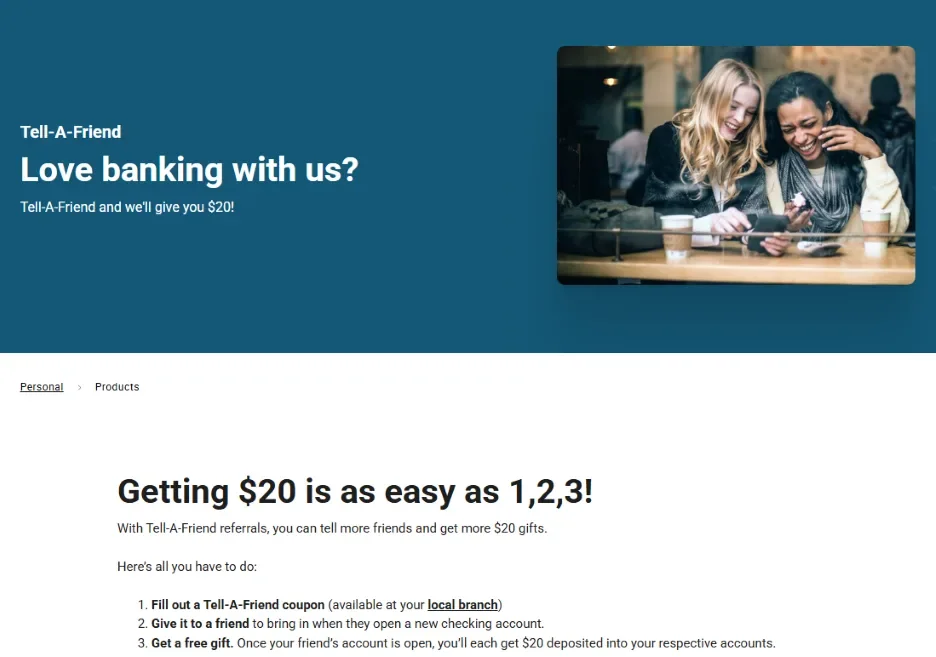
Double-sided referral programs like this one are the default.
🛑 Referrals aren’t the only way to leverage positive customer experiences. Find more in How to Get More Reviews: 8 Tips to Boost Ranking, Reputation, & Revenue.
How to build a customer referral program in 8 steps
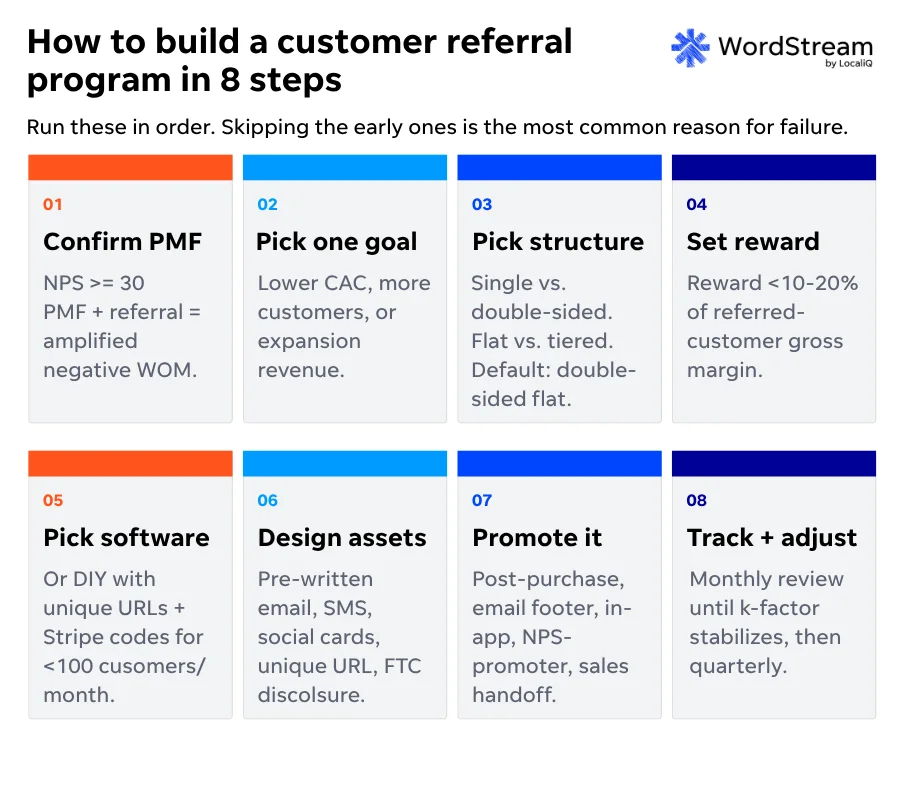
To build a customer referral program there are 8 key steps: confirm product-market fit and a positive NPS (net promoter score) signal, pick one goal (lower CAC, more customers, or expansion revenue), choose a single-sided or double-sided structure, set rewards using customer lifetime value, select software or a do-it-yourself process, design shared assets including the properly compliant disclosure, promote the program across post-purchase, email, in-app, and NPS-promoter touchpoints, and review the program monthly.
Here’s an in-depth breakdown of each step:
- Confirm product-market fit (PMF): NPS 30 or higher, or equivalent positive word-of-mouth signal. Pre-PMF plus referral equals amplified negative word-of-mouth.
- Pick one goal: Choose lower CAC, more customers, or expansion revenue. Programs that try to optimize for all three optimize for none.
- Choose your structure: Single-sided versus double-sided. Flat versus tiered. Default to double-sided flat for the first quarter, layer on tiers later.
- Set the reward: The reward should not exceed 10 to 20% of the gross margin on a referred customer. Above that, your unit economics break before the program scales.
- Pick software: Or build a do-it-yourself version with unique URL parameters, Stripe coupon codes, and your existing CRM. For under 100 customers per month, do-it-yourself usually wins on cost.
- Design share assets: Pre-written email, SMS, social cards, unique URL, and a compliant FTC disclosure. Your referrers should never have to think about what to say.
- Promote it: Post-purchase page, order confirmation email, shipping notifications, in-app widget, NPS promoter follow-up, customer support resolution email, and quarterly dedicated campaign. The settings-page-only launch is how programs die.
- Measure and iterate: Monthly review until the virality (aka “k-factor”)stabilizes (usually 60 to 90 days), then quarterly.
8 referral marketing examples worth copying
The eight referral programs worth studying in 2026 are not the eight with the biggest budgets; they are the eight where the mechanic is the lesson. Each one solved a specific design problem in a way most operators can adapt.
8 Referral Marketing Examples Worth Copying
The eight programs worth studying are not the eight with the biggest budgets. They are the eight where the mechanic is the lesson.
| Company | The mechanic | The operator lesson |
|---|---|---|
|
D
Dropbox
Cloud storage
|
Two-sided in-product reward (extra storage). The reward was tied to the product's primary value metric, not a cash payout. |
Lesson
Tie the reward to whatever your product makes more of (storage, seats, credits, usage), not to discounts the customer might not want. |
|
P
PayPal
Fintech / payments
|
Pure cash payouts in the early days, $10 to each side. |
Lesson
Only works when LTV is enormous. PayPal could afford it because each new account was worth hundreds of dollars in lifetime fees. |
|
T
Tesla
EV / automotive
|
Milestone rewards with status as the prize (a Model X for the top regional referrer at one point). |
Lesson
Rewards work best when they match what customers already feel about the brand. Do not try to manufacture love with a discount. |
|
R
Robinhood
Fintech / investing
|
Pre-launch waitlist that let you jump the line by referring friends. |
Lesson
Referral can be a pre-launch growth engine, not just a post-launch retention play. |
|
A
Airbnb
Travel marketplace
|
Two-sided cash credit plus aggressive email re-engagement of dormant referrers. |
Lesson
Re-marketing the program is half the program. Most users invite zero or one friend ever; the email loop is what moves them. |
|
C
Casper
DTC mattresses
|
Refer-a-friend $75 / $75 surfaced at the post-purchase peak. |
Lesson
Ask at the moment the customer feels best about you, usually right after the purchase or the first successful use. |
|
H
Hims & Hers
Telehealth subscription
|
Refer-a-friend discount integrated into the subscription stack. |
Lesson
Subscription plus referral is a force multiplier. Refer rates run 2 to 3x typical ecommerce because the customer is already locked in monthly. |
|
H
Harry's
DTC grooming
|
Pre-launch milestone tiers (5 / 10 / 25 / 50 referrals unlocked progressively bigger gifts). |
Lesson
Tiers make the small-number problem manageable. Most users refer zero or one, but the small tail that refers 50+ generates enormous cost-efficient growth. |
Referral mechanics compiled by WordStream. Each program reflects the company's publicly documented referral approach; specific reward amounts and structures have changed over time.
In each of these, the reward maps closely to the core value of the product, and the ask lands at a high-trust moment in the customer journey.
How to promote a referral program
A referral program launch is about 10% of the work. The other 90% is surfacing the program in the moments customers are most willing to share. The eight placements that matter most are post-purchase, order confirmation email, shipping notifications, in-app widgets, NPS promoter follow-up, customer support resolution emails, quarterly dedicated campaigns, and sales rep outreach to closed-won B2B accounts.
8 Places to Promote a Referral Program
Launch is the easy 10% of the work. The other 90% is surfacing the ask at the high-trust moments in the customer journey, not burying it in a settings page.
| Placement | Why it works | How to run it |
|---|---|---|
|
1
Post-purchase or order-confirmation page
|
The highest-trust moment in the entire customer journey. |
Surface the program right here. If you do not, you leave most of the revenue on the table. |
|
2
Order confirmation and shipping emails
|
Higher open rates than any other email you send. |
Add the referral CTA (call to action) above the fold. |
|
3
In-app widget
|
A persistent, low-friction reminder while the customer is already logged in. |
Place it on the logged-in dashboard for SaaS, or the account page for ecommerce. |
|
4
NPS promoter follow-up
|
The single highest-leverage placement. Conversion from this audience runs 3 to 5x the program average. |
Anyone who scores you 9 or 10 on an NPS (Net Promoter Score) survey gets the referral ask in the response email. |
|
5
Customer support resolution email
|
When you resolve a ticket well, the customer is in a high-trust state. |
Drop the referral ask into the resolution thank-you message. |
|
6
Quarterly dedicated email campaign
|
Most customers forget the program exists after the first announcement. |
Run a dedicated campaign each quarter to refresh the audience. |
|
7
Sales rep outreach to closed-won (B2B)
|
Manual but high-value, reaching the customer during the post-close honeymoon period. |
Reps ask for referrals 30 to 60 days after the deal closes. |
|
8
Reviews and UGC cross-promotion
|
Same audience, adjacent ask. Review writers are already willing advocates. |
If you run a reviews program, surface the referral CTA in the review-collection email. (UGC means user-generated content.) |
The pattern across all eight: surface the ask at high-trust moments in the customer journey, not on your settings page.
A key across all of these tactics is that you need to surface the “ask” at high-trust moments in the customer journey.

Promote your referral program on social media for more reach.
Below is a series of copy-and-paste templates you can use at various specific points to ask for a referral:
How to Ask for a Referral (Copy-Paste Templates)
Subject: [First name], know someone who needs [product]?

Hi [First name],

You mentioned [specific result]. If a colleague could use the same, your link gives them [referee reward] and gives you [referrer reward] when they [sign up or place a first order]: [referral link].

Easier to forward? Send this: "I have used [product] for [time] and it is [result]. Use my link for [referee reward]. I get [referrer reward] if you sign up: [referral link]."

Thanks,
[Your name]
[First name], glad [product] is working out. Share your link and you both get [reward]: [referral link]. We credit you the moment they [sign up or order]. You get a reward when they buy, so only send it to people it will help.
Headline: Enjoying [product]? Give [referee reward], get [referrer reward].

Share your personal link. When a friend makes their first [purchase], you both get [reward].

Buttons: [Copy my link]  [Share by email]

Small print under the buttons: Friends will see that you receive a reward when they buy.
One rule ties these together: the disclosure travels with the share. Any message a customer sends on your behalf has to state, in plain language and every time, that they get something in return. Build that line into the template so referrers never have to think about compliance. See FTC Disclosure and Legal Considerations for the full rule.
Referral program metrics that matter
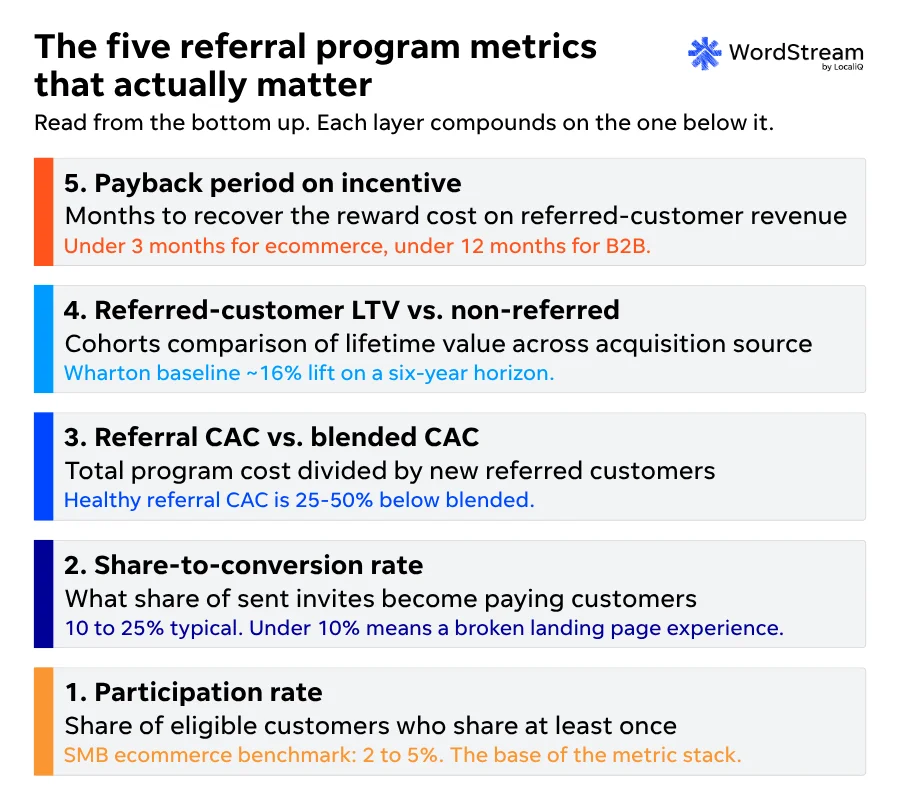
The five referral program metrics worth tracking are:
- Participation rate: What percentage of eligible customers shared at least once? SMB ecommerce benchmarks typically land around 2 to 5%. Below 2% means the program is buried; above 5% means you have either a superfan base or a very strong post-purchase placement.
- Share-to-conversion rate: Of the shares you sent, what percentage became paying customers? 10 to 25% is typical. Lower than 10% usually means a broken landing page experience for the referred customer.
- Referral CAC versus blended CAC: Total program cost (rewards plus overhead) divided by new referred customers. Compare that to your blended CAC across all channels. A healthy referral CAC is 25 to 50% below blended.
- Referred-customer LTV versus non-referred LTV: The Wharton finding was around 16% higher LTV on a six-year horizon. Track your own cohort comparison; this is the metric a CFO will care about most.
- Payback period on incentive: How many months of customer revenue does it take to recover the incentive spend? Under three months for ecommerce, under twelve months for subscription B2B is the rough bar.
Track k-factor (the viral coefficient—see the explanation below) only if you are explicitly aiming for compounding growth. Most healthy programs run at K = 0.1 to 0.5 and remain profitable.
K-factor (virality coefficient) calculator
K equals invites per user times the conversion rate of invited users. If K is greater than 1, the program compounds; every cohort produces more than one new cohort. If K is less than 1, the program is additive, which is still useful but not viral. Most real businesses live at K = 0.1 to 0.5 and, that is fine.
This calculator shows you where you sit and what to do about it:
K-Factor (Viral Coefficient) Calculator
K = invites per user x conversion rate of invited users. K > 1 means your program compounds. K < 1 means it adds, which is still useful.
Referral program software for SMBs in 2026
There is no best referral marketing software in 2026, only the right one for your stack and scale. The category map is small enough to fit on one screen. Pick based on whether you are on Shopify, on a custom site, on a B2B SaaS stack, or running enterprise-scale, then run as much of a trial as you can before committing.
- Shopify and ecommerce: ReferralCandy, Yotpo, Smile.io. Native Shopify apps with the fastest install and opinionated defaults.
- General SMB and no-code: Referral Rock, Referral Factory, Friendbuy. Work across stacks, more customization, longer setup.
- B2B SaaS: Cello, GrowSurf. Built for SaaS metrics (monthly recurring revenue, expansion, multi-step rewards). PartnerStack is in this conversation too, but it is a partner-program platform first and a referral second.
- Enterprise: Extole, Buyapowa, Mention Me, Annex Cloud, Ambassador. Enterprise-grade attribution, multi-program management, and dedicated CSMs (customer success managers). Pricing starts in the four-figure-per-month range.
- The do-it-yourself path: For under 100 customers per month, a Tally form (or free Google Forms), unique URL parameters, Stripe coupon codes, plus your existing CRM can replicate most of a referral platform. Do not pay $300 per month for software until you have signal the program will scale past that.
The biggest mistake at this step is letting a vendor demo set your strategy. Pick your program structure first, then evaluate software against it.
When referral marketing does not work
Referral marketing does not work in five specific situations:
- Pre-product-market-fit: You will amplify negative word-of-mouth instead of growth.
- Once-in-a-lifetime purchases: Think wedding, funeral, mortgage refinance.
- Heavily regulated verticals: Financial advice, healthcare, and legal, for example, without legal review
- Commoditized products: Especially where the referrer has no story to tell
- Very low customer acquisition: we’re talking paybacks in under a month.
In all five cases, the program overhead outweighs the gains.
The most expensive version of this mistake is launching a referral program before you have product-market fit. Referral marketing is an amplifier. If your customers are not happy, the referral program speeds up the spread of that unhappiness. The first step in the eight-step build sequence is not “set up the software”; it is “confirm a positive net promoter score.” That ordering is intentional.
For regulated industries, the FTC and state-level rules can be aggressive enough that the legal review cost outweighs the program revenue. If you sell financial advisory services, run any referral mechanism through compliance counsel before you launch. The same applies to healthcare, where HIPAA and state-level practice rules can prohibit pay-for-referral entirely.
FTC disclosure and legal considerations
The FTC’s Endorsement Guides require clear and conspicuous disclosure of any material connection between a brand and an endorser, including referral rewards (cash, credit, discount, free product, or status). The 2023 update to the guides explicitly extended the rule to refer-a-friend share copy you provide to your customers, and 2024 enforcement updates raised civil penalties into the five figures per violation. If your share copy pretends a paid referral is an organic recommendation, you are out of compliance.
FTC Referral Disclosure Generator
Paste the output into share copy your referrers send. The FTC's Endorsement Guides require clear and conspicuous disclosure of any material connection, including referral rewards.
The material connection rule in plain English
Any time a customer recommends your product and receives something in return (cash, credit, a discount, a free product, status, or even an entry into a sweepstakes), that customer must disclose the relationship in the recommendation. The disclosure has to be clear (plain language, not legalese), conspicuous (visible without expanding hidden text, in a font size comparable to surrounding copy), and consistent (every time the endorsement appears, not just once at signup).
In practice, that means three things for a referral program:
- Pre-written shared copy must include the disclosure: If you provide an email template, the template ships with the disclosure baked in.
- The disclosure has to fit the channel: Email and SMS get a “heads up, I get $X if you sign up” line. Social posts get #ad or #sponsored at the front. In-app widgets get the disclosure adjacent to the share button.
- You are responsible for what your referrers say: Even if a customer goes off-script and posts something on Instagram without the disclosure, the FTC can hold the brand accountable for failing to provide adequate guidance.
Special rules
Healthcare, financial services, and anything aimed at children under 13 (COPPA overlap) have additional state and federal rules layered on top of the FTC’s baseline. Do not launch a referral program in those verticals without counsel.
This section is not legal advice. Review the FTC’s Endorsement Guides directly and consult an attorney for your specific program.
Referral marketing FAQs
Here are several answers to the most asked questions about referral marketing.
What is referral marketing in simple terms?
Referral marketing is a customer acquisition strategy that rewards existing customers for introducing new customers to your business. It formalizes word-of-mouth into a trackable program with unique links or codes, defined rewards (cash, credit, discount, or product), and measurable conversion data, turning unpaid recommendations into a managed channel.
What is the difference between referral marketing and affiliate marketing?
Referral marketing rewards existing customers who personally share your product with their own network, usually a one-to-one share. Affiliate marketing pays third-party publishers (bloggers, creators, deal sites) a commission for sending public traffic to you, often via SEO or content. Different audiences, different reward structures, different software. Most companies should run both separately.
What are the main types of referral programs?
The eight common structures are single-sided (referrer only), double-sided (referrer and referee), tiered or milestone (rewards scale with referral count), mystery (randomized reward), gamified (badges, leaderboards), advocacy or VIP (status, early access), charitable (donation per referral), and cash (fintech and high-LTV verticals). Double-sided is the default and outperforms single-sided in nearly every published test.
How do you build a customer referral program step by step?
To build a customer referral program: confirm product-market fit and a positive NPS signal first; pick one goal (lower CAC, more customers, or expansion); choose a single or double-sided structure; set rewards using customer lifetime value math (reward should not exceed 10 to 20% of referred-customer gross margin); select software or build with unique URL parameters; design share assets; promote across post-purchase, email, in-app, and NPS-promoter touchpoints; and review monthly.
What metrics should I track for a referral program?
Track participation rate (the percentage of eligible customers who share at least once), share-to-conversion rate, referral customer acquisition cost (CAC) versus blended CAC, referred-customer lifetime value (LTV) versus non-referred LTV, and payback period on incentive spend. Track the k-factor (invites-to-conversion rate of invited users) only if you are aiming for viral growth. Most healthy programs run at K = 0.1 to 0.5 and remain profitable.
What is the best referral marketing software in 2026?
The best referral marketing software depends on your stack and scale. For Shopify ecommerce: ReferralCandy, Yotpo, or Smile.io. For general SMB or no-code: Referral Rock, Referral Factory, or Friendbuy. For B2B SaaS: Cello or GrowSurf. For enterprise: Extole, Buyapowa, Mention Me, or Annex Cloud. Under 100 customers per month, a do-it-yourself setup with unique URLs, plus Stripe coupons, plus your CRM is usually enough.
Do I have to disclose referral relationships under FTC rules?
Yes. The FTC’s Endorsement Guides require clear and conspicuous disclosure of any material connection, including discounts, store credit, cash, or free product, every time the endorsement appears. The 2023 update and 2024 enforcement updates raised per-violation civil penalties into the five figures. Pre-written share copy you provide to referrers should include the disclosure. Do not disguise paid referrals as organic recommendations.
When does referral marketing not work?
Referral marketing does not work when you do not yet have product-market fit (you will amplify negative word-of-mouth), when the purchase is once-in-a-lifetime (referee-side rewards still work but referrer-side does not), in heavily regulated verticals without legal review (financial advice, healthcare, legal), or when your current customer acquisition cost is already very low, and payback is under a month. Program overhead may outweigh the gains.
What’s the difference between B2B and B2C referral programs?
B2B and B2C referral programs share the same strategy but require different mechanics.
B2C runs short cycles, low-friction, two-sided cash or credit, with in-app and post-purchase placements. While B2B runs longer cycles, multi-step rewards tied to pipeline stages, CRM-attached attribution, and sales handoff for high-ACV deals.
Confusing the two is the most common mistake B2B teams make when adapting a Shopify-style program to their funnel.
What changes in B2B:
- Attribution window: A B2C referral closes in hours or days. A B2B referral can take 6 to 18 months. The tracking has to survive that.
- Multi-step rewards: Pay a small bonus when the referral becomes a marketing-qualified lead (MQL), a larger bonus when it becomes closed-won. Single-payment-on-conversion programs fail at B2B time horizons.
- CRM attachment: The program runs out of the CRM (HubSpot, Salesforce, Pipedrive), not out of a Shopify app. The referral-source field on the deal record is non-negotiable.
- Sales handoff: High-ACV referrals get routed to a human, not a self-serve flow. The referrer expects their friend to be treated like a warm lead instead of a cold signup.
- Reward type: Gift cards or charitable donations work better than cash for buyer-side compliance. Many enterprise procurement teams ban employees from accepting direct cash from vendors.
- Ownership: B2B referral programs live with Growth or Marketing, with a defined handoff to Sales. B2C programs live entirely with Marketing or Ecommerce Ops.
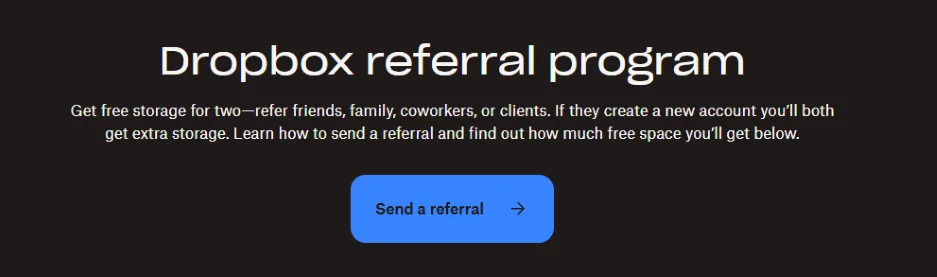
Dropbox offers free storage capability for referrals.
If you sell to mid-market and enterprise accounts, your referral motion is closer to a partner program than to a refer-a-friend widget. Acknowledge that up front and build the CRM plumbing before launching.
Make referral marketing work for you
Referral marketing isn’t a passive strategy. You have to take regular action to launch, manage, track, and improve the program. But with the right plan in place, it can drive consistent, low-cost customer acquisition.
The key is tailoring your referral marketing program to your business, goals, and ideal customers. Once you have the match, it’ll deliver dependable results.
Speaking of dependable results, reach out, and we’ll show you how our digital marketing solutions can help support all of your marketing goals.
About the WordStream Blog
We've been a trusted source of data, news, and strategy for over 15 years. All of our content is written and reviewed by real people: a dedicated team of professionals with decades of combined experience in marketing and advertising for businesses of all sizes.


Add us as a preferred source on Google
Are you wasting money in Google Ads?

Meet The Author
Tom Demers
Tom Demers is the co-founder and managing partner of Measured SEM. He has over a decade of experience helping businesses generate meaningful growth through SEO, PPC, content marketing, and online publishing. Formerly the Director of Marketing at WordStream, Tom has also worked as an in-house SEO specialist, SEO manager, agency consultant, and independent search marketing advisor. Through Measured SEM and his own publishing properties, he has driven millions of dollars in incremental pipeline and sales, generated millions of unique visitors, and built, monetized, and sold high-traffic sites. His insights have been featured in outlets including Search Engine Land, Search Engine Journal, USA Today, and Fox Business.
Recommended for you