About the Author


If you spent the last year ignoring advice about llms.txt files, AI-specific content rewrites, and specialized schema markup for AI search, you made the right call.
In late May 2026, Google published its first official guidance on how AI Overviews and AI Mode work. It is the clearest thing the company has said on the subject, and it points directly at the fundamentals: fast, accessible websites, content that reflects genuine expertise, and strong local reputation signals. These are the same things that have driven search visibility for years.
The entire category of “AI optimization” services (the chunking, the file formats, the rewrites) does not appear in the guidelines as something Google uses or rewards. In fact, Google addressed these tactics in a section titled “Mythbusting.”
That is worth pausing on. Not because you should feel validated (though you might), but because it tells you exactly where to spend your time. You don’t need a new playbook; you simply need to execute the existing one more consistently.
Here is what Google actually said in their AI search guidelines, what it means for your business, and one question that will tell you whether your website is already in good shape.
Contents
- What’s in Google’s AI search guidelines?
- What to focus on for AI search visibility, according to Google (+experts!)
- What’s less important for AI search
- How to apply these AI search guidelines in one easy step
What Google says about AI search in its guidelines
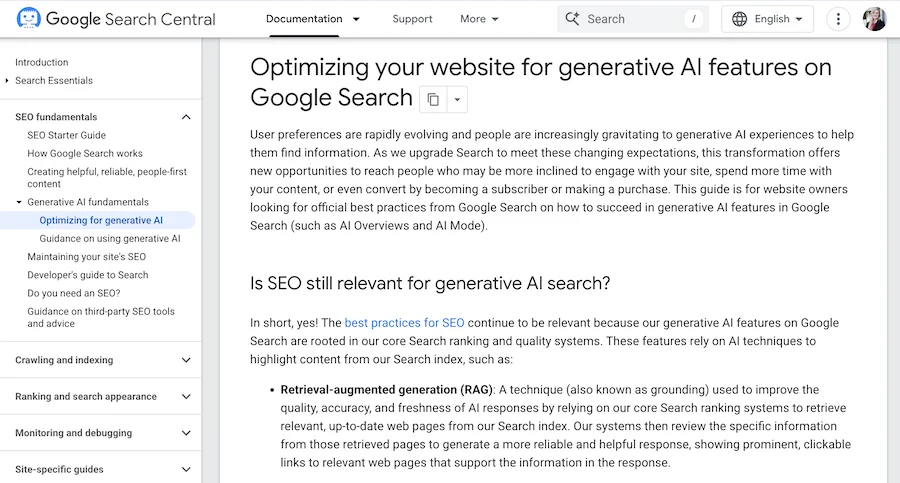
The guidance lives in Google Search Central’s documentation under “Optimizing for generative AI features on Google Search.” It was announced at Google I/O 2026 and covers AI Overviews, AI Mode, and the emerging category of agentic search experiences.
The document answers a question that has been floating around since AI Overviews launched: Does SEO still matter for AI search?
Nikiya Griffith, Director of Organic Growth at BX Studio, says the answer has been clear in practice for some time. “We’ve seen that about 80% of the time, what’s good for SEO is good for GEO. Our most successful strategic initiatives over the last year have been ones where SEO and GEO were approached in unison as one holistic strategy. Of course, you still need to devote time and attention to the considerations that are unique to GEO or SEO, but overall, we really see GEO as an extension of good SEO.”
Google’s guidance lands in the same place. Its answer is direct: “In short, yes.” Its generative AI features pull from the same Search index as traditional results. They use the same ranking systems. Succeeding in AI Overviews or AI Mode starts with succeeding in search.
Three themes run through the document: foundational SEO, demonstrable expertise, and trust and local relevance. This is not a new set of requirements. It is a clarification of which signals Google already counts, now applied to AI-powered experiences.
For small businesses, that is genuinely good news: The work you have already done holds more value than the AI optimization industry would have you believe.
🛠️ Get everything you need to know about showing up in AI search in our free guide: The AI Search Toolkit >>
What to focus on for AI search visibility, according to Google (and the experts!)
While the mythbusting section is detailed (which we’ll cover shortly), the guidance on what actually works breaks into three areas that will feel familiar to anyone who has been paying attention to SEO over the past few years.
Foundational SEO
AI systems still need to discover, access, understand, and retrieve content. That process works the same way it always has. The guidance explicitly references crawlability, site structure, mobile usability, page speed, and internal linking, and these same factors affect both traditional search visibility and how AI Overviews retrieve content.
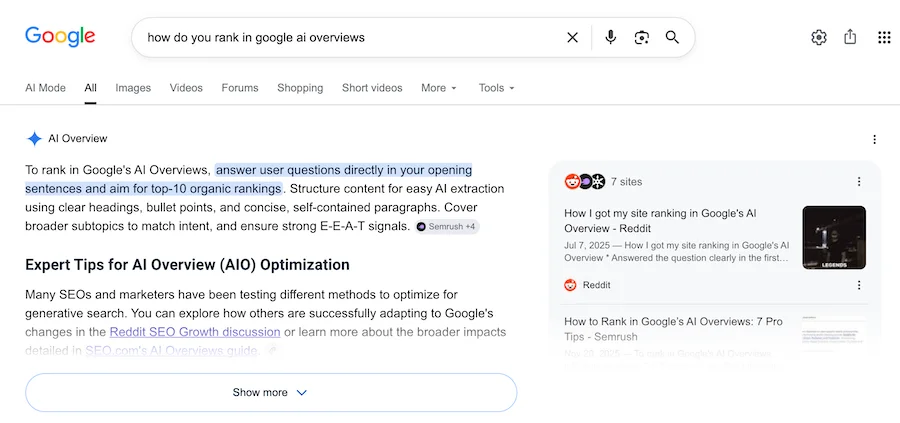
A plumbing company in Phoenix with a slow mobile site creates a barrier for both. These used to feel like two separate problems. Google’s guidance makes clear that they are the same problem.
For most small businesses, the technical bar is not complicated. Make sure your content is crawlable, your site performs well on mobile, and your pages meet the basic technical requirements to be eligible for indexing. If you can check those three things, you have covered most of what the technical section describes.
Content built on real experience
This is where the guidance spends the most time, and it is worth reading carefully.
Google explicitly prioritizes what it calls “non-commodity content,” meaning content that goes beyond what anyone with a search engine could produce.
The guidance gives a clear example of the distinction: a summary of existing advice is commodity content. A first-hand account based on real experience (“Why We Waived the Inspection and Saved Money: A Look Inside the Sewer Line”) is non-commodity content. The difference is not length or format. It is whether the content reflects genuine knowledge that is not widely available elsewhere.
For SMBs, this is a real structural advantage over larger publishers or businesses. An HVAC technician in Cleveland who writes about why heat pumps underperform during polar vortex conditions, covering the specific settings to adjust and the system configurations that tend to fail, is providing something a national publisher writing generic HVAC content cannot replicate. A dental practice that explains what patients actually notice during their first Invisalign appointment, drawn from hundreds of cases, is working with knowledge that competitors cannot simply copy.
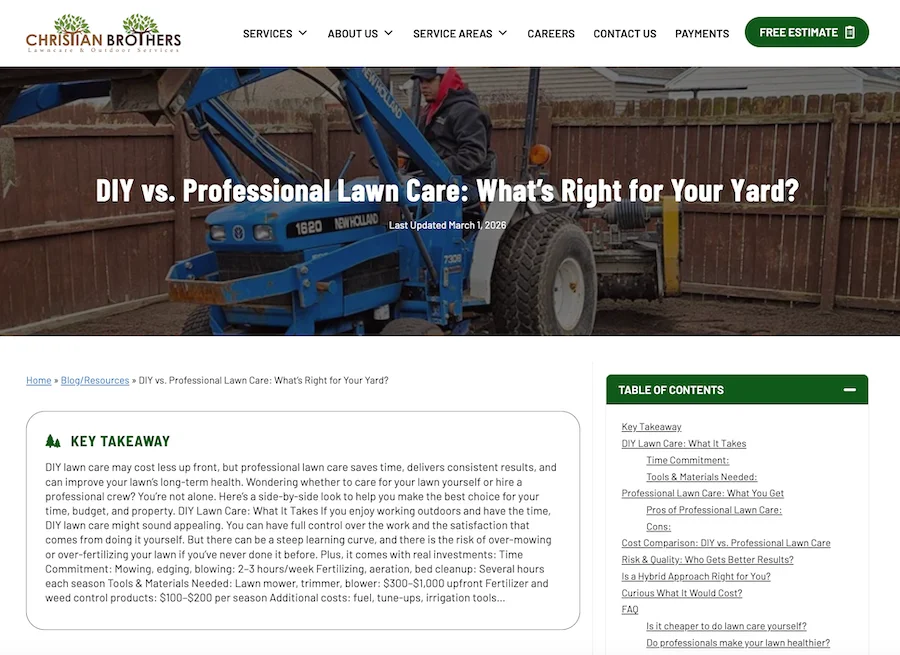
Businesses closest to customer problems often have information that larger publishers cannot easily replicate. Google’s guidance points toward making that expertise visible.
“If you have genuinely unique insights to share, whether it’s in the form of expert quotes, original data, or something else, you’re going to have a much better chance of winning in organic and AI search,” said Nikiya.
“You still need to make sure you’re following best practices and formatting fundamentals, so your content can be easily crawled and gets discovered. But quality beats quantity if you’re aiming for long-term growth.”
Local relevance and trust signals
The guidance calls out Google Business Profile, reviews, citation consistency, and local mentions as signals that carry weight in both traditional and AI-powered local results.
For small businesses, reviews that describe specific services or outcomes carry more than generic five-star ratings. “Arrived on time, fixed the leak” gives AI systems less to work with than a review describing a specific situation: an emergency repair at 2 a.m., or a problem that two other companies had misdiagnosed. Specific language gives Google’s systems more context about what your business actually does and how well it does it.
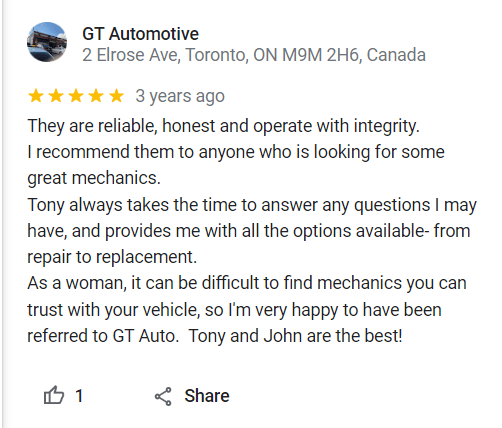
Citation consistency matters too. If your address, phone number, and business name appear differently across directories, it weakens the trust signal. Cleaning that up pays off in both traditional and AI-powered local results.
🔎 Need help understanding the modern rules for SEO? Download our free guide >> How to Do SEO Right—Right Now!
What’s less important for AI search, according to Google
The mythbusting section of Google’s AI search guidelines is where businesses can save real time and money. Google names five tactics and explains that none of them are required for AI search visibility.
Llms.txt files
An llms.txt file is a markdown document placed at a site’s root that summarizes what a site is and links to its most important content. The idea, proposed by Jeremy Howard of Answer.AI in 2024, was that AI systems could use this file to orient themselves without crawling everything. The SEO industry ran with it quickly.
The problem is that AI systems have largely not read it. Ahrefs analyzed 137,000 sites in May 2026 and found that 97% of existing llms.txt files received zero traffic. Not low traffic. Zero, meaning no bots, no humans, nothing fetching the file at all. Of the 3% that did receive any traffic, AI retrieval bots accounted for just 1.1% of requests. Slackbot, a chat app’s link-preview mechanism, fetched more llms.txt files than PerplexityBot did.
Ahrefs also found that zero AI bots went looking for llms.txt files that did not exist. There is no knock at the door you are missing by not having one.
Google’s guidance matches this data precisely. The mythbusting section states that businesses do not need to create new machine-readable files, AI text files, markup, or Markdown to appear in generative AI search.
Google’s own Search Advocate John Mueller has called llms.txt “a temporary crutch, perhaps to save some tokens” for AI coding tools parsing developer documentation. The file was designed for software developers, not HVAC companies or dental practices.
Content chunking
Chunking means breaking content into short, discrete sections under the theory that AI systems retrieve information in small pieces and prefer content formatted that way. Google says this is not accurate.
Its systems can understand multiple topics on a single page and surface the relevant portion without the publisher doing that work in advance. Write pages for your audience. Length should follow the content, not the other way around.
AI-focused content rewrites
Some businesses have been rewriting perfectly serviceable pages to add “long-tail keywords” and “AI-retrieval phrases.” Google says this is not necessary.
Its systems understand synonyms and general meaning well enough that content does not need to mirror every variation of a query. Chasing retrieval phrases is work that produces diminishing returns.
Specialized AI schema
Structured data continues to matter for rich results, including review stars, FAQ boxes, and local business details. But Google is explicit that there is no special schema.org markup for AI search. There is no AI-specific type or new property you need to add. If your structured data is already in place for traditional search, you are covered.
Nikiya flags one practical risk worth watching here. “There’s been a lot of mixed messaging around schema markup recently, and as a result, we’ve seen an uptick in what I consider schema slop. I think the intention behind it is good; people want to follow best practices, but if you have an AI tool write schema for you, and you don’t have an expert with technical SEO or GEO experience to review that code, you can actually wind up doing yourself a disservice. If you’re going to add schema markup to your website, you need to make sure it matches what’s actually on the page, and you need to validate it.”
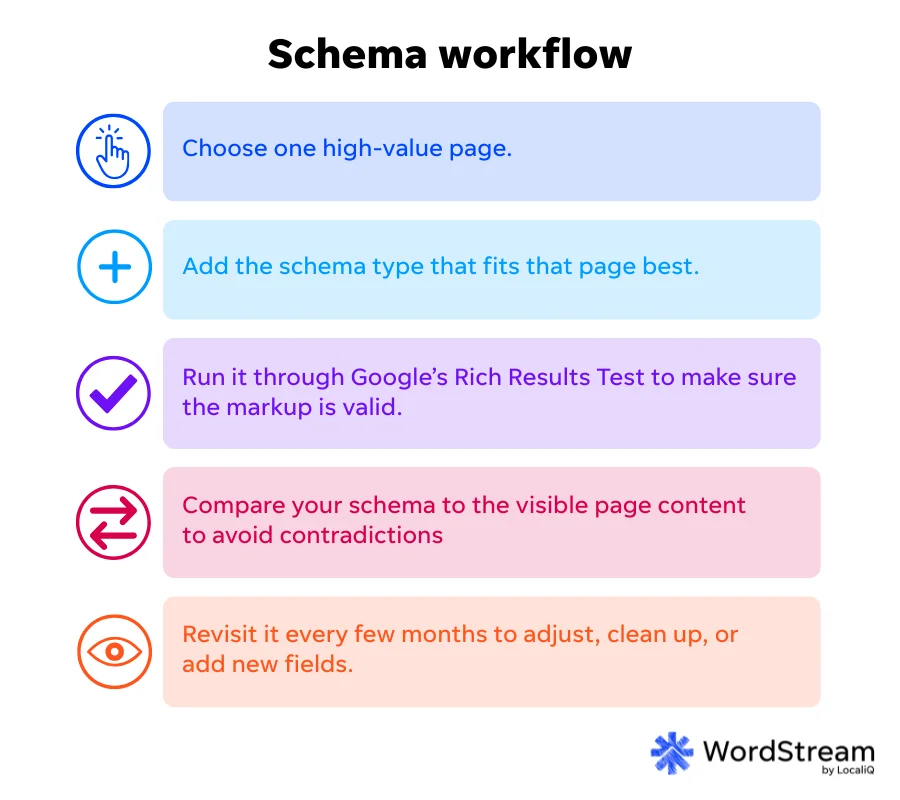 Follow this schema workflow if you do add it to your site.
The short version: existing, accurate, validated structured data is what matters. Adding more schema without those conditions is not a neutral act.
How to apply these AI search guidelines in one easy step
When reviewing a page, ask: Would a customer who already trusted your business find this genuinely useful?
Read each page as a prospective customer would, and look for:
- Specifics
- Evidence of experience
- Practical guidance rather than general statements
Pages that sound interchangeable with your competitors are the ones that deserve attention first. Pages that reflect how your business actually thinks about problems and solves them are already aligned with what Google describes throughout its guidance.
The content that tends to underperform in AI search is the same content that tends to underperform in traditional search: thin, generic pages that do not add anything beyond what is already available everywhere else. That has not changed. It is simply more visible now.
What Google’s guidance clarifies
The most valuable aspect of this document may simply be the clarity it provides. For the first time, businesses have a written reference from Google itself on what it evaluates across traditional and AI-powered search experiences.
When someone tries to sell you a new AI optimization service, whether it involves chunking, llms.txt files, or special schema, you can check it against published guidance. If Google explicitly says it does not matter, that is a definitive answer.
The work that has always driven search visibility is the same work this guidance describes: technical accessibility, demonstrated expertise, and local trust signals. Adding AI to search does not change what the foundation requires. If anything, it makes getting that foundation right more consequential.
About the WordStream Blog
We've been a trusted source of data, news, and strategy for over 15 years. All of our content is written and reviewed by real people: a dedicated team of professionals with decades of combined experience in marketing and advertising for businesses of all sizes.


Add us as a preferred source on Google
Are you wasting money in Google Ads?

Meet The Author
Goran Mirkovic
Goran Mirković is a marketing leader with over a decade of experience in SaaS growth, SEO, content strategy, and demand creation, a freelance contributor for WordStream, and a 2x CMO. With a background spanning both agency and in-house leadership roles, he focuses on AI-era search, the evolution of content marketing, demand creation, and practical strategies that help businesses turn expertise into revenue. Outside of marketing, he is a dedicated cinephile with a particular obsession for horror films.