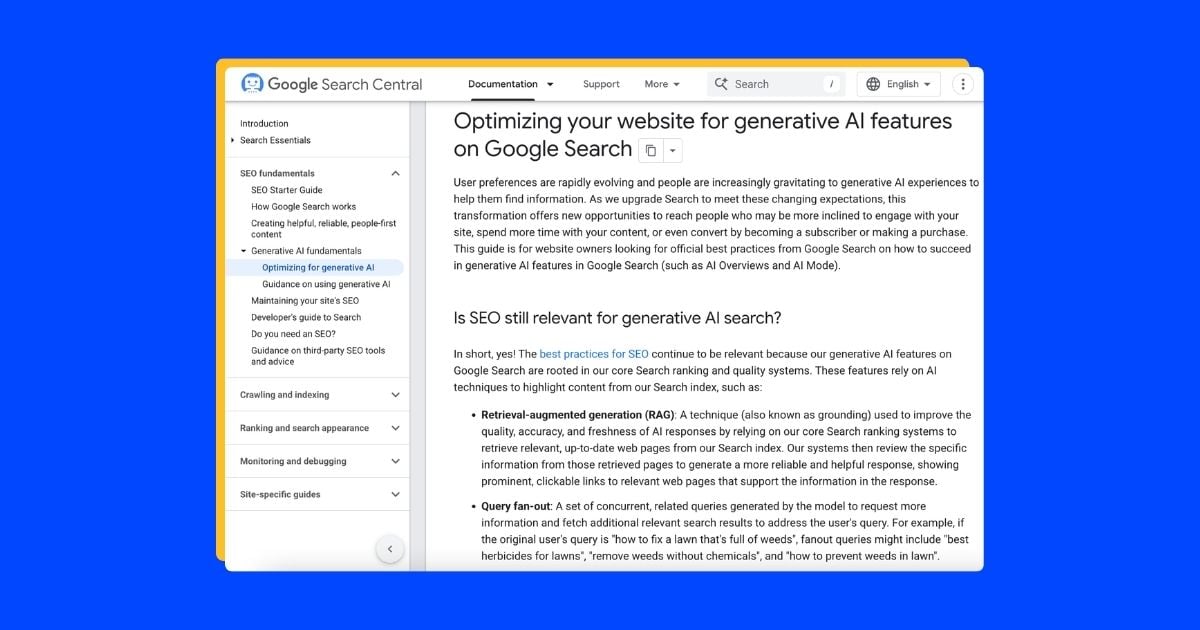
About the Author


Ekamoira research studied 72,000+ AI-generated queries and found that a single prompt in ChatGPT or Gemini routinely triggers 8–10 parallel queries before an answer is returned. SEER Interactive’s research showed that Gemini generates 10.7 average fan-out queries per prompt.
This is called “query fan-out,” and it’s a critical component of AI responses (and, subsequently, getting more visibility, traffic, leads, and sales from AI search/GEO/AEO).
Surfer SEO’s query fan-out study found that you’re 161% more likely to get cited in Google’s AI Overviews if you also rank for fan-outs
While AI Overviews and AI search/AI response optimization (or GEO) are relatively new, I’ve already worked with a number of businesses of various sizes to get more visibility in AI search. A key component of getting that increased visibility is understanding how query fan-out works.
In this article, I’ll walk you through everything you need to know about query fan-out so you can improve your visibility in AIOs and AI search.
Contents
- What is query fan-out?
- Query fan-out examples
- How does query fan-out work?
- What does this mean for SEO and AI search optimization?
- Query fan-out optimization
- Query fan-out calculator
What is query fan-out?
Query fan-out is a process where AI tools like ChatGPT, Google, and Gemini take the question, prompt, or search term (query) that you entered and generate a series of sub-queries related to the initial query to help develop a comprehensive response.
🛠️ Get everything you need to know about showing up in AI search in our free guide: The AI Search Toolkit >>
Query fan-out examples
Let’s walk through a specific example: you want help from ChatGPT choosing the best CRM software for your specific needs. You type in “what’s the best CRM software for a small business?”
Rather than simply pulling up lists of CRM software, ChatGPT would look at queries it assumes will help provide a better response, such as:
- CRM pricing comparison
- CRM feature comparison
- CRM reviews
- CRM statistics
This helps give the tool a more complete picture of CRM tools so that it can provide a comprehensive, specific answer related to the initial query. It’s actually a bit like how you might research the topic yourself if you were trying to do a deep dive—digging into specific aspects of CRMs and the CRM market rather than just taking the first listicle you see as gospel.
We built the interactive query fan-out visualization below with some pre-loaded examples so you can see how the query fan-out process works:
How does query fan-out work? Query fan-out technique
Query fan-out works differently in different systems (ChatGPT, AI Overviews, AI Mode, Gemini, Claude, etc.), but there are multiple patents and research papers we can use to get to the root of how query fan-out works:
- “Search with stateful chat:” Google Patents — This patent states that the AI creates queries with intent diversity (comparing, exploring, buying), lexical variation (synonyms, paraphrasing), and entity-based reformulations (specific brands or features).
- “Systems and methods for prompt-based query generation for diverse his retrieval:” Google Patents — This patent shows how Google trains a “query expansion model” to offer “diverse intent interpretation” or different answers for different intents.
- “Query Expansion by Prompting Large Language Models” (Google Research Paper, May 2023): arXiv — Another prompting technique for expanding queries.
How Query Fan Out Works
Inside the AI search mechanism that decides which pages get cited, based on Google patents and research.
User Query
"best CRM software for small business"
A single search query enters the AI system along with user context signals (location, history, device).
LLM Prompted Expansion
The generative model decomposes the query using Chain-of-Thought reasoning, generating multiple sub-queries with diverse intents, varied vocabulary, and specific entities.
CRM pricing comparison 2026
Salesforce vs HubSpot vs Zoho
customer management tools
free CRM for startups
CRM implementation guide SMB
Sub-queries execute simultaneously across the index. Parallel retrieval, not sequential.
Retrieval, Deduplication, and Ranking
Results from all sub-queries are merged, deduplicated, and ranked by semantic relevance plus profile alignment. Pages covering more sub-queries score higher.
Synthesized AI Answer
"For small businesses in 2026, HubSpot and Zoho are top choices, offering affordable pricing ($0 to $50/month), essential features like contact management..."
Two users asking the same query may see different citations because inclusion is a function of both semantic relevance and profile alignment.
The Five Expansion Mechanisms
How Google's LLM transforms one query into many. Click any row to see an example.
Example
"best CRM" → "CRM pricing comparison" + "CRM vs spreadsheet" + "buy CRM for small business"
Example
"reduce churn" → "decrease attrition" + "improve retention" + "stop customers leaving"
Example
"best CRM" → "Salesforce pricing" + "HubSpot reviews" + "Zoho features"
Example
CoT prompt: "Think about what someone asking this really wants to know..." → expanded term list
Example
Document about CRM → LLM generates 10+ synthetic queries users might ask to find it
Key Implication for SEO
Traditional SEO optimizes for one query. Fan out optimization means your page must answer many.
Because the AI system decomposes every search into 10 to 30 sub-queries, pages that only target the head term will match a fraction of the retrieval surface. Comprehensive topical coverage, addressing multiple intents, using varied vocabulary, and including specific entities, dramatically increases the number of sub-queries your page matches, and therefore your probability of being cited in the AI answer.
Source References
Google Patent
US20240289407A1
Search with Stateful Chat
Google Patent / WIPO
WO2024064249A1
Prompt-Based Query Generation for Diverse Retrieval
Research Paper
arXiv:2305.03653
Query Expansion by Prompting Large Language Models
All three sources are publicly available Google patents and research papers documenting query expansion and fan out mechanisms in AI search systems.
The query fan-out process is generally similar across platforms, but the volume and types of sub-queries run by each platform do vary.
👀 Looking for more ways to drive people to your site? Free guide >> 25 Ways to Increase Traffic to Your Website
What does this mean for SEO and AI search optimization?
What difference does it make to business and website owners that AI tools are using query fan-out to build responses for their users?
The existence of query fan-out means that you have to consider two things as you build your content:
- You want to anticipate and service “fan-out queries.”
- You want to format your content in a way that makes it more likely to be cited and potentially linked to in AI Overviews and AI responses.
Surfer SEO’s study found that the more often you cover and rank for a sub-query (or fan-out query), the more likely you are to be cited in AI Overviews. Here’s a visual representation of that across a series of simulated pages, where you can see the inflection points of how frequently your content is ranking for sub-queries versus how often it’s getting shown in AI Overviews:
Fan Out Coverage vs. AI Citation Probability
0 sub-queries
0% citation probability
15+ sub-queries: citation probability accelerates
Source: Modeled from SurferSEO study of 173,902 URLs. Simulated dataset of ~186 data points.
Another important note: visibility in fan-out queries can help you to “jump over” resources that are ranking in traditional search to show up more prominently in AI search for queries you could never rank for in traditional search.
Surfer SEO’s study further found that while there is a high correlation between ranking well for fan-out queries and being cited in an AI response, a majority of sites being cited for a query in AIOs didn’t actually rank in traditional search results for that query:
Where AI-Cited Pages Actually Rank
68% of AI-cited pages are NOT in the top 10
The largest single bucket (Position 11–20) accounts for 22% of all AI-cited pages.
Hover any bar for details
Source: SurferSEO analysis of 173,902 URLs.
And while there is some correlation between ranking higher in search results and being more likely to be cited for an AI response (if you’re not in the top 100, it’s very unlikely you’d be cited, and the top 10 rankings for a given query were responsible for a significant percentage–32%–of citations) there was an even stronger correlation in the data between ranking for sub-queries or fan-out queries:
The Fan Out Visibility Multiplier
AI citation probability: fan out optimized vs. traditional SEO
At 15+ Sub-Queries
Fan out optimized content achieves 85% AI citation probability compared to just 8% with traditional SEO.
more likely
Key Insight: Traditional SEO approaches plateau quickly, hitting diminishing returns around 10–12% AI citation probability. Fan out optimization unlocks exponential visibility gains by systematically targeting supporting sub-queries.
Source: Modeled from SurferSEO study of 173,902 URLs.
Query fan-out optimization
So if you’re looking for AI visibility, there’s clearly value in optimizing for fan-out queries and ranking for them. How do you actually do it? So if we’re trying to get visibility for people looking for the “best CRM software” and we want to show up prominently in AI results, we need to be optimizing for not just the core term, but also the sub-queries.
First, how do we know what those are?
Use query fan-out tools
There are several tools that can help simulate query fan-out or even capture the actual fan-out of queries run by tools like ChatGPT in real time.
Dejan’s Query Fan-out Tool is very simple to use and gives you multiple ways to use it. Qforia from iPullRank is also free with an API key.
Previously, ChatGPT had actually exposed fan-out queries in a way that Chrome extensions were able to capture, but that stopped working with one update to ChatGPT.
David McSweeney shares a good framework for predicting likely query fan-outs in his tweet about fan-out queries from ChatGPT no longer being shared publicly:
The query fan-outs are probabilistic anyway folks.
If you know how to do SEO in any way, you already know what they are/were/will be for a given head term. It’s a little thing called topic/keyword research.
Stop tracking and obsessing over noise.
Want to pretty much replicate… https://t.co/zHlV8pGO5f
— David McSweeney (@top5seo) March 6, 2026
The Resoneo Chrome Extension is actually able to get query fan-out data if you switch the ChatGPT model to 5.4 rather than 5.3 instant.
Here’s a more in-depth breakdown of additional query fan-out tools:
Create fan-out friendly content
Once you have a list of fan-out queries to target, how do you put your page and your site in a position to rank well for those queries?
The good news is, many of the things you should be focusing on to perform better in organic rankings will help you rank well in fan-out queries, including:
- The link popularity and authority of your site.
- Your topical authority for the subject in question.
- Providing “information gain” in your content—unique expertise and perspective, proprietary data and research, etc.
- Having accessible, fast-loading pages that are resource-efficient for AI tools to consume.
Tactically, you also want to answer the fan-out queries directly and with specific formatting:
- Create self-contained content “chunks” of 100-300 words addressing specific sub-queries.
- Write content that stands alone when extracted. AI pulls passages, not full pages.
- Use clear, direct language at the start of sections.
- Provide definitive answers to questions, not hedging or vague statements.
- Add structured data for entity/relationship understanding.
Mike King, who built the Qforia tool, wrote: “Citation-worthy content must present facts clearly, avoid speculation, and include attributes like sources or structured claims (semantic triples).”
He also goes on to outline the importance of vector embeddings in AI search, specifically how, if you want to rank for a sub-query and be cited in AI, you have to be sure your “content chunk” is seen by AI tools as more relevant than other documents (or what’s already been cited).
If you want to get a sense of whether you’re on the right track with a specific passage, we built the tool below to help you determine if your passage is likely to “beat” a competitor passage or (better yet) the passage you see being cited in AI Overviews or in ChatGPT or other AI tools:
Query fan-out calculator
Use this query fan-out calculator we built to estimate your chances of appearing in AI results for a page’s covered topic. Plus get tips to improve your coverage.
Make optimizing for query fan-out part of your search strategy
As with many things related to AI search/GEO/AEO, the reality when it comes to query fan-out optimization is:
- Many SEO best practices represent the underpinnings of your opportunity to rank well in sub-queries (and subsequently in AI results).
- In addition to many general best practices, some specific best practices (content formatting, tone, content) are particularly important for ranking for fan-out queries.
- Some specific elements (relevance of specific passages) are much more important for AI search than for traditional SEO.
You can also check out our query fan-out resource library below if you want to dive deeper into specific tools, long-form articles, webinars, etc., on the topic of query fan-out.
The Query Fan Out Library
The definitive collection of patents, research, expert analysis, data studies, tools, and commentary on AI search query decomposition
Google Patents
The technical blueprints behind query fan out live in Google's patent filings. These documents describe the systems that decompose queries, route sub-queries to retrieval, and synthesize AI-generated answers.
US20240289407A1 — Search System with Stateful Chat-Based Interaction
The closest public documentation of the fan out mechanism powering AI Overviews. Describes Google's architecture for decomposing a single user query into multiple sub-queries, routing them to different retrieval systems, and merging results into a unified AI-generated response.
WO2024064249A1 — Prompt-Based Query Generation for Search
Details how an LLM generates reformulated search queries from an original prompt — covering intent diversification, lexical variation, and entity reformulation. Foundational to understanding how AI search systems expand a single question into dozens of retrieval sub-queries.
WO2024030443 — Generating Search Results Using LLMs
Covers how large language models generate search results by synthesizing information from multiple retrieved passages, including how source attribution and citation ranking work in AI-generated answers.
US20240346256A1 — Response Generation Using a Retrieval-Augmented AI Model
Describes the retrieval-augmented generation pipeline where queries retrieve augmentation information that gets injected into LLM prompts for grounded response generation — the mechanism that determines which passages become citations in AI answers.
US11769017B1 — Generative Summaries for Search Results
Google's approach to generating summaries for search results using generative models. Establishes how the system selects, ranks, and synthesizes passages from multiple sources into a coherent summary — the output side of the fan out pipeline.
US11874863B2 — Query Expansion in Information Retrieval Systems
Details query expansion techniques using machine-learned language models to enhance query relevance beyond traditional pseudo-relevance feedback. The technical precursor to LLM-powered query decomposition in modern AI search.
Academic Research
The theoretical foundations behind query decomposition and retrieval-augmented generation, from the research teams building these systems.
Query Expansion by Prompting Large Language Models
The seminal paper demonstrating that LLM-generated query expansions significantly outperform traditional pseudo-relevance feedback methods. Provides the theoretical grounding for why AI systems decompose queries into sub-queries rather than relying on single-query retrieval.
FanOutQA: A Multi-Hop, Multi-Document Question Answering Benchmark
A benchmark of 1,034 fan-out questions requiring complex multi-hop reasoning across multiple documents, with 7,305 human-written decompositions. The most direct academic framing of the "fan out" retrieval pattern as a distinct information retrieval challenge.
Chain-of-Retrieval Augmented Generation (CoRAG)
Introduces CoRAG for multi-hop question answering with explicit retrieval chains that dynamically reformulate queries at each step. Shows 10+ point improvements over single-query baselines — demonstrating why iterative decomposition beats one-shot retrieval.
DeepRAG: Thinking to Retrieval Step by Step for Large Language Models
Models retrieval-augmented reasoning as a Markov Decision Process, bridging query expansion and decomposition. Achieves 21.99% accuracy improvements by having the system decide when and how to decompose queries during the retrieval process.
Retrieval-Augmented Generation for Large Language Models: A Survey
The comprehensive RAG survey covering Naive RAG, Advanced RAG, and Modular RAG paradigms. Essential context for understanding where query fan out fits within the broader architecture of AI search systems.
A Survey of Query Optimization in Large Language Models
Comprehensive survey of query optimization techniques in LLM systems, covering decomposition strategies, expansion methods, and rewriting approaches. Maps the full landscape of how AI systems transform user queries before retrieval.
Data Studies & Empirical Research
Large-scale studies measuring how AI Overviews actually cite sources, where citations come from, and the real traffic impact of AI search.
SurferSEO: AI Overviews Study of 173,902 URLs
The largest empirical study of AI citation patterns. Key finding: 68% of AI-cited pages don't rank in the traditional top 10 — proving that fan out optimization creates citation opportunities independent of classic ranking position.
Semrush: AI Overviews Study of 10M+ Keywords
Analysis of 10M+ keywords showing AI Overviews peaked at 24.61% prevalence. Tracks zero-click rate changes and citation source distribution over time — essential data for understanding the scale of fan out's impact on organic search.
Ahrefs: AI Overviews Reduce Clicks by 58%
Tracks the escalating click impact of AI Overviews over time. Key finding: citation sourcing from top 10 results has been declining — more citations are pulled from pages that wouldn't traditionally rank, underscoring the fan out opportunity.
seoClarity: Impact of Google's AI Overviews
Ongoing longitudinal tracking of AI Overviews across seoClarity's keyword database. Documents the rapid expansion of mobile AIOs and the shrinking overlap between traditional top-10 rankings and AI citation sources.
Expert Analysis & Strategy
The practitioners and researchers leading the conversation on what fan out means for SEO strategy.
Query Fan Out: The New SEO Battleground
The definitive practitioner guide to query fan out. King breaks down Google's patent filings, introduces his "Relevance Engineering" framework for optimizing passage-level content, and explains how semantic triples and cosine similarity scoring determine which pages get cited in AI responses.
Everything We Know So Far About AI Overviews
Continuously updated analysis of AI Overviews drawing on a dataset of 546,000+ AIOs. Documents citation patterns, appearance rates by query type, and the distribution of cited URLs across ranking positions — the empirical backbone for fan out strategy.
Query Fan Out Technique in AI Mode: New Details From Google
Google VP Robby Stein's official explanation of query fan out mechanics: one user query expands to multiple related searches, with Deep Search issuing dozens to hundreds of background queries. The closest thing to a first-party confirmation of how fan out works.
Optimizing for AI: How Search Engines Power ChatGPT, Gemini, and More
Explains the multi-step query decomposition and fan out process across different AI search providers — Google, ChatGPT, Perplexity — with practical optimization guidance for each platform's retrieval approach.
A Reflection on SEO, GEO & AI Search in 2025
Amsive's VP of SEO Strategy on why SEO isn't dead in the age of AI search, and how many AI visibility tactics — including fan out optimization — are evolved versions of existing SEO and digital PR processes rather than entirely new disciplines.
SearchPilot Podcast: Fan Out & AI Search
Will Critchlow discusses the implications of query decomposition for enterprise SEO, including A/B testing approaches for measuring AI citation impact and how fan out changes the ROI calculation for content investment.
Videos & Webinars
Watch experts break down fan out strategy in depth.
Query Fan Out — What It Is, How It Works, and What You Should Do About It
King's comprehensive video breakdown of query fan out: what it is, how Google's AI systems decompose queries into sub-queries, and actionable steps for optimizing your content to get cited in AI-generated responses.
How to Optimize for AI Mode Using Query Fan Outs and User Context
Practical walkthrough of optimizing for Google's AI Mode, covering how fan out sub-queries incorporate user context, and how to structure content so it matches the reformulated queries AI systems actually send to retrieval.
Expert Commentary
Key social posts and threads from SEO practitioners breaking down fan out in real time.
Mike King on Qforia & Fan Out Analysis
King announces Qforia, his tool for reverse-engineering query fan out sub-queries, and demonstrates how to identify which sub-queries your content is (and isn't) being surfaced for.
DEJAN on Query Reformulations
Dan Petrovic breaks down how Google reformulates queries before sending them to retrieval systems — showing the gap between what users type and what the AI actually searches for.
Aleyda Solis on Locomotive & AI Search Visibility
Aleyda previews Locomotive, her AI search optimization tool that maps fan out sub-query coverage and identifies content gaps across AI citation sources.
Tools for Fan Out Optimization
Emerging tools purpose-built for analyzing and optimizing content for AI query decomposition.
Qforia
Mike King's tool for reverse-engineering the sub-queries AI systems generate from a seed query. Maps which sub-queries your content currently covers and where gaps exist — the most direct way to audit fan out coverage.
Locomotive
AI search visibility platform that tracks how your pages appear across AI-generated results, maps sub-query coverage, and identifies optimization opportunities for fan out.
SurferSEO
Content optimization platform whose research team produced the 173,902-URL study on AI citations. Their content editor can help structure pages to cover fan out sub-topics with appropriate depth and semantic relevance.
Stay Ahead of AI Search
Query fan out is changing how content gets discovered. Bookmark this resource library — we'll update it as new research, tools, and patents emerge.
About the WordStream Blog
We've been a trusted source of data, news, and strategy for over 15 years. All of our content is written and reviewed by real people: a dedicated team of professionals with decades of combined experience in marketing and advertising for businesses of all sizes.


Add us as a preferred source on Google
Are you wasting money in Google Ads?


Meet The Author
Tom Demers
Tom Demers is the co-founder and managing partner of Measured SEM. He has over a decade of experience helping businesses generate meaningful growth through SEO, PPC, content marketing, and online publishing. Formerly the Director of Marketing at WordStream, Tom has also worked as an in-house SEO specialist, SEO manager, agency consultant, and independent search marketing advisor. Through Measured SEM and his own publishing properties, he has driven millions of dollars in incremental pipeline and sales, generated millions of unique visitors, and built, monetized, and sold high-traffic sites. His insights have been featured in outlets including Search Engine Land, Search Engine Journal, USA Today, and Fox Business.