About the Author


Ever since ChatGPT burst onto the scene, we at WordStream by LocaliQ have been reading, hearing, and writing about how to get seen in AI search. We’ve also been trying to optimize our own content to get found there. (Marketers, they’re just like us!) And while we’ve seen progress and wins on this front, the end result has been a little depressing: increased AI mentions with minimal traffic impact, fewer clicks from organic rankings, tears, frustration.
Seemingly everyone in the marketing world has pivoted to saying stuff like this: “Citations are the new rankings.” “Brand exposure is the new traffic.” In other words, most marketers have capitulated to a world where AI tools scrape content from sites that have built up authority and expertise for years–and then don’t send traffic back to those sites where it came from. They tell us to accept this new reality and optimize for it to survive.
Our director of content and SEO, Elisa Gabbert, sees things differently. She has argued that optimizing solely for AI search is misguided—and not just because the click-through rates are so low. She also noticed that the AI Overviews she saw for similar queries cited different sites every time. If there’s no consistency in what Google chooses to pull into the AIO, how can you even figure out what they’re looking for? What assurance would you have that a citation wouldn’t disappear the next day?
The experiment
To test Elisa’s hypothesis, every Thursday afternoon for six weeks, I conducted the same 14 searches (using common marketing terms) and manually (the horror!) recorded the top 10 sources Google cited in the resulting AI Overview.
And while, for one, this experiment did solidify our team’s hypothesis that optimizing for AI search is unreliable, it also uncovered some interesting information about what Google is valuing in its AI results (for now).
And because I spent a collective 10 hours conducting this experiment and analyzing the data, I’m going to share it with you here along with some takeaways I find particularly interesting.
Contents
- AI Overview results are not stable over time
- Results follow a bit of a formula
- Reddit is a big winner
- Social sites and videos present an opportunity for creators and smaller brands
- Content from educational institutions is a sleeper hit
- Google’s read on search intent is iffy
- Thought leadership is nowhere to be found
6 surprising results from our AI results stability study
How stable are AI results in AI Overviews, what types of sites does Google prioritize, and who were the big winners (and losers) when it comes to AI results? We’re answering those questions and more.
AI Overview results are not stable over time
The crux of our experiment was to see whether AI Overview results remained stable (or even stable-ish) over time. Because if you’re going to put in a bunch of time and effort to show up for these AI answers, you want to know that it’s going to be worth it.
And yeah, the AI Overviews looked different pretty much every single time. On average, source retention was only 50% (a coin flip). For some it was much lower, closer to 20%.
Overall, roughly three out of every four AI Overview sources changed from one week to the next.
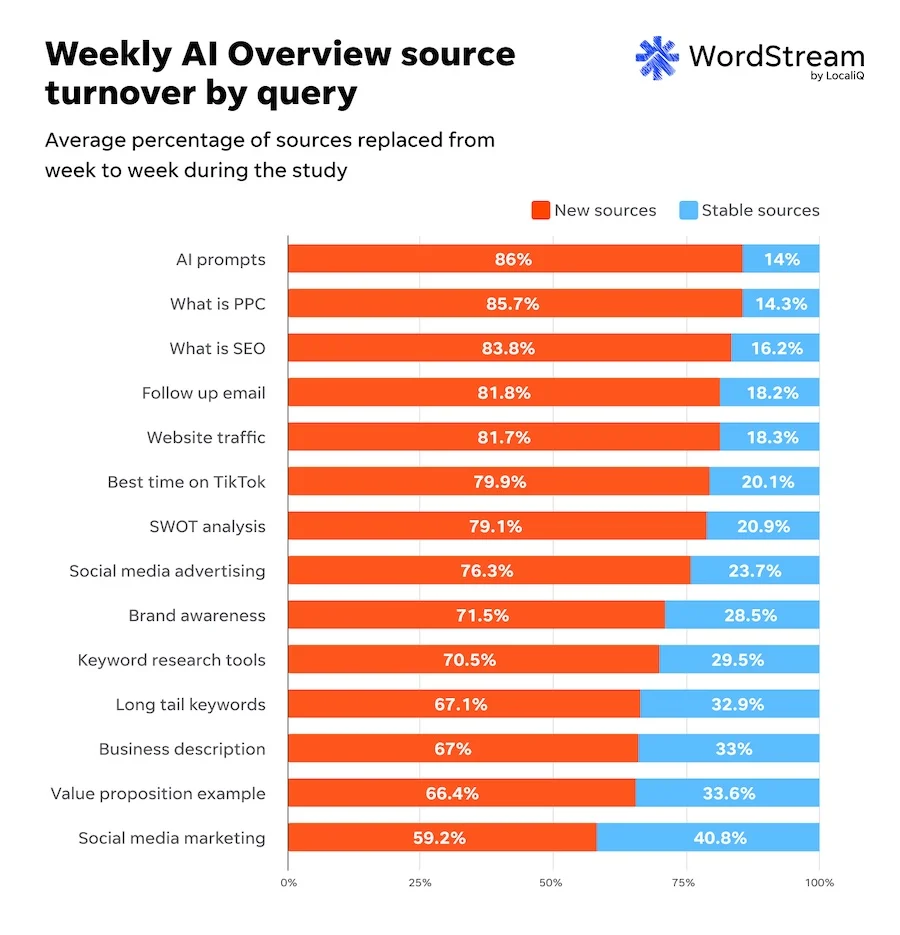
Not only were the sites the results cited different, but the actual layout of the AI Overview changed, too.
For instance, the search “keyword research tools” fluctuated between six and 15 cited sites. One week, my search for “ai prompts” had no AIO at all. So one week, you’re killing it in the top 10 results cited in AIOs, and then the next week you completely fall off the map.
And yes, you might be thinking “Well, traditional search results also change.” And while that’s true, they didn’t use to change this much unless there was a major algorithm update. AI search results are proving to be much more volatile. (Plus, even a short-lived ranking in the old Google search actually drove some clicks.)
You might also be thinking, “Well, yes, but these are your results. Mine look or would look different.” And you would be correct. But that’s also proving my point. No one’s getting the same results—hence, the moving target.
And our results are only from AI Overviews. BuzzStream ran their own experiment to see what the overlap looked like for results across different AI search platforms and found 76% appear on only one, and less than 1% appear across multiple. So even if you’re getting visibility in AIOs, you’re probably not getting visibility in other platforms like ChatGPT and Gemini.
What this means for you
AI visibility is important (for brand awareness, at least) but you shouldn’t put all your eggs in the AI search results basket. The results will continue changing, and even if you show up there, chances are, you’re not going to get very many clicks.
🔎 Need help understanding the modern rules for SEO? Download our free guide >> How to Do SEO Right—Right Now!
AIO results tend to follow a formula
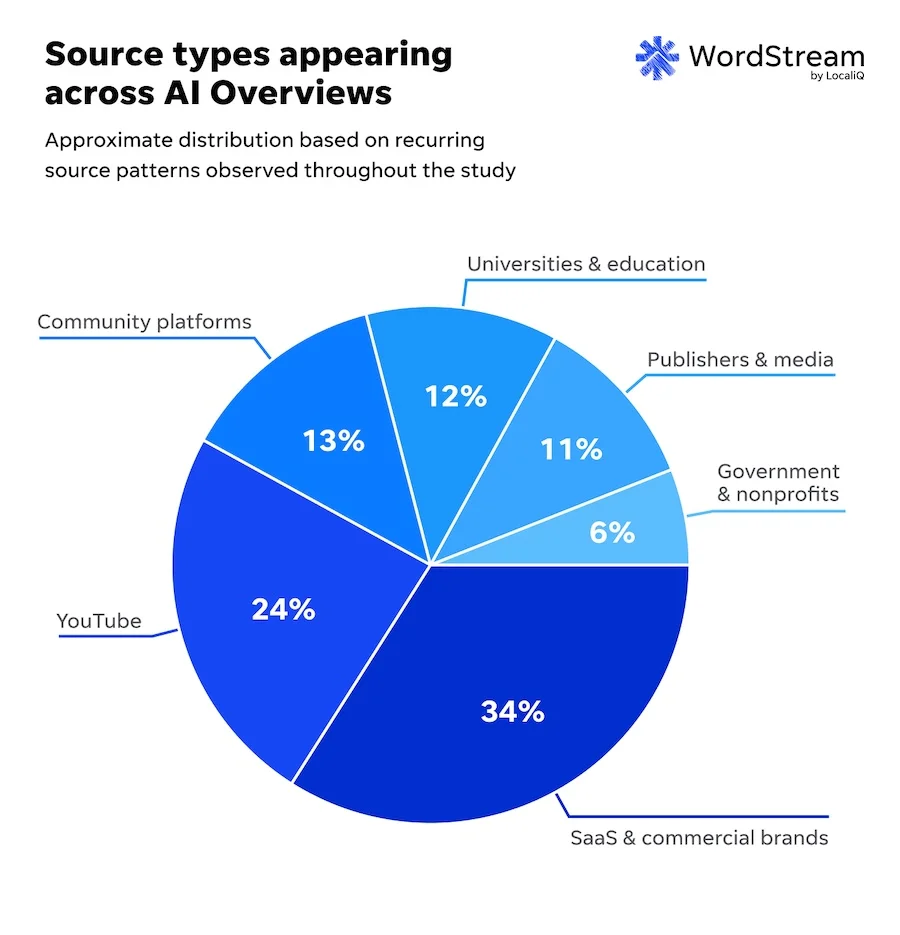
One thing that stood out to me while conducting this experiment was an interesting formula Google seemed to follow for AI Overviews. Results for each search reliably included:
- A few industry-specific sites
- A community platform result
- A YouTube video (or two)
- One to two education, government, or nonprofit sites
- Often a social media post or two (typically TikTok or Facebook)
So you are seeing some variation in the types of content that Google is pulling into results, but they almost always fall into one of these categories. And if your site doesn’t fall into any of these categories, you might be out of luck, regardless of how useful or optimized your content is.
Our friend and SEO expert Tom Demers pointed out a comparable pattern he found when conducting an SEO audit of the first page of organic search results. So it seems Google is using a similar system across the board.
What this means for you
If you’re only relying on articles to rank in AI Overviews (or in organic results on Google), you have a competitive road ahead of you. Google is giving those slots to pretty high domain authority websites—in my searches, that included Forbes (DR 94), Mailchimp (DR 93), and Semrush (DR 92), just to name a few.
You may have a better chance of showing up if you’re consistently publishing content on social media sites like TikTok and Facebook or as videos on YouTube (including YouTube Shorts).
Either way, publishing on social sites is important—according to our Small Business Website Trends Report, 64% of small businesses say social media is a main source of traffic (compared to 52% for SEO).
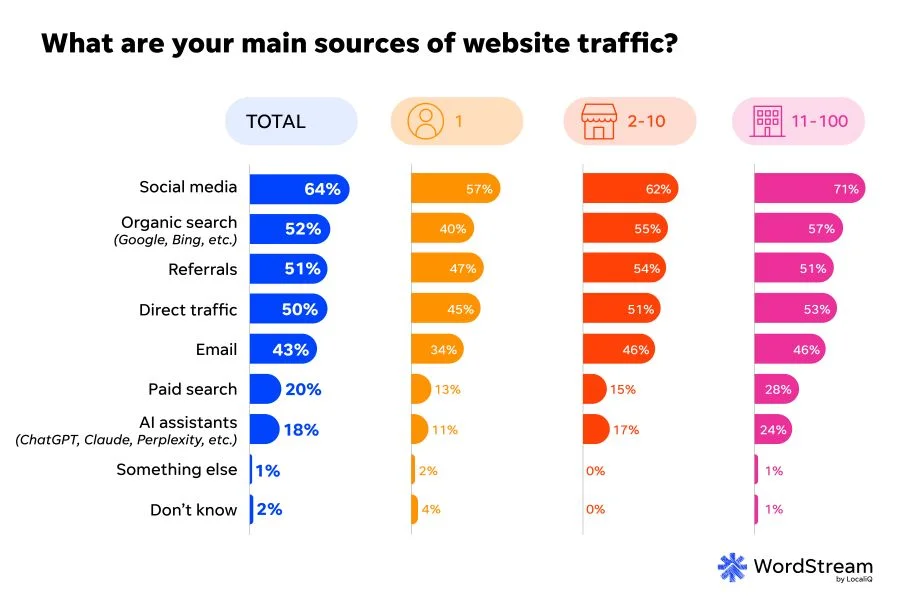
⬇️ Download our Small Business Website Trends Report to find out how businesses are planning and thinking about SEO and their web presence.
Reddit is a big winner
We’ve seen Reddit’s star on the rise over the last five years, so it’s no surprise Google is sourcing results here. They’ve been significantly prioritizing community results—even more so over the last two years.
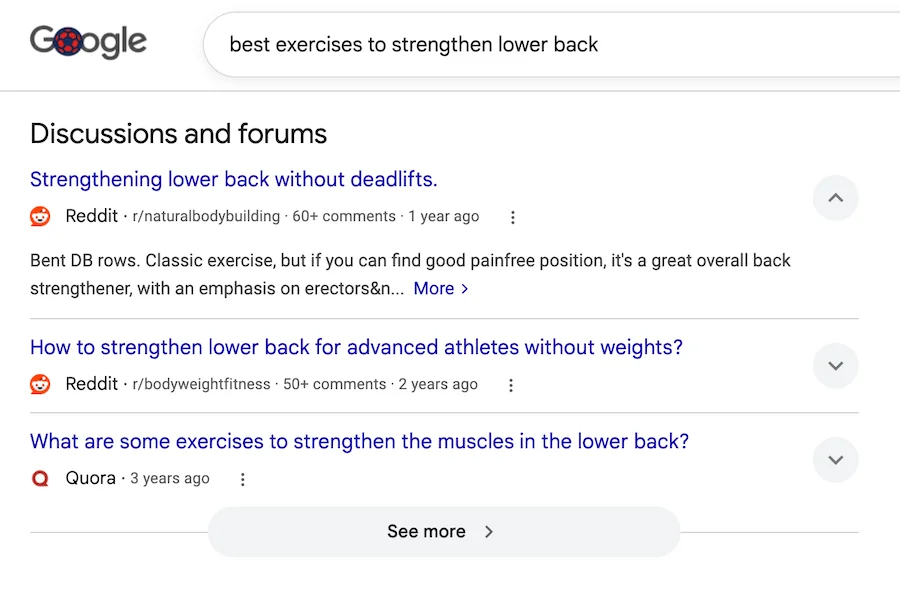
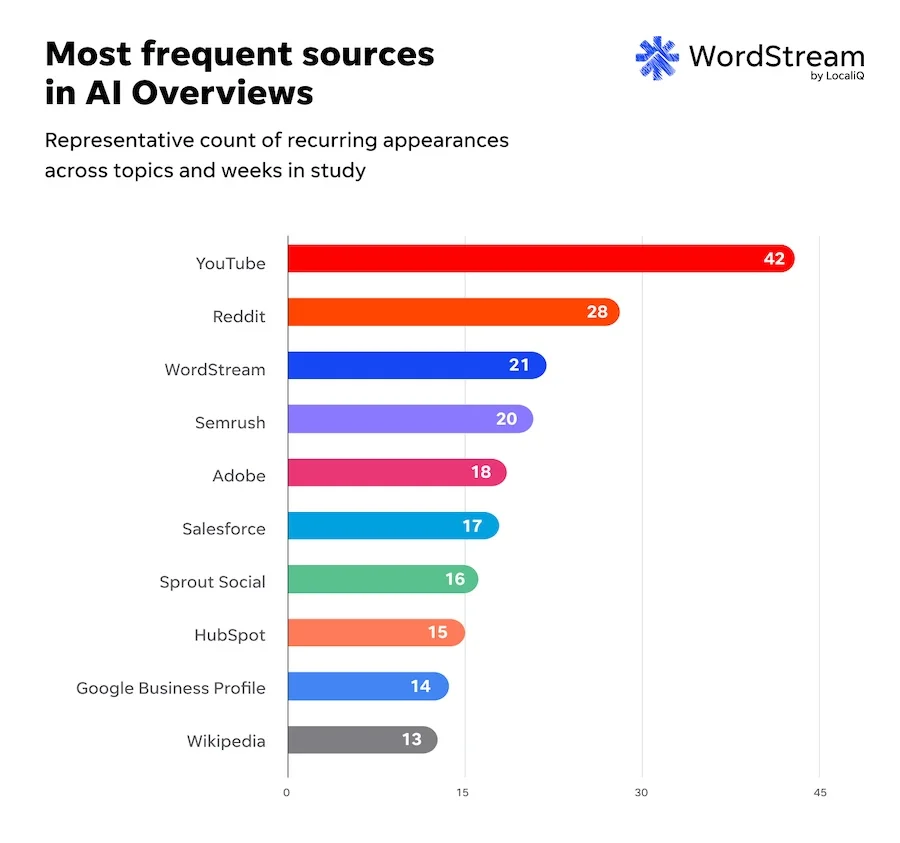
Many of the searches we conducted included Reddit results, especially for tips and definition-based queries, showing Google’s reliance on experience-driven content to inform its AI results.
What this means for you
Establishing a presence for your business on Reddit can help you see increased referral traffic directly from the source, which is going to be more valuable than an impression in an AIO.
Reddit makes it difficult to proactively market your business on the platform, so you have to get creative here.
Find the right subreddits to engage in, build up brand awareness to increase the chances Redditors might mention you, and potentially invest in paid ads.
Get our guide to Reddit marketing for more tips.
Social sites and videos present an opportunity for creators and smaller brands
As I mentioned, YouTube and social sites like TikTok and Facebook had consistent visibility in AI Overviews results.
It was interesting to see so many TikTok results, especially over Instagram considering Instagram content is now indexed on Google. This opens a potential path for businesses already building a community on TikTok to see some crossover visibility in AI results.
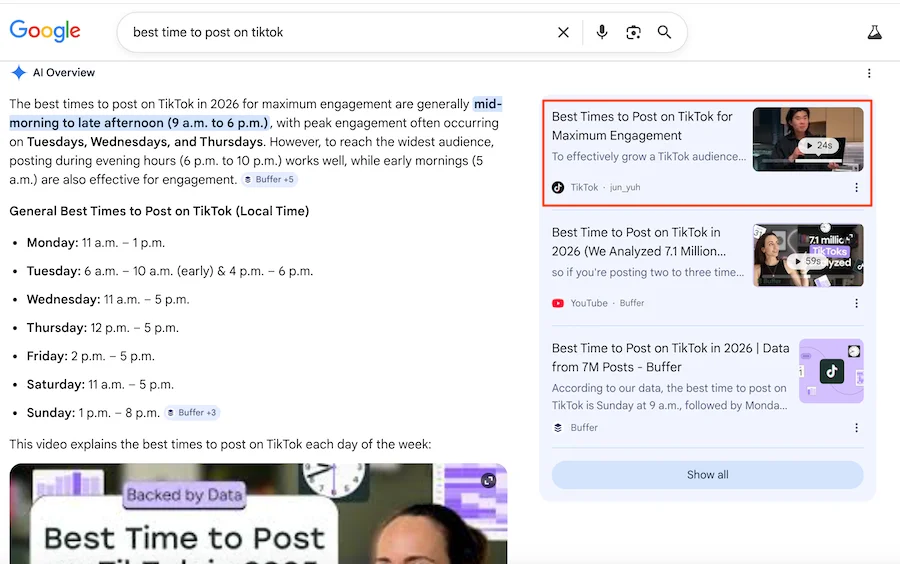
The YouTube and social site results also varied between larger, industry-specific brands and individual creators and smaller brands.
What this means for you
Google sourcing social content presents an opportunity for your business. You can edge out larger, higher-domain authority sites if you’re creating video and social content that aligns with searches your customers are conducting.
Plus, sharing regular social media content and short-form videos is just good for business overall. We already shared that social media is a top driver of traffic for SMBs, and one study found that short-form videos have the highest return on investment among content types.
Content from educational institutions is a sleeper hit
I’ll be honest, I was pretty surprised to see so many .edu sites showing up in AI Overview results—but it happened in almost every search. This seems to go against Google’s guidelines to build out your niche and stick to it.
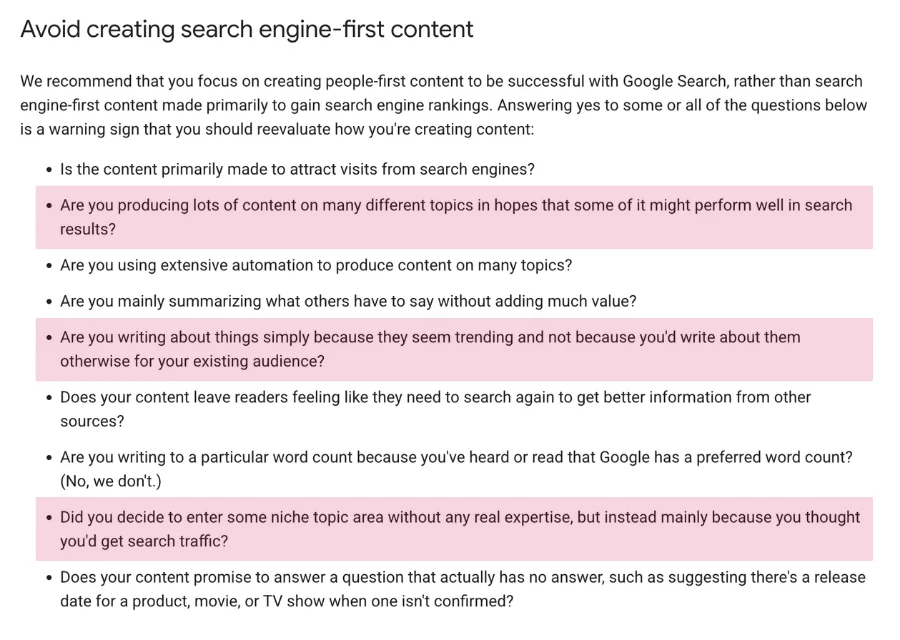
I wouldn’t say a college or university has more expertise in social media marketing over sites like Sprout Social and Hootsuite, but what do I know? I’m just a human woman with 15 years of social media marketing experience and not an AI bot.
Snark aside, this does further prove the hypothesis that AI systems prioritize content from trustworthy sources. Edu and Org sites are often seen as highly trustworthy, which lends itself well to AI results here.
What this means for you
Unless you’re an Edu or Org site, there’s not really much for you here. But if you do have one of these types of sites, this is good news for you! You have a pretty good chance of surfacing in AI results if you’re creating content around these AI searches.
Search intent interpretations are iffy
For many of the searches, the AI’s perception of query intent shifted from week to week. This was especially true for definition-based searches like “What is PPC” and “What is SEO.” Google seemed to have a difficult time 1) understanding what I was searching for, and 2) surfacing results with the correct intent.
For example, “What is PPC” yielded results about pay per click but also about production planning and control and the public procurement commission. And this was a search done on my browser where I search for marketing-related content five days a week.
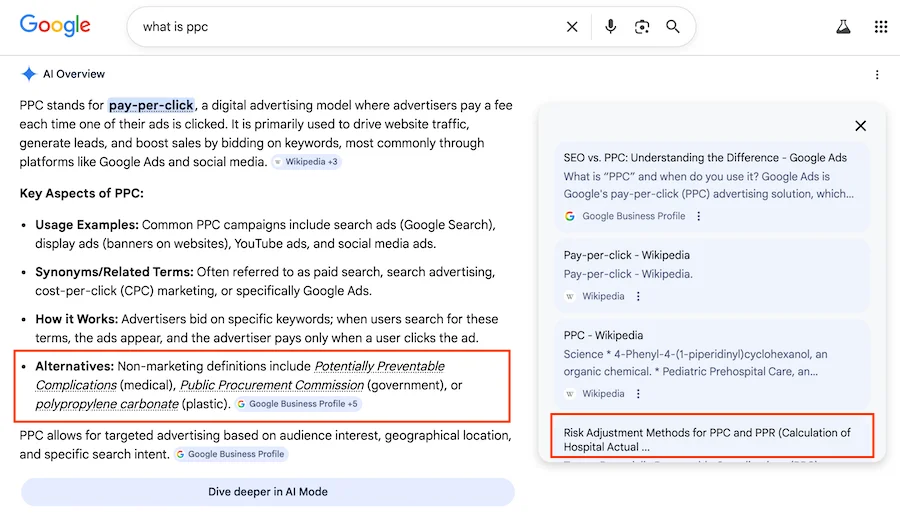
The results also included a mix of definition results from sites like Wikipedia and tips or strategies from industry sites. But, most of the results were in-depth guides around PPC.
What this means for you
The content that was consistently cited in AI Overviews was pretty in-depth, essentially providing a 101-level guide of the topic that included definitions, tips, strategies, tools, and examples. This shows the importance of comprehensive educational content for your areas of focus.
It also further proves the importance of optimizing for query fan-out. Query fan-out describes the process AI systems use to address questions and topics related to the initial query in the results. Optimizing for query fan-out can give you a better chance of appearing in AI results, especially when Google is a little confused about the intent.
Thought leadership is nowhere to be found
Google says it values original, well-written content—and this used to be the case. Thought leadership content from trusted brands previously ranked well in organic search, but we know that’s fallen off in recent years, and it was glaringly absent in AI Overviews.
In a way, this makes sense, as AI systems surface content they can easily verify or that at least conforms to consensus. And you can’t verify an opinion or a strong take on a subject.
In my (unverifiable) opinion (although I can find some other sources to back me up), this is going to lead to a bunch of lousy, repetitive slop filling search results. If the content being sourced is pretty beginner-friendly definition articles (i.e., What Is Keyword Research?), businesses aren’t going to put in the time and effort to create original thought leadership content that goes beyond the basic and can help readers think critically about what they’re doing—or why they’re doing it.
In other words, Google says you should create non-commodity content (and plenty of marketers are saying that too), but they’re not actually rewarding it.
What this means for you
Thought leadership content might not be what AI systems are looking for, but that doesn’t mean you shouldn’t do it. It’s a strong fit for your social sites where you can start a conversation with your audience. And thought leadership content is still getting surfaced in other important channels like newsletters. (A recent thought leadership report we released got more traffic from marketing newsletters than organic search!)
Thought leadership isn’t dead—it just might not have a place in organic search like it once used to.
🚀 Free guide >> 10 Tangible & Free Ways to Get on the First Page of Google
What the lack of AI stability means for your strategy
What’s the bottom line here? Yes, AI results are unstable. Yes, it’s difficult to optimize for (and track) these results. No, you shouldn’t ignore optimizing for AI results as a strategy (completely).
The best generative engine optimization strategy is one that will also drive meaningful performance in channels that still contribute to your real business goals. In other words, don’t chase AI citations as an end goal in themselves.
The SEO and content strategies that make sense in an AIO world include:
- Focus on creating in-depth, helpful content for your audience addressing their most pressing questions and concerns.
- Make sure your content is structured so it’s easy to digest and organize by both humans and AI.
- Create a variety of content types including articles for your website or blog and video content for YouTube and social sites.
- Build brand awareness and increase brand authority to get more mentions across the web and in community sites.
That’s just the start. We cover more ways to optimize for GEO here. And you can always reach out if you’d like more help adapting your strategy for AI search.
About the experiment and the data
For this experiment, I solely looked at the websites listed in the sources section of Google AI Overviews. We chose these searches based on queries we found in our own Google Search Console dashboard as ways that people are finding WordStream by LocaliQ content. I conducted the same set of searches one time per week around the same time, starting on April 2, 2026, and ending on May 7, 2026, and recorded the first 10 results that appeared in the source section.
About the WordStream Blog
We've been a trusted source of data, news, and strategy for over 15 years. All of our content is written and reviewed by real people: a dedicated team of professionals with decades of combined experience in marketing and advertising for businesses of all sizes.


Add us as a preferred source on Google
Are you wasting money in Google Ads?

Meet The Author
Stephanie Heitman
Stephanie is the Associate Director of Content for LocaliQ and WordStream. She has over 10 years of experience in content, SEO, social media marketing, and writing about all things digital marketing. Stephanie’s work has been featured in publications like Social Media Today, PPC Land, and others. She loves an em dash and an Oxford comma, watching reality TV with her husband, and cuddling with her two pups.