About the Author


For years, SEO for small businesses meant guessing which words people typed into Google. Now it’s about understanding how they talk to AI.
Customers no longer type short phrases; they ask real questions. Instead of “plumber near me,” people ask: “Who can fix a leaking water heater this week without charging an emergency fee?” Instead of “email marketing tips,” they type: “How can I get more people to open my weekend specials without spamming them?”
These prompts are conversational, specific, and tied to real problems. AI models like ChatGPT, Perplexity, and Gemini interpret them as context-rich messages that reveal who the user is and what they want.
The result is a new discovery model where answers appear instantly, often without a single click. A Bain and Dynata study found that 80% of consumers now rely on zero-click results for at least 40% of their searches, cutting organic traffic by up to 25% across industries.
Based on that data alone, it’s safe to say that static keyword research is becoming a thing of the past.
To stay visible, marketers need to study prompts (the real language customers use when they talk to AI) and create content that joins those conversations instead of waiting for clicks that may never come.
This article will show you how to rethink keyword research for the AI era and optimize your content for prompt-based search.
Contents
- Why traditional keyword research is breaking down
- What prompt-based keyword research looks like
- How to do prompt-based keyword research
- How to turn prompts into content wins
- Tools and tactics to help you find prompt-based keywords
- How to measure success in prompt-driven content
Why traditional keyword research is breaking down
Traditional keyword research is still valuable for many marketing activities but struggles to keep up with AI-driven search for a few key reasons:
- Stale data: Keyword tools still rely on historical Google queries that fail to capture live AI interactions.
- Flat intent: Traditional tools measure volume but not motivation, tone, or situational context.
- Fragmented meaning: Old SEO models treat words in isolation. AI interprets them through relationships, synonyms, and user goals.
- Single-answer logic: Legacy SEO assumes one query leads to one result. AI generates branching follow-up questions that reveal new layers of intent (AKA query fan-out).
“Keyword tools tell you what people searched. Prompts tell you what they meant,” says Nikiya Griffith, Director of Growth at BX Studio. “That difference decides who gets seen in AI search results.”
This interactive tool below can help you visualize how AI systems take an initial search and expand upon it in the AI-generated answer to better address search intent.
🛠️ Get everything you need to know about showing up in AI search in our free guide: The AI Search Toolkit >>
What prompt-based keyword research looks like
Unlike traditional keywords, prompts contain context. They reveal:
- Who is asking: “I own a small bakery in Austin.”
- What they want: “I need to get more local customers ordering online.”
- How they frame it: “Without paying for ads or hiring an agency to run our social media accounts.”
For example, instead of targeting a generic phrase like “local marketing ideas,” you might uncover prompts such as:
- “How can I get more people to find my bakery on Google Maps?”
- “What’s the best way to collect emails from customers in-store?”
- “Write a short post to promote our new seasonal menu on Instagram.”
These kinds of prompts expose your audience’s real problems, goals, and language. A plumber might ask, “What’s the best way to get reviews without bothering customers?” or a fitness-studio owner might ask, “How do I keep class bookings full during summer slow months?”
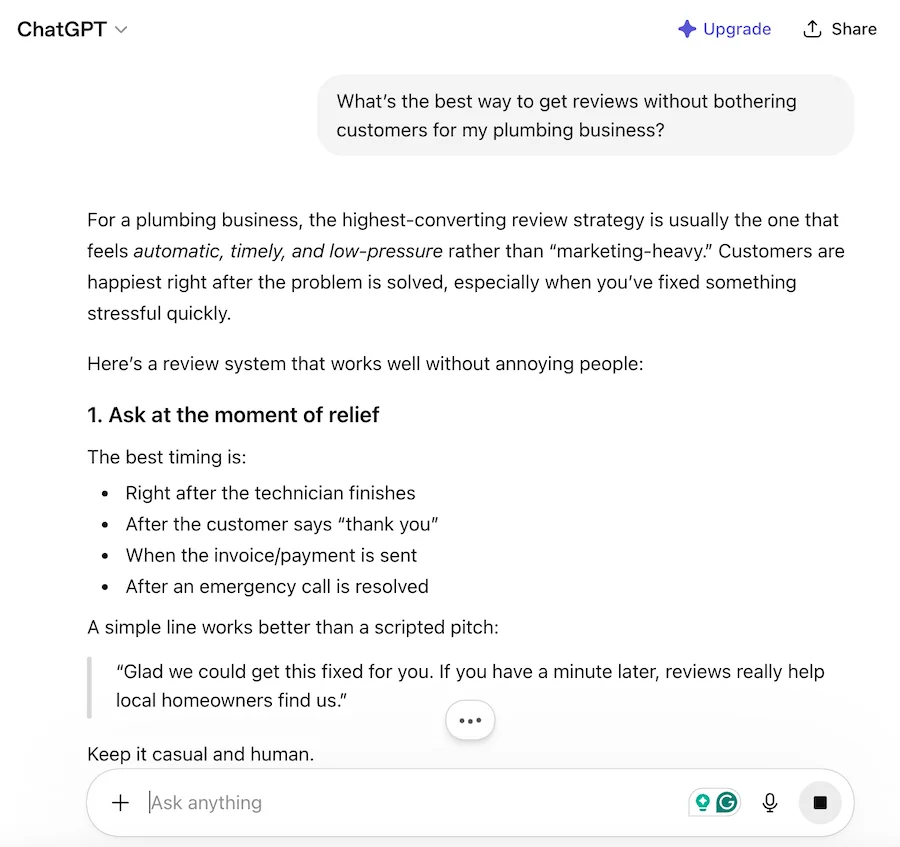
These prompts uncover your audience’s challenges, expectations, and preferred language. That insight gives you a content advantage that search volume never could.
🔎 Need help finding the right keywords? Try our Free Keyword Tool!
How to do prompt-based keyword research
There are five sure-fire ways to research prompts to optimize for so you can increase your chances of appearing in AI search results.
1. Observe real prompts in AI interfaces
Think of this as listening in on your customer’s thought process. Go beyond keyword tools and start collecting real language from AI chats.
Enter your seed topics into ChatGPT, Perplexity, or Gemini and pay attention to what happens next.
- How does the AI autocomplete your query?
- What related questions does it suggest?
- Which words or phrases appear most often in the responses?
Patterns such as “best way to,” “how can I,” or “should I” show how people naturally frame their problems.
For example, a local gym owner might type, “How can I get more members without running discounts?” That prompt reveals not just interest in marketing but also a concern about profit margins.
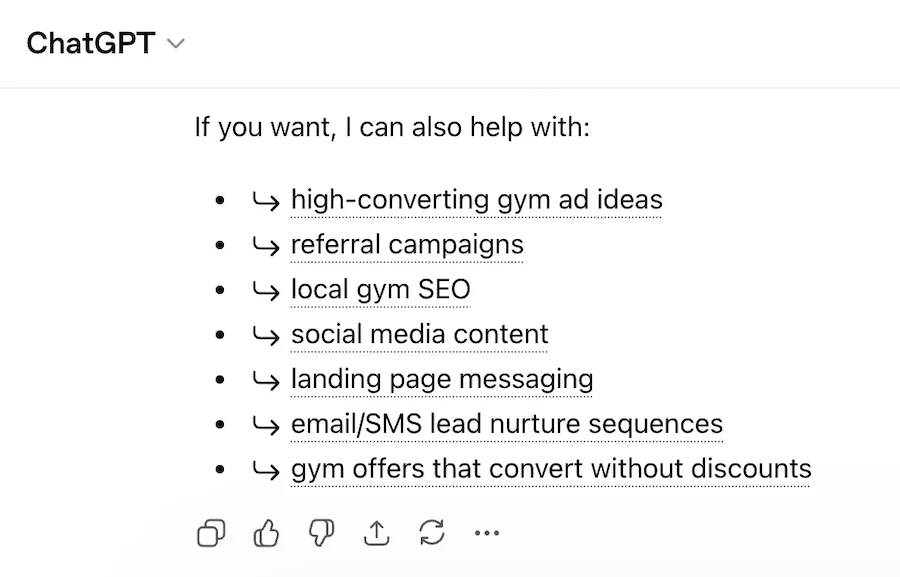
“Gym offers that convert without discounts” could be a helpful content topic to cover.
Capture at least 20 to 30 authentic prompts around your topic. This small dataset becomes the foundation for understanding your audience’s mindset, something no keyword tool can show.
🚨 Get ready-to-use AI prompts to help you begin your prompt-based research journey >> 200+ Best AI Prompts Any Business Can Use
2. Visualize conversation flows
Prompts rarely stop at one question. People ask, refine, and follow up, just as they would in a conversation with an expert. Mapping that flow helps you see the journey from curiosity to decision.
Use a simple mind-mapping tool or even paper to diagram how questions evolve.
Start with an initial query such as “How can I promote my bakery locally?”
Then branch out.
- Follow-up 1: “What’s the best way to advertise without paying for ads?”
- Follow-up 2: “Can Instagram help small bakeries get more orders?”
- Follow-up 3: “What should I post to attract morning customers?”
Label each question by intent: informational (learning), comparative (evaluating), or transactional (ready to act).
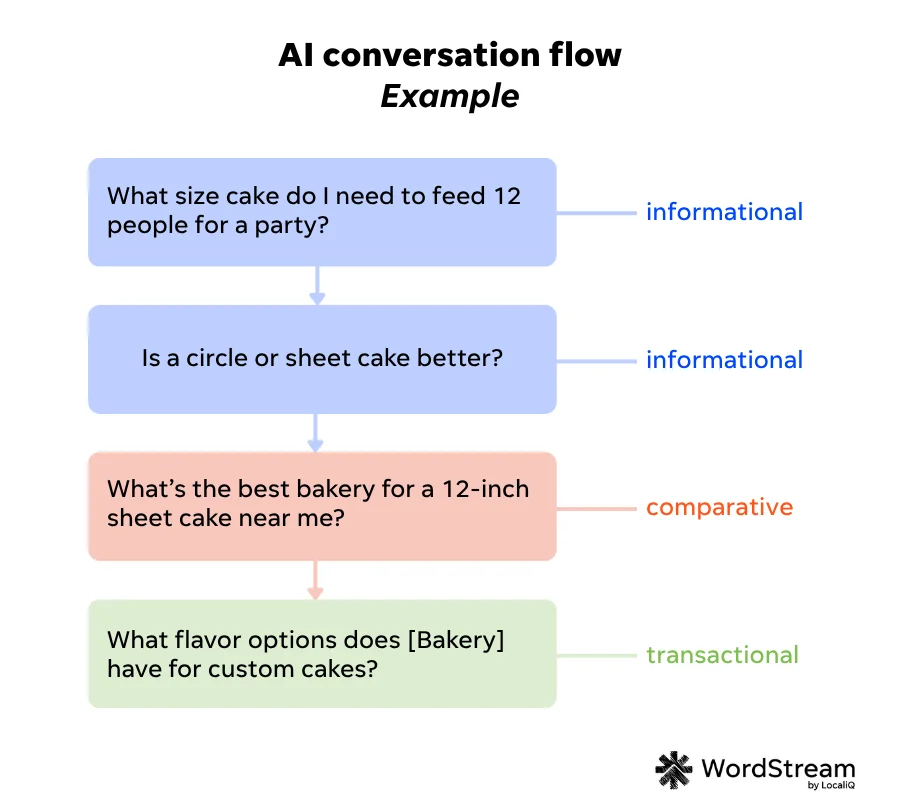
This exercise shows you where people shift from research to action. When your content mirrors this flow, from awareness to conversion, AI tools recognize it as a comprehensive answer path.
3. Extract entities and themes
Generative AI doesn’t think in keywords. It understands meaning through entities: people, brands, products, and ideas that appear together in context. When you understand which entities your audience connects with, you can structure your content the same way AI understands relationships.
Start by reviewing your list of prompts. Highlight every time a tool, platform, or concept repeats. Then group those mentions into clusters around shared goals or industries.
For example:
- A café owner might ask about Instagram Reels, Canva, and brand visibility.
- A fitness coach might mention Calendly, email reminders, and client retention.
- A local contractor might talk about Google Reviews, Nextdoor, and word-of-mouth referrals.
Each cluster tells you what that audience values, which tools they trust, and what outcomes they are chasing. From there, you can create content that directly connects those same entities.

A topic like “How Local Shops Can Use Canva Templates to Create Instagram Reels That Drive Foot Traffic” does more than target a keyword. It mirrors how users think and talk. That alignment makes your content more recognizable to AI systems that are trained to surface material reflecting those relationships.
When you consistently connect the right entities in your articles, your brand starts to “live” in those associations. Over time, AI begins to understand that you are part of that conversation, not just another website trying to rank.
4. Cross-validate with search data
Prompt analysis shows how people talk to AI, but you still need to confirm there is real search demand. That is where SEO validation comes in.
Plug your top prompts or variations into Google Search Console, Ahrefs, or Semrush and check:
- Which of these prompts or variations already generate impressions?
- What related queries appear in Google’s “People Also Ask” section?
- Are there modifiers that signal purchase intent, such as “best,” “affordable,” or “pricing comparison”?
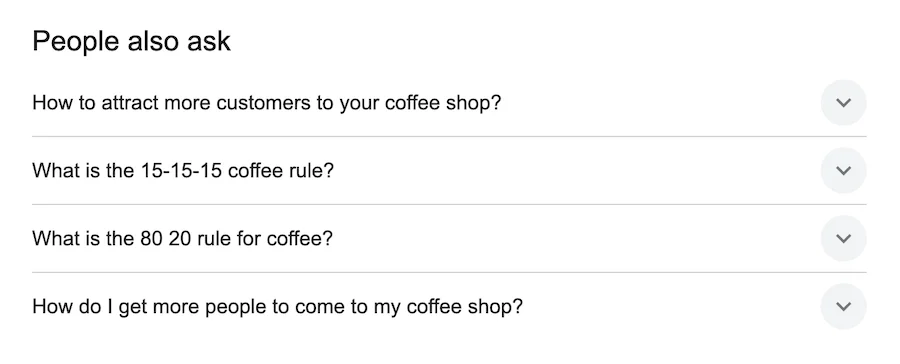
This process helps you filter out prompts that sound interesting but have little visibility potential. For instance, if you discover that “How do I get more walk-ins to my coffee shop on weekdays” has no measurable impressions, try simplifying it to “How to get more customers to a local café.” Keep the natural tone, but align with what people actually type.
This is where old and new SEO meet. Prompt analysis gives you the language of your audience; search validation keeps your strategy grounded in discoverability. When you combine the two, you create content that feels human, performs in search, and stands a chance of being surfaced inside AI-generated answers.
How to turn prompts into content wins
Once you have collected and analyzed your prompts, you can turn them into assets that attract both readers and AI engines.
1. Form “prompt clusters”
Group related prompts by shared goals or pain points.
Example goal: Attract more local customers
- “How can I get more walk-ins to my coffee shop during weekdays?”
- “What type of social media posts bring customers back?”
- “How do I ask for Google reviews without sounding pushy?”
Each prompt can become its own section or article that mirrors the path users take when asking AI for help. By organizing your content this way, you create what search systems recognize as an “answer hub” that covers every angle of a problem.
2. Write conversationally
The best AI-optimized content sounds like it was written for people, not algorithms. Start each section by setting context, for example, “If you manage a small business newsletter…” and then answer the core question clearly before expanding with examples, visuals, or short data points.
End with a “Next question” prompt, such as “What’s the best day to send your weekly newsletter?” to signal related intent.
This pattern improves clarity for readers and helps AI models understand the structure of your ideas.
3. Structure for AI extraction
Even the most useful content can be ignored if it is not formatted for easy parsing. AI engines and readers both prefer clarity and structure.
Use:
- Descriptive subheadings that match user intent.
- Bullet points and short paragraphs.
- HowTo or QAPage schema markup.
- Concise definitions and data points that can be quoted or cited.
This type of formatting gives your pages dual value, making them easy for readers to scan and easy for AI systems to extract.
Tools and tactics to help you find prompt-based keywords
If you need help finding prompt-based keywords, here’s a list of tools we recommend.
| Purpose | Recommended tools | What to track |
| Observe live prompt trends | Perplexity AI | Common phrasing and topic clusters |
| Test AI query reformulation | ChatGPT with browsing | Variations in question structure |
| Analyze long-form phrasing | AnswerThePublic, Keyword Insights | Natural language question frequency |
| Validate impressions | Google Search Console | Long-tail and conversational query visibility |
| Visualize relationships | Looker Studio, MindNode | Prompt clusters vs. legacy keyword groups |
Prompt insights guide where to dig; SEO tools validate where to invest.
How to measure success in prompt-driven content
Prompt-based optimization changes what success looks like. Focus on engagement and visibility rather than clicks alone.
- Impressions: Track growth in conversational queries in Search Console.
- AI presence: Test your prompts inside ChatGPT, Gemini, and Perplexity to see if your content appears or is referenced.
- Engagement: Monitor time on page, scroll depth, and repeat visitors. These reflect how effectively your content satisfies user intent.
- Attribution: Use GA4 to analyze assisted conversions from visitors who found your content indirectly through AI exposure.

These signals reveal whether your content is participating in the conversation, not just listed in search results.
The road ahead: Conversation as SEO foundation
Search and chat are merging into a single experience. Users expect instant, personalized responses, not pages of links. In 2026, most companies will rely on generative AI for marketing and research. The ones that succeed will see every prompt as a clue to customer intent.
Prompt-based research is no longer experimental. It is the new foundation of SEO, built on understanding how people ask, how AI interprets, and how your content becomes part of that dialogue.
As Oskar Duberg, Freelance Content Specialist, explains: “SEO is shifting from search to conversation. It is not about being the loudest or ranking the highest anymore, but about being the most relevant voice in the dialogue. When your content reflects how people actually speak, think, and build on ideas, AI systems start recognizing your brand as a trusted contributor. Visibility will depend on authority within context, not just keywords.”
Marketers who adapt to this conversational model will move beyond optimizing for clicks. They will learn to participate in the exchanges that now define discovery itself.
About the WordStream Blog
We've been a trusted source of data, news, and strategy for over 15 years. All of our content is written and reviewed by real people: a dedicated team of professionals with decades of combined experience in marketing and advertising for businesses of all sizes.


Add us as a preferred source on Google
Are you wasting money in Google Ads?

Meet The Author
Goran Mirkovic
Goran Mirković is a marketing leader with over a decade of experience in SaaS growth, SEO, content strategy, and demand creation, a freelance contributor for WordStream, and a 2x CMO. With a background spanning both agency and in-house leadership roles, he focuses on AI-era search, the evolution of content marketing, demand creation, and practical strategies that help businesses turn expertise into revenue. Outside of marketing, he is a dedicated cinephile with a particular obsession for horror films.
Recommended for you




![The 22 Best Keyword Research Tools for Every Need [Free & Paid!]](https://www.wordstream.com/wp-content/uploads/2013/09/keyword-research-tools-feature.png)