About the Author


A SWOT analysis is how you figure out where your business actually stands before you commit budget to a plan. It maps four things in one grid: Strengths, Weaknesses, Opportunities, and Threats.
The framework has staying power for a reason. In the Competitive Intelligence Alliance’s State of SWOT report, nearly half of respondents had run at least one SWOT in the previous two months, and 76% said no other framework could replace it. That survey ran in 2023, but in my experience the pattern holds: SWOT is still the default starting point for strategic planning.
The problem is that most SWOTs die as a list on a whiteboard. In this guide, I’ll walk you through how to do a SWOT analysis with examples, questions to ask, and a free template. Then I’ll show you how to convert the finished grid into actual strategies using a TOWS matrix. There are interactive tools throughout so you can build yours as you read.
Contents
- What is a SWOT analysis?
- Breaking down the SWOT analysis definition
- SWOT analysis internal and external factors
- How to do a SWOT analysis
- SWOT analysis questions
- What makes a good SWOT entry?
- A full SWOT analysis example
- SWOT analysis example: acting on your results
- Turn your SWOT into strategy with a TOWS matrix
- 8 common SWOT analysis mistakes
- How often should you update a SWOT analysis?
- What is PEST analysis?
- Benefits of SWOT analysis for small businesses
- Free SWOT analysis template
- SWOT analysis FAQs
What is a SWOT analysis?
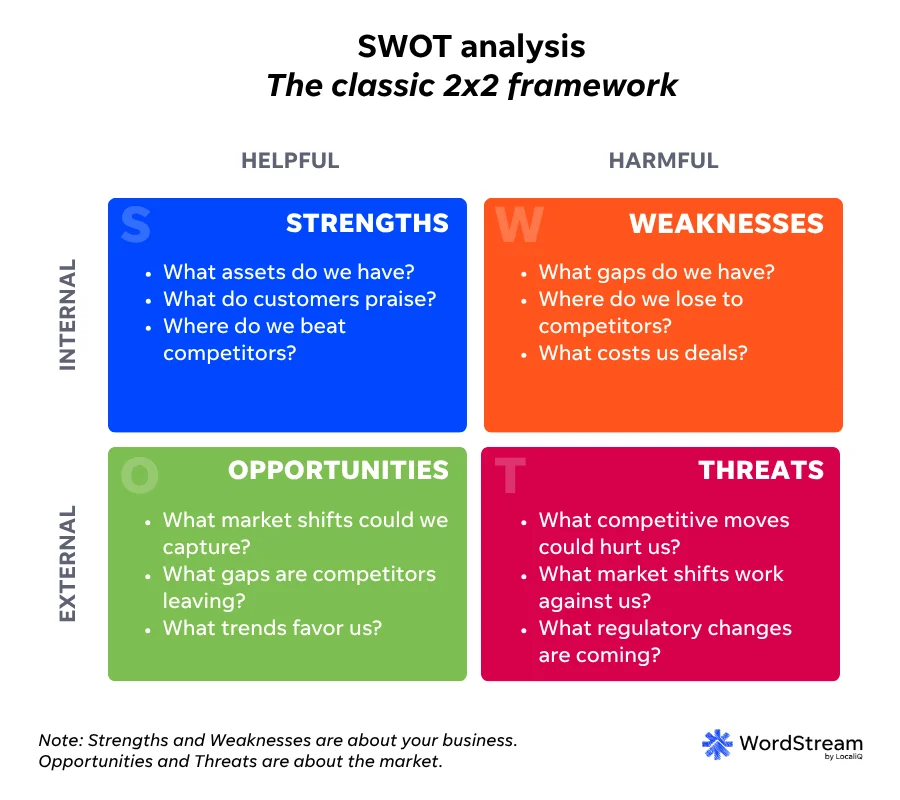
A SWOT analysis is a strategic planning framework that maps your business’s internal Strengths and Weaknesses against external Opportunities and Threats in a four-quadrant grid, so you can see in one view what to build on, what to fix, what to pursue, and what to defend against.
The framework is commonly credited to Albert Humphrey’s research at Stanford Research Institute in the 1960s, though management historians still argue about its exact origin. What nobody argues about is its reach: it has been a fixture of business planning for more than half a century.
SWOT analyses can be applied to an entire company or to individual projects within a single department. Most commonly, they’re used at the organizational level to gauge how closely a business is tracking against its growth benchmarks. But they also work well at the campaign level, for example, to assess how a paid search program is performing against initial projections.
Whatever you apply it to, the output is a grid-like matrix with four distinct quadrants, one for each element. That format has two real benefits: it separates internal factors from external ones at a glance, and it compresses a lot of information into something the whole team can read in a minute.
Prefer to watch first? Our video covers the whole framework:
🥤 Want this info to go? Download the guide >> How to Do a SWOT Analysis (With Examples & Reusable Template)
Breaking down the SWOT analysis definition
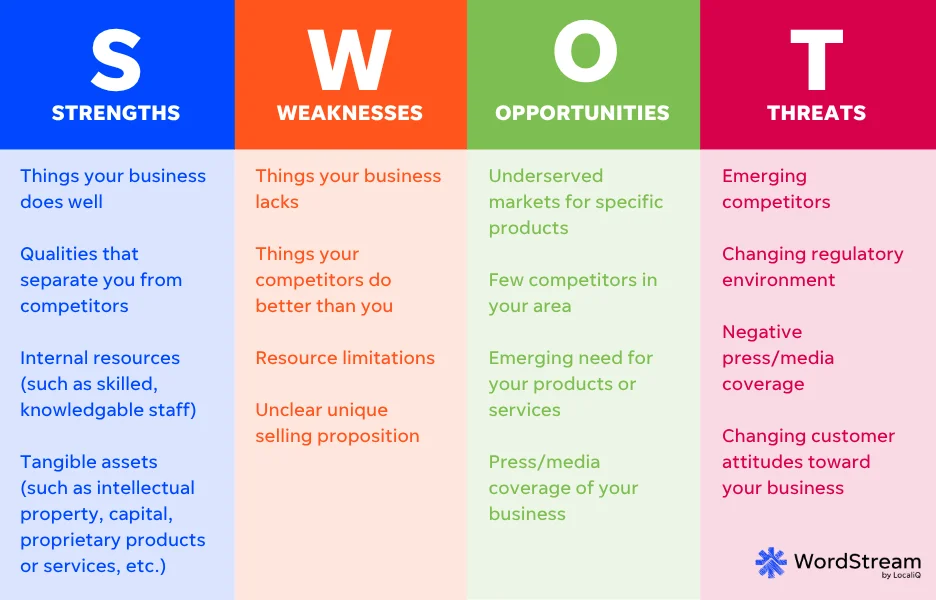
We know SWOT stands for Strengths, Weaknesses, Opportunities, and Threats. Here’s what each element actually covers.
Strengths
The first element of a SWOT analysis is Strengths.
- Things your company does well. Capabilities you can point to with evidence, not aspirations.
- Qualities that separate you from competitors. A defensible unique selling proposition (USP), not “great service.”
- Internal resources. Skilled, knowledgeable staff; strong leadership; a proven engineering team.
- Tangible assets. Intellectual property, capital, proprietary technology, distribution.
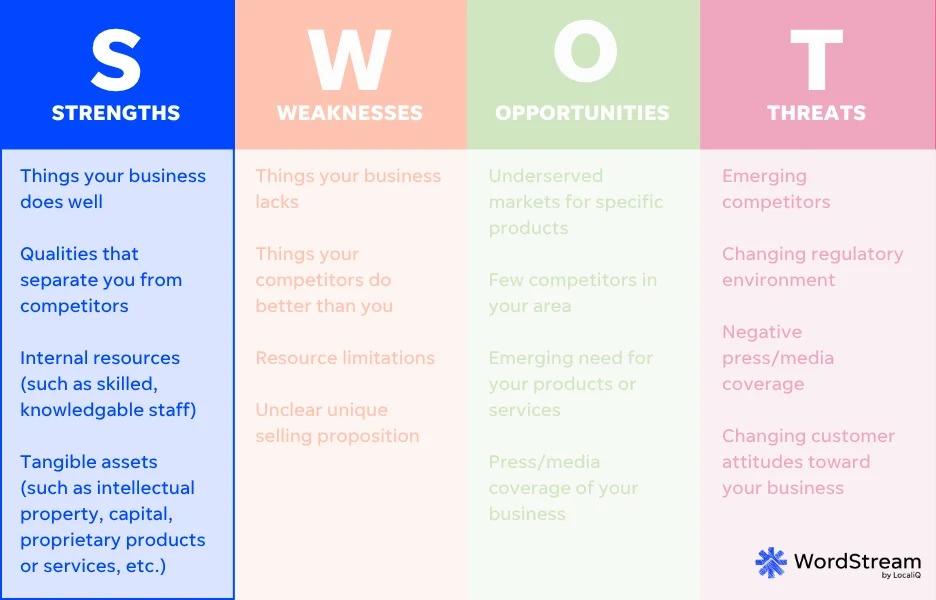
Strengths can be intangible (brand attributes) or concrete (the USP of a specific product line). The test I use: would a competitor agree this is an advantage? If yes, it belongs here.
Weaknesses
Weaknesses are internal, harmful factors: the gaps holding your business or project back.
- Things your company lacks. Missing capabilities, missing roles, missing infrastructure.
- Things competitors do better than you. Be honest here. This row only helps if it hurts a little.
- Resource limitations. Budget, headcount, time.
- An unclear unique selling proposition. A common one in crowded markets.
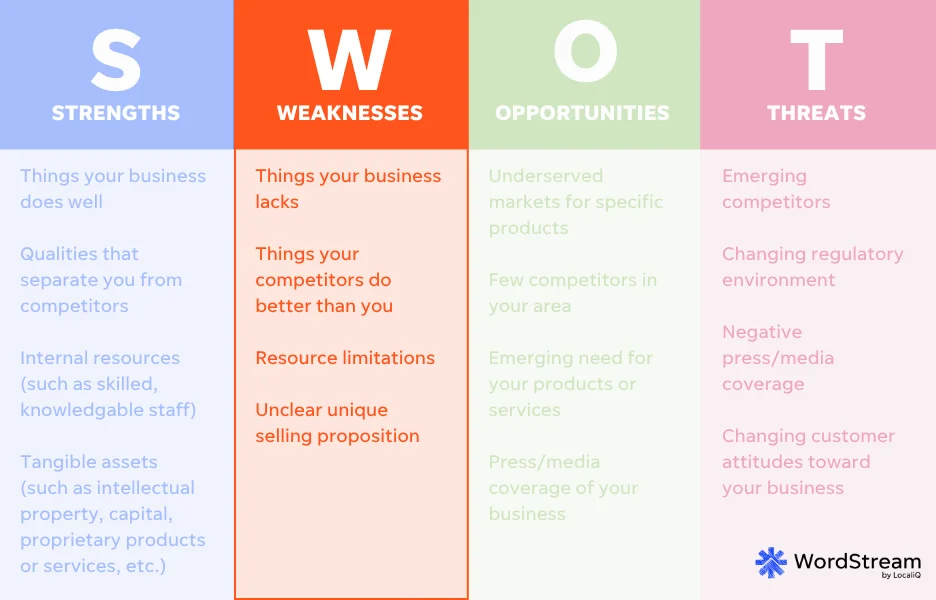
Weaknesses can include organizational challenges like a shortage of skilled people or budget constraints, as well as competitive gaps like the lack of a clearly defined USP.
Opportunities
Opportunities are external, helpful factors: openings in the market you could capture.
- Underserved markets for specific products. Demand that existing players aren’t meeting.
- Few competitors in your area. Geographic or niche gaps.
- Emerging needs for your products or services. Trends moving toward you.
- Press or media coverage of your company. Attention you can convert.
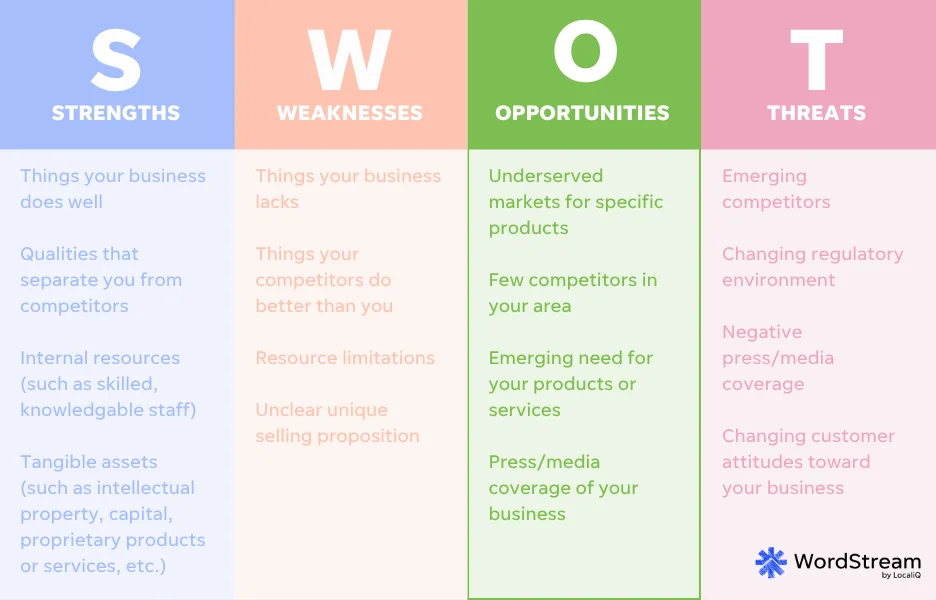
Can’t keep up with the volume of leads your marketing generates? That’s an opportunity. Developing something that opens a new market or demographic? Also an opportunity. This quadrant covers everything you could do to grow sales or advance the organization’s mission.
Threats
Threats are external, harmful factors: anything that puts your company’s success or growth at risk.
- Emerging competitors. New entrants or established players moving into your space.
- Changing regulatory environment. Rules that could raise your costs or limit your model.
- Negative press or media coverage. Reputation risk you don’t fully control.
- Changing customer attitudes. Shifts in how your market perceives your category or brand.
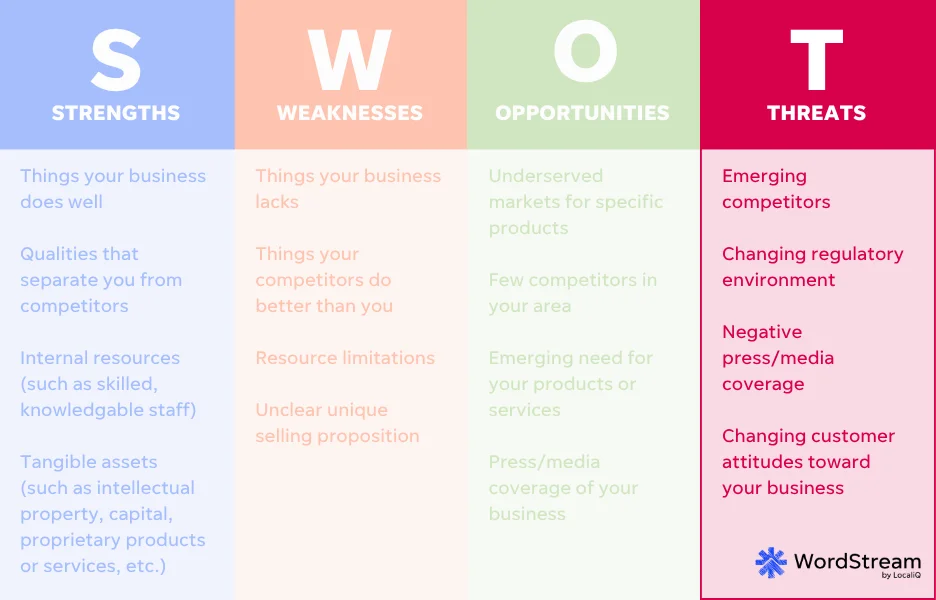
Threats also include financial risks and market volatility: essentially anything that could jeopardize the future of the company or project and sits mostly outside your control.
📗 Free Guide >> The 37 Best Ways to Promote Your Business
SWOT analysis internal and external factors
The four elements above are common to all SWOT analyses, but the more useful cut is the one running through the middle of the grid: internal versus external.
Internal factors
Strengths and Weaknesses are internal factors. They result from decisions and conditions under your company’s control. A high churn rate is a weakness, but improving churn is within your control, which is what makes it internal.
External factors
Opportunities and Threats are external factors. An emerging competitor is a threat, but there’s very little you can do to stop a competitor from existing, which is what makes it external. This is why you’ll sometimes see SWOT analyses called Internal-External Analyses or IE matrices.
Subcategorizing this way isn’t strictly required, but it tells you something practical: how much control you have over each item on the grid. That tends to change what you do about it.
How to do a SWOT analysis
To do a SWOT analysis, gather a cross-functional team, set up the four quadrants, fill each one with specific evidence-backed entries, prioritize the top three to five per quadrant, and then convert the grid into strategies with owners and deadlines.
You can get the full walkthrough in our video below. The rest of this article expands on every step.
Here’s the process step by step:
- Gather your team. Sales, marketing, operations, and customer-facing staff each see different things. Bring candy. This should be a meeting people want to attend.
- Set up your quadrants. Whiteboard, projector, or our free template below.
- Start with Strengths. Work through the strengths questions listed in the next section.
- Repeat for Weaknesses, Opportunities, and Threats. Same drill, same honesty.
- Pressure-test every entry. Each one should be specific enough to argue with and backed by at least one data point. “5-star Google rating with 312 reviews” beats “great reviews.”
- Prioritize and document. Cut each quadrant to its top three to five entries and send the document to the team with notes.
- Reconvene to assign action items. A second meeting converts the analysis into strategies, owners, and deadlines. The TOWS matrix section below is built for exactly this.
You can build yours right here as you work through the article:

SWOT Analysis Builder
Fill in each quadrant. Your work saves automatically in your browser. Export to CSV or copy as Markdown when done.
SWOT analysis questions
The fastest way to fill the grid is to ask a structured series of questions for each quadrant. Here are the ones I use.
Strengths questions
- What do your customers love about your company or product(s)?
- What does your company do better than other companies in your industry?
- What are your most positive brand attributes?
- What’s your unique selling proposition?
- What resources do you have at your disposal that your competitors do not?
Answer those, and you’ll have a solid starting list of organizational strengths.
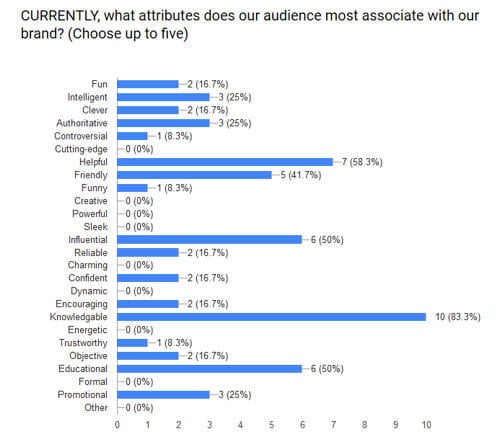
Positive brand attributes associated with WordStream, as identified by our customers.
Weakness questions
- What do your customers dislike about your company or product(s)?
- What problems or complaints come up repeatedly in your negative reviews?
- Why do your customers cancel or churn?
- What could your company do better?
- What are your most negative brand attributes?
- What are the biggest obstacles in your current sales funnel?
- What resources do your competitors have that you do not?
You may find that strengths and weaknesses come together much faster than opportunities and threats. That’s expected. Internal factors are visible from inside the building. External factors usually require more data and more digging.
Opportunities questions
- How can we improve our sales, onboarding, or customer support processes?
- What kind of messaging resonates with our customers?
- How can we further engage our most vocal brand advocates?
- Are we allocating departmental resources effectively?
- Are there budget, tools, or other resources we’re not using to full capacity?
- Which advertising channels exceeded our expectations–and why?
Identifying opportunities often requires real competitive analysis or an examination of wider economic trends. But opportunities can be internal too, surfaced directly from your own strengths and weaknesses.
🕵️♀️ Want a look at what your competitors are doing? Free guide >> How to Spy on Your Competitors: 7 Ways to Become a Competitive Supersleuth
Threat questions
Threats tend to surface without much prompting. Most teams can list them cold: emerging or established competitors, changing regulatory environments, market volatility, or internal threats like high staff turnover that could derail current growth. If you want a structured starting point, run the opportunities questions in reverse: where are we losing ground and to whom?
What makes a good SWOT entry?
A good SWOT analysis entry is specific, evidence-backed, and prioritized: “website last updated in 2019” is a usable weakness entry, while “outdated web presence” is wallpaper. In the SWOT analyses I’ve reviewed, vague entries are the single most common reason the exercise produces nothing.
Three tests I apply to every entry:
- Specific enough to argue with. If nobody could reasonably disagree with it, it’s too vague to act on.
- Backed by at least one data point. A review count, a churn rate, a traffic number, a named competitor move. If you can’t cite one, downgrade the entry.
- Ranked, not just listed. Three to five entries per quadrant. Twenty sticky notes is a brainstorm, not an analysis.
Score your own SWOT against the full eight-point checklist here:
SWOT Quality Scorer
Most SWOTs fail because the entries are vague, opinion-based or untestable. Check off what's true of yours, then score it against 8 quality criteria.
If you score under 75%, tighten the entries before you take the analysis to a planning meeting. A weak SWOT confidently presented is worse than no SWOT at all.
A full SWOT analysis example
To show how this works in practice, here’s a SWOT analysis example for a fictional family-owned restaurant: single location, urban area, competing against chains. Here’s the completed matrix:
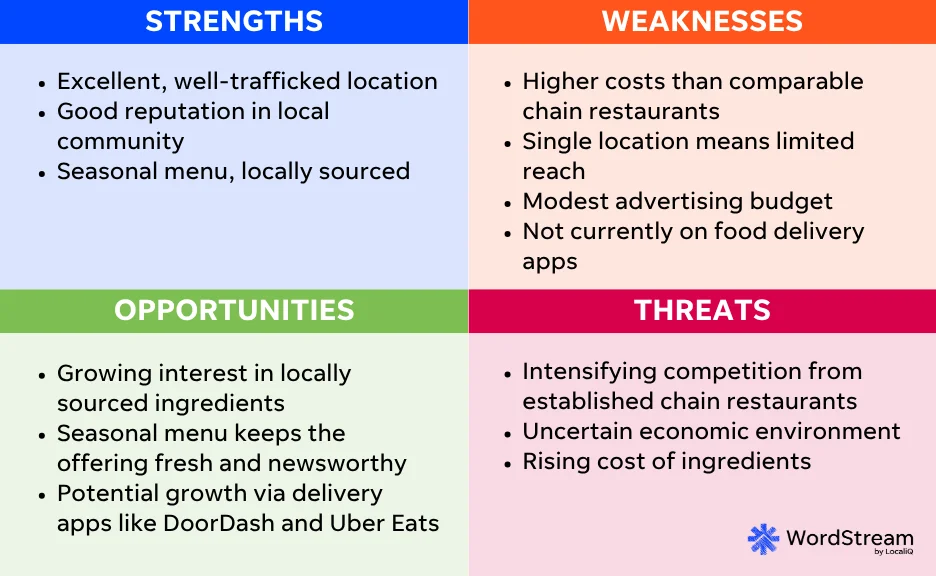
As you can see, this matrix format allows you to quickly and easily identify the various elements you’ve included in your analysis.
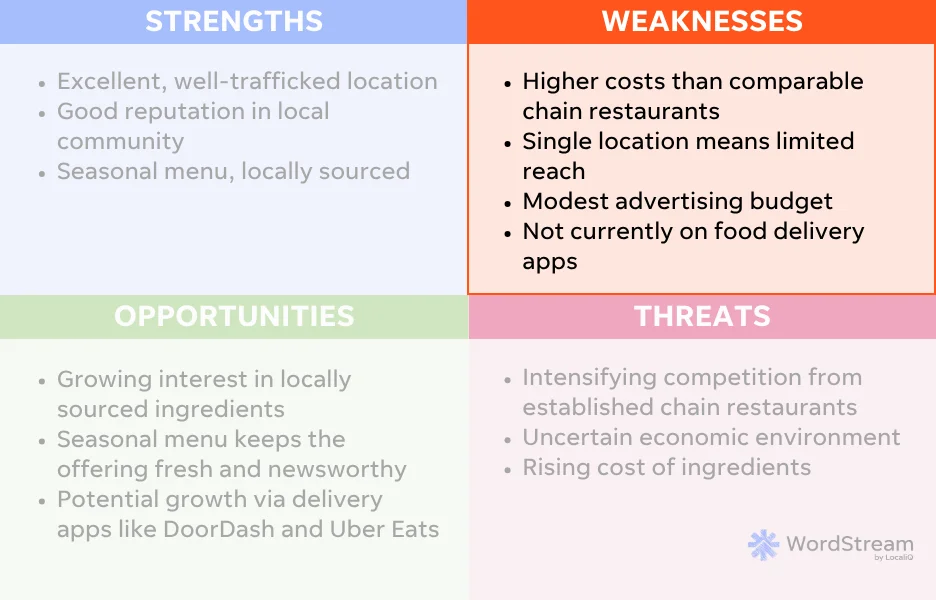
Strengths examples
- Excellent, well-trafficked location
- Good reputation in local community
- Seasonal menu, locally sourced
Weaknesses examples
- Higher costs than comparable chain restaurants
- Single location means limited reach
- Modest advertising budget
- Not currently on food delivery apps
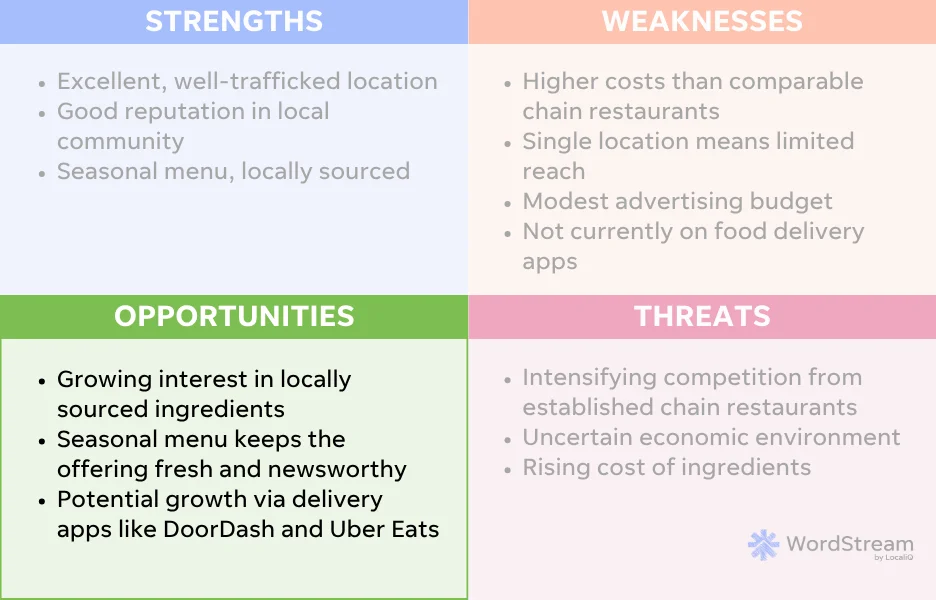
Opportunities examples
- Growing interest in locally sourced ingredients
- Seasonal menu keeps the offering fresh and newsworthy
- Potential growth via delivery apps like DoorDash and Uber Eats
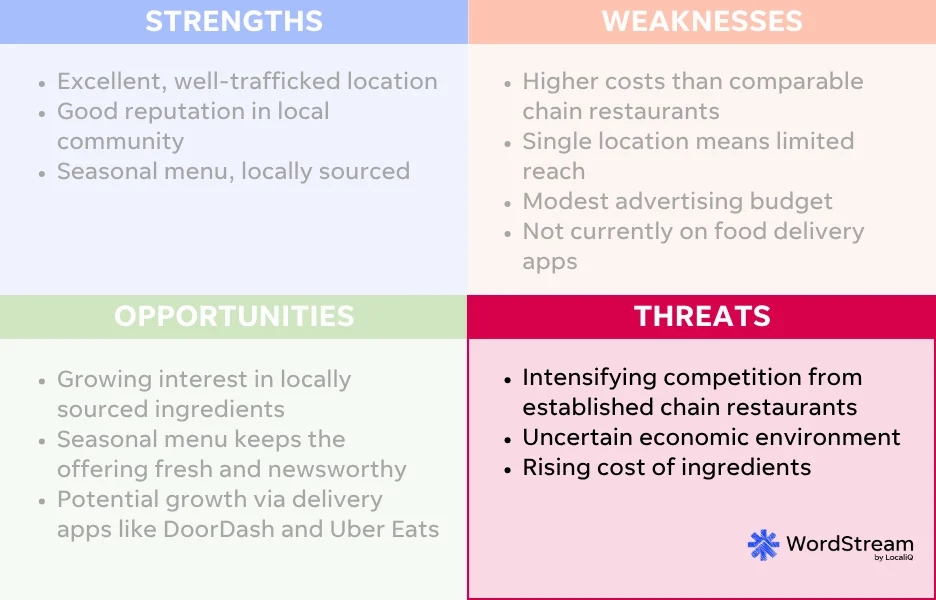
Threat examples
- Intensifying competition from established chain restaurants
- Uncertain economic environment
- Rising cost of ingredients
The matrix format makes the tradeoffs readable at a glance: a strong local brand with real cost and reach disadvantages, in a market where delivery demand is growing. If you run a restaurant yourself, our restaurant marketing ideas guide pairs well with this example.
SWOT analysis example: Acting on your results
A completed SWOT matrix is a diagnosis, not a plan. The value shows up in the two moves that follow: matching strengths to opportunities and converting weaknesses into strengths. Here’s how that works with the restaurant example.
1. Harness your strengths
The best thing about your strengths is that you’re already doing them.
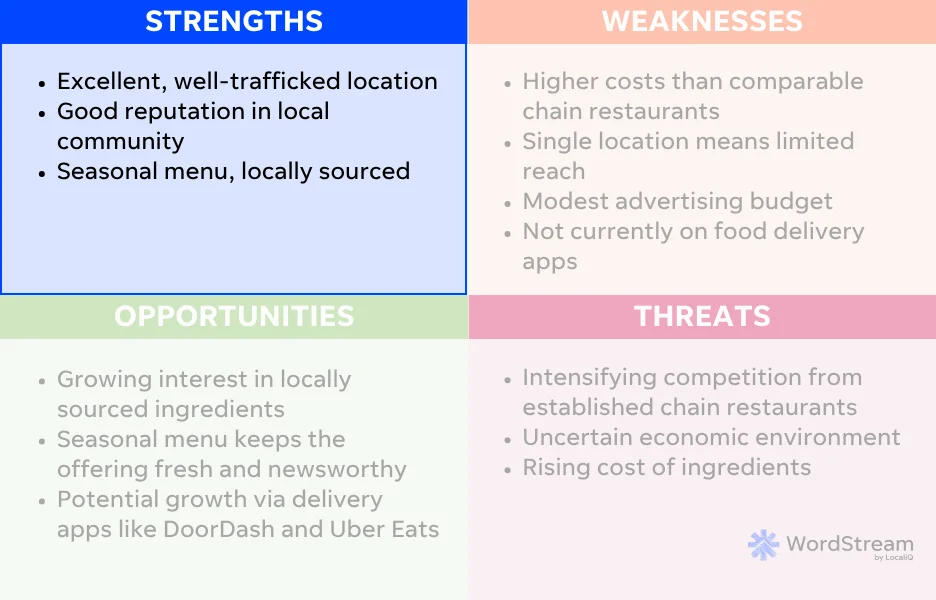
In our example, the location, reputation, and seasonal menu are all strengths. The play is to keep investing in what’s working: keep experimenting with the seasonal menu and keep nurturing the regular-customer relationships that built the reputation.
Acting on strengths mostly means doing more of what you’re already good at, deliberately instead of accidentally.
2. Shore up your weaknesses
Acting on weaknesses is trickier, not least because it requires being honest about them in the first place.
Some weaknesses resist direct attack. A single-location restaurant can’t out-purchase a chain. But it can compete where the chain structurally can’t: deep, personal customer relationships. And some weaknesses are just unfinished tasks. Not being on delivery apps was a weakness in this example; joining DoorDash or Uber Eats converts it directly into an opportunity captured.
3. Seize opportunities
The opportunities quadrant is the most actionable part of the grid, by design.
In this example, growing consumer interest in locally sourced ingredients is a major opening, but it doesn’t capture itself. It might mean sourcing local produce more aggressively to bring costs down or building the delivery-app presence to widen reach. Two cautions from experience: opportunities decay if you don’t fund them. Even an iron-clad advantage erodes if you stop maintaining it.
Every business’s opportunities differ, but every business needs the same thing: a clearly defined roadmap for capturing each one, internal or external.
4. Mitigate threats
Threats are mostly external, so full mitigation is usually impossible. The goal is monitoring plus positioning.
In this example, all three threats are hard ones. Competing with chain prices could force a choice between cheaper ingredients and thinner margins. Economic uncertainty can’t be mitigated at all, only planned around.
But look for the crossovers between quadrants. Locally sourced ingredients showed up as an opportunity while chain competition showed up as a threat. Highlighting the restaurant’s relationships with local farmers reinforces its community position AND blunts the chains’ main advantage. When one move captures an opportunity and reduces a threat at the same time, that’s usually your first priority.
Turn your SWOT into strategy with a TOWS matrix
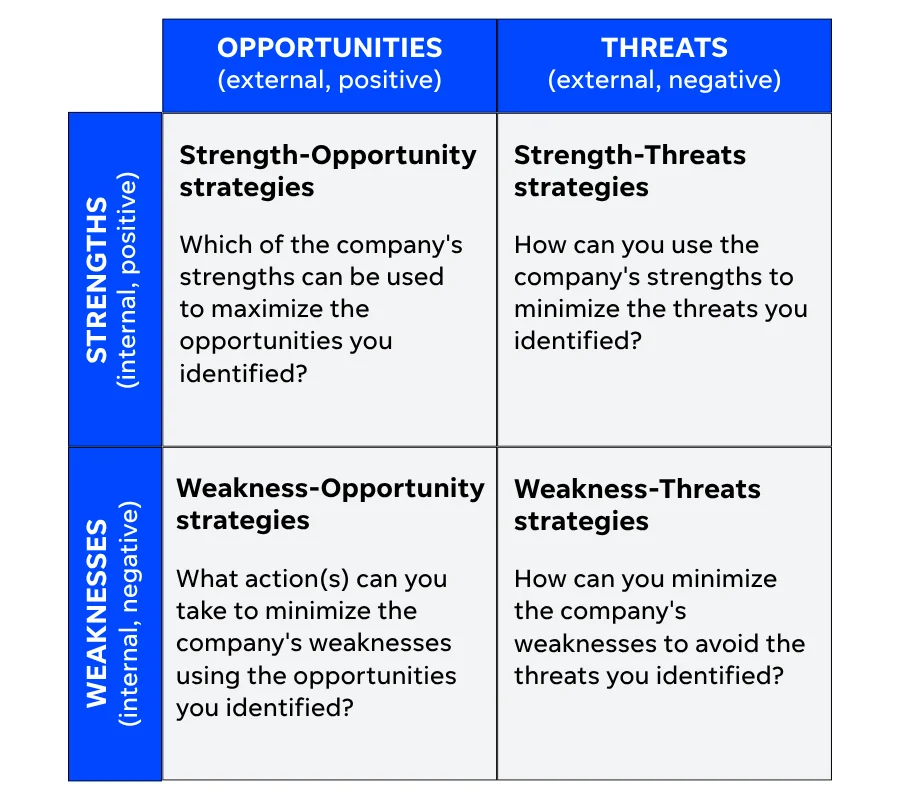
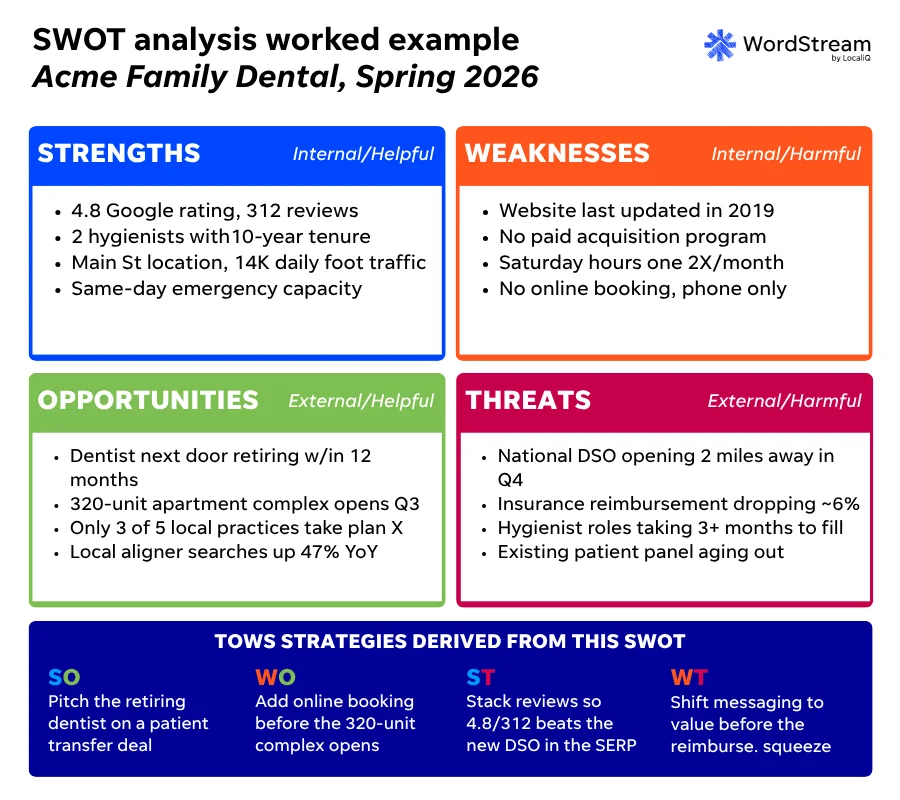
A TOWS matrix converts a finished SWOT analysis into four types of strategy by crossing internal factors against external ones: SO strategies use Strengths to capture Opportunities, WO strategies fix Weaknesses to capture Opportunities, ST strategies use Strengths to defend against Threats, and WT strategies minimize Weaknesses to avoid Threats.
The framework comes from Heinz Weihrich’s 1982 paper “The TOWS Matrix: A Tool for Situational Analysis”, published in Long Range Planning. It’s the standard answer to the most common SWOT complaint: “we made the grid, now what?”
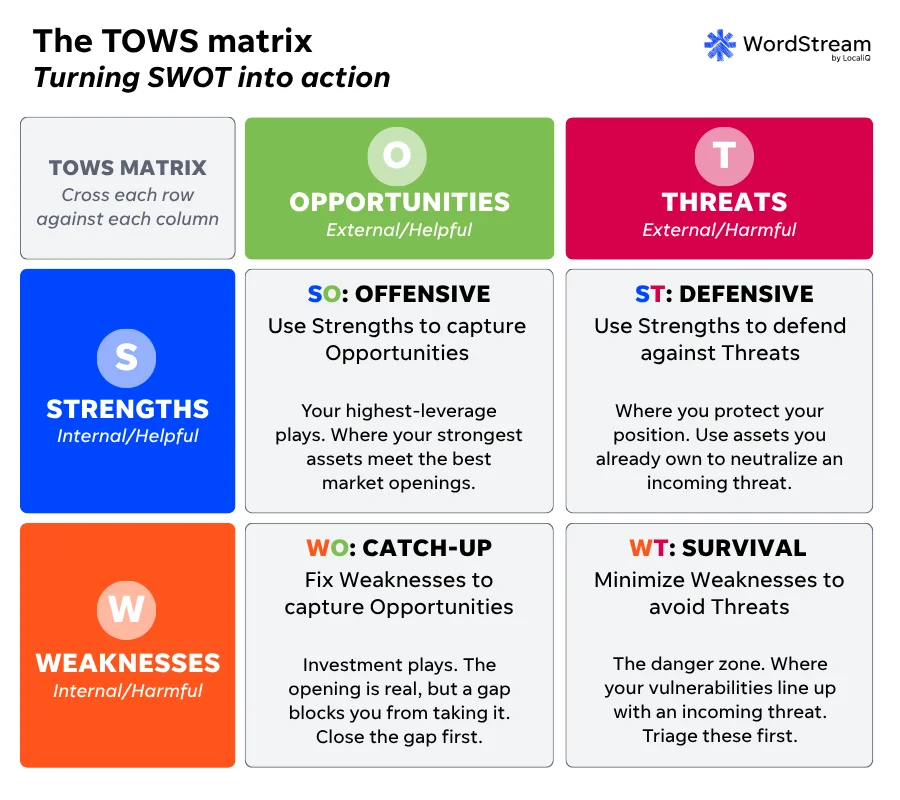
Here’s how each intersection works:
- SO (Offensive). Your strongest assets meet the best market openings. These tend to be the highest-leverage plays on the board.
- WO (Catch-up). The opening is there, but a gap blocks you from taking it. These are investment plays.
- ST (Defensive). Use existing assets to neutralize incoming threats. This is where you protect your position.
- WT (Survival). Vulnerabilities meet incoming threats. Triage these first, even if the work is unglamorous.
In practice, SO and WT pairs are the easiest to spot. The WO and ST intersections are where I most often find strategies a team hadn’t considered.
Here’s a worked example using a dental practice’s spring marketing plan, so you can see what evidence-backed entries and month-level strategies look like side by side:
And here’s a generator that crosses your own entries automatically. It pulls from the SWOT Builder above. You can also paste entries directly:
TOWS Matrix Generator
SWOT is a list. TOWS turns it into action. Load your entries from the SWOT Builder above or paste your top entries below, one per line.
Generate the candidates, then pick two or three to actually commit to, each with an owner and a deadline. A strategy without an owner is a suggestion.
8 common SWOT analysis mistakes
The most common SWOT analysis mistakes are vague entries, mixing internal with external factors, treating the exercise as an unfiltered brainstorm, skipping supporting evidence, stopping at the list instead of converting it to strategy, running it solo, letting it go stale, and letting confirmation bias inflate the strengths quadrant.
I see the same failure patterns over and over. The full breakdown, with what each mistake costs you and how to fix it:
Eight Common SWOT Analysis Mistakes
These patterns turn an analysis into wallpaper. Each row pairs the mistake with the cost and the fix.
THE MISTAKE
WHAT IT COSTS YOU
HOW TO FIX IT
THE MISTAKE
1. Vague entries
WHAT IT COSTS YOU
"Strong team" or "good reputation" tell you nothing. The SWOT becomes wallpaper and cannot drive resource decisions.
HOW TO FIX IT
Every entry must pass the "specific enough to argue with" test. "5-star Google rating with 312 reviews" beats "great reviews."
THE MISTAKE
2. Mixing internal and external
WHAT IT COSTS YOU
Putting "competitor X is winning" in Weaknesses (it is a Threat) or "we should hire a marketer" in Opportunities (it is a TOWS action).
HOW TO FIX IT
S and W are about your business. O and T are about the market. If you control it, it is internal.
THE MISTAKE
3. Treating it as a brainstorm
WHAT IT COSTS YOU
20 sticky notes per quadrant. No prioritization. No filter. The output is a noisy list, not an analysis.
HOW TO FIX IT
Cap each quadrant at 3 to 5 top entries. Forced ranking surfaces the real signal.
THE MISTAKE
4. No supporting evidence
WHAT IT COSTS YOU
"Our customer service is amazing" with no NPS data, review analysis or churn numbers to back it. Opinion masquerading as analysis.
HOW TO FIX IT
Every entry needs at least one anchoring data point. If you cannot cite one, downgrade the entry.
THE MISTAKE
5. Stopping at the list
WHAT IT COSTS YOU
SWOT alone is description. Without TOWS, you have not produced a single decision or action.
HOW TO FIX IT
Always pair SWOT with TOWS. Generate SO, WO, ST and WT strategy candidates and pick 2 to 3 to commit to.
THE MISTAKE
6. Doing it alone
WHAT IT COSTS YOU
A founder running SWOT solo misses sales-team objections, customer-success patterns and operations gaps invisible from the top of the org chart.
HOW TO FIX IT
Include sales, marketing, customer success and operations. Each lens surfaces different entries.
THE MISTAKE
7. Updating once a year (or never)
WHAT IT COSTS YOU
An annual offsite SWOT goes stale by month four. Market shifts, competitor moves and internal capability changes all invalidate entries.
HOW TO FIX IT
Refresh quarterly at minimum. Do a full rebuild if a major event (new competitor, regulatory change) reshapes your market.
THE MISTAKE
8. Confirmation bias
WHAT IT COSTS YOU
Strengths inflate, Weaknesses shrink, Threats get minimized. The SWOT becomes the story the team wants to tell, not the one the market is telling.
HOW TO FIX IT
Assign a "red team" to attack the SWOT. Use AI tools for devil's advocate prompts. Pressure-test before committing.
Two of these deserve special emphasis:
- Stopping at the list. SWOT alone is description. Without a conversion step like TOWS, the meeting produced a poster, not a plan.
- Confirmation bias. Strengths inflate, weaknesses shrink, threats get minimized. Assign someone to red-team the grid before you commit to it. It’s a lot cheaper to be wrong in the meeting than in the market.
How often should you update a SWOT analysis?
I recommend refreshing a SWOT analysis quarterly, with a full rebuild whenever a major event reshapes your market: a new competitor, a regulatory change, a pricing shift from a key player, or a big swing in your own capabilities.
An annual offsite SWOT tends to go stale within a few months, because the external half of the grid is a snapshot of a moving picture. Competitor moves and market shifts don’t wait for your planning cycle.
A practical cadence that works for most small businesses:
- Quarterly: 30-minute review. Re-read every entry and ask “is this still true?” Update what changed.
- Annually: Full rebuild with the whole team, starting from a blank grid rather than editing last year’s.
- Event-driven: Rebuild the external quadrants any time a major competitor, regulation or technology shift lands.
If you’re tracking competitors between refreshes, a lightweight competitive analysis template makes the quarterly pass much faster.
What is PEST analysis?
While we’re here, it’s worth covering a related but separate framework: PEST analysis.
External pressures like regulatory change and market volatility can be listed as threats in a SWOT, but they’re often driven by dozens of underlying factors, which puts them beyond the scope of a typical SWOT session. That’s the gap PEST fills. A PEST analysis works much like a SWOT analysis but focuses entirely on four external forces:
- Political
- Economic
- Sociocultural
- Technological
Pros of PEST analysis
Many of the factors that land in a PEST matrix are also relevant to the Opportunities and Threats quadrants of your SWOT. Political and economic volatility can pose real threats (and open real opportunities) for many businesses, but these forces tend to be more complicated than typical SWOT entries, with broader scale and messier underlying causes. PEST gives them the dedicated treatment they need.
Cons of PEST analysis
PEST obstacles usually sit on much longer timeframes. It’s a lot faster to fix high staff turnover than to wait out an economic cycle.
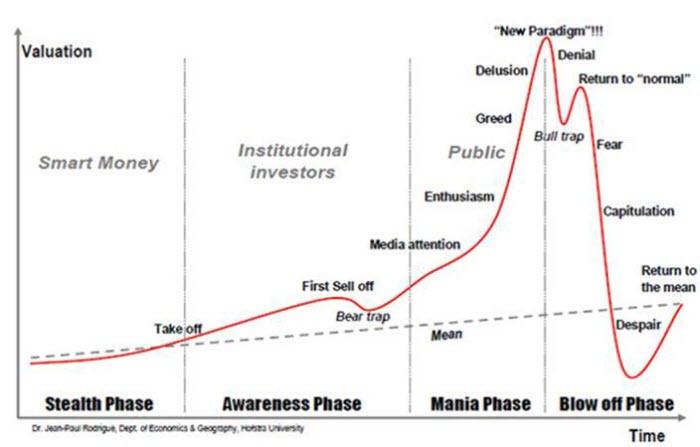
Image via Dr. Jean-Paul Rodrigue/Hofstra University
For most small businesses, SWOT plus a quarterly refresh covers it. Add PEST when regulation or macro conditions are a first-order driver of your business.
Benefits of SWOT analysis for small businesses
If you run a small business, you might wonder whether a SWOT analysis is worth the overhead. In my experience, it usually is, for three reasons:
- Get a bird’s-eye view. It’s easy to get lost in the day-to-day weeds. A SWOT analysis forces a broader look at your business and the position it occupies in your market. Pairing it with a clear mission statement makes the “where are we going” half of planning much easier.
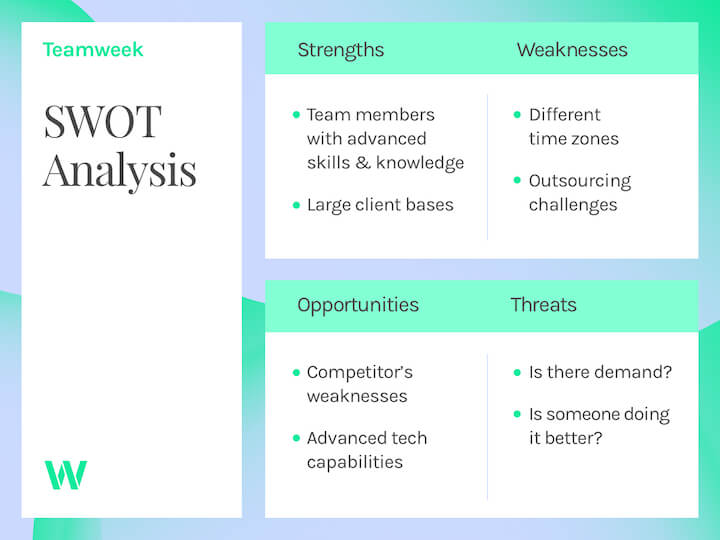
- Improve specific campaigns and projects. The framework scales down well. You can SWOT a forthcoming ad campaign, a content project, or a trade show appearance, not just the whole company. Here’s an example of a project SWOT analysis:
- Develop tangible roadmaps. The exercise surfaces what you do well, where you lag, and what’s coming, then hands you the raw material for budgets, hiring plans, and mid-term strategy.
The overhead is one or two meetings. The return is a shared, prioritized picture of the business that everyone in the room helped build.
Free SWOT analysis template
Ready to put it all into practice? Here’s our free, editable SWOT analysis template.
It’s a Google Sheet, so you can add and remove rows, edit and answer the questions, paste the grid into a slide deck, and more. We’ve included a blank version too.
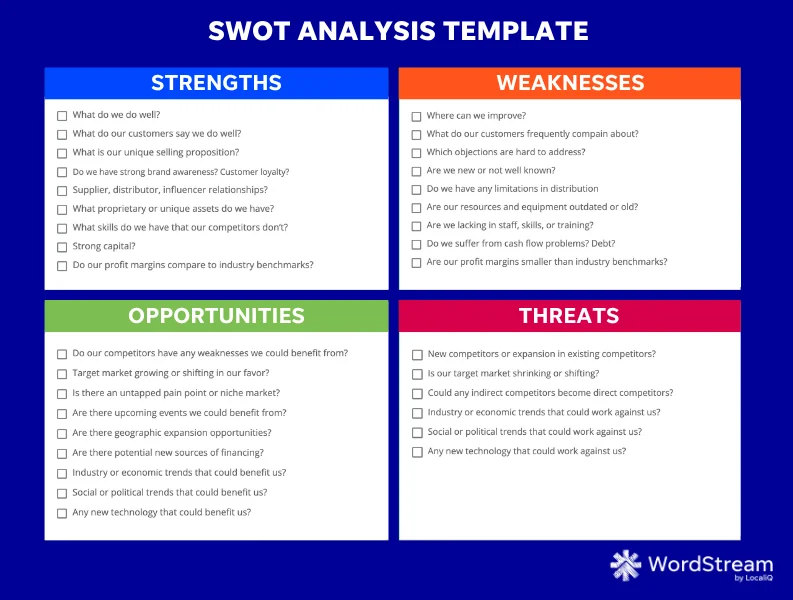
Grab your copy of the free SWOT analysis template here.
If you’d rather work in the browser, the interactive SWOT Builder earlier in this post exports to CSV and Markdown as well.
SWOT analysis FAQs
What does SWOT stand for?
SWOT stands for Strengths, Weaknesses, Opportunities, and Threats. Strengths and Weaknesses are internal factors within your company’s control, while Opportunities and Threats are external factors coming from your market, competitors, or operating environment.
What is a SWOT analysis used for?
A SWOT analysis is used to assess a business, department, or project before making strategic decisions. Common uses include annual planning, evaluating a new campaign or market entry, preparing for competitive shifts, and building a shared, prioritized view of the business across a leadership team.
How do you do a SWOT analysis?
Gather a cross-functional team, draw a four-quadrant grid, and fill in Strengths, Weaknesses, Opportunities, and Threats using structured questions. Make each entry specific and evidence-backed, prioritize the top three to five per quadrant, then convert the grid into strategies with owners and deadlines.
What’s the difference between SWOT and TOWS?
SWOT is the diagnosis; TOWS is the prescription. A SWOT analysis lists Strengths, Weaknesses, Opportunities, and Threats, while a TOWS matrix crosses those quadrants (SO, WO, ST, WT) to generate four types of strategy, from offensive plays to survival moves.
How often should you update a SWOT analysis?
Review your SWOT quarterly and rebuild it annually; in my experience, the minimum for keeping it decision-grade. Also rebuild the external quadrants after any major market event, such as a new competitor entering, a regulatory change, or a major pricing move by an incumbent.
What’s the difference between SWOT and PEST analysis?
A SWOT analysis covers internal strengths and weaknesses plus external opportunities and threats. A PEST analysis is external only, examining Political, Economic, Sociocultural, and Technological forces. Larger companies often run both: SWOT for near-term action, PEST for longer-term strategy.
Who invented the SWOT analysis?
The SWOT framework is commonly credited to Albert Humphrey’s research at Stanford Research Institute in the 1960s, though its exact origin is debated among management historians. The TOWS matrix extension was introduced by Heinz Weihrich in a 1982 Long Range Planning paper.
What are examples of strengths and weaknesses in a SWOT analysis?
Strength examples include a 4.8-star Google rating, long-tenured staff, or a high-traffic location. Weakness examples include an outdated website, no paid acquisition program, or limited hours. The common thread: each is internal, specific, and verifiable rather than a vague label like “good reputation.”
Where to go next
A SWOT analysis is worth the meeting it takes to build, but only if you convert it: prioritize the entries, cross them in the TOWS generator, and leave with two or three owned, deadlined strategies. Then put a quarterly review on the calendar before everyone forgets.
From here, the natural next steps are a proper competitive analysis, a look at your competitive positioning, and, if you compete in search, a competitor keyword analysis to see where rivals are winning attention you could own.
About the WordStream Blog
We've been a trusted source of data, news, and strategy for over 15 years. All of our content is written and reviewed by real people: a dedicated team of professionals with decades of combined experience in marketing and advertising for businesses of all sizes.


Add us as a preferred source on Google
Are you wasting money in Google Ads?

Meet The Author
Dan Shewan
Originally from the U.K., Dan Shewan is a journalist and web content specialist who now lives and writes in New England. Dan’s work has appeared in a wide range of publications in print and online, including The Guardian, The Daily Beast, Pacific Standard magazine, The Independent, McSweeney’s Internet Tendency, and many other outlets.
Recommended for you