✨ Quick overview
This article from our senior copywriter, Rob Glover, outlines the top content marketing trends for 2026, showing how AI, visibility shifts, content formats, and audience engagement will reshape how brands create, distribute, and measure content.
Key takeaways
- Zero-visit visibility becomes essential, as AI summaries and platforms reduce traditional clicks.
- Multi-media content (video, images, interactivity) will attract attention and support visibility across search and social channels.
- Email and social gain ground as search traffic becomes less predictable, pushing brands to diversify how they reach audiences.
- Content moves toward conversations, not just answers, encouraging deeper engagement and mapping user intent across query paths.
Content marketing has always been guided by customer behavior. When people flocked to search engines to click blue links, we optimized posts to rank on results pages. When buyers began engaging with brands on social, we poured our hearts into publishing posts to meet them there.
In 2026, it’s consumers’ relationship with AI that will have the biggest influence on content marketing trends.
Millions of people now get ideas, education, and recommendations directly from ChatGPT, Perplexity, and AI Overviews—placing a generative engine between us and our audience. At the same time, many consumers are pushing back against AI-generated content, or at least asking brands to be transparent about it.
These behavioral shifts will reverberate across content marketing, whether you’re chasing AI citations or not. We’ll see new structures in written content and a push to publish things that AI can’t recreate. There’ll also be increased competition outside of search, as marketers look for the clicks they lost to AI-generated answers.
To be fair, not everything is about AI. User-generated content and strategic repurposing continue to be hot topics. But in this guide, I’ll focus on new content marketing trends for 2026, why they matter, and how you can adjust your strategy to meet them.
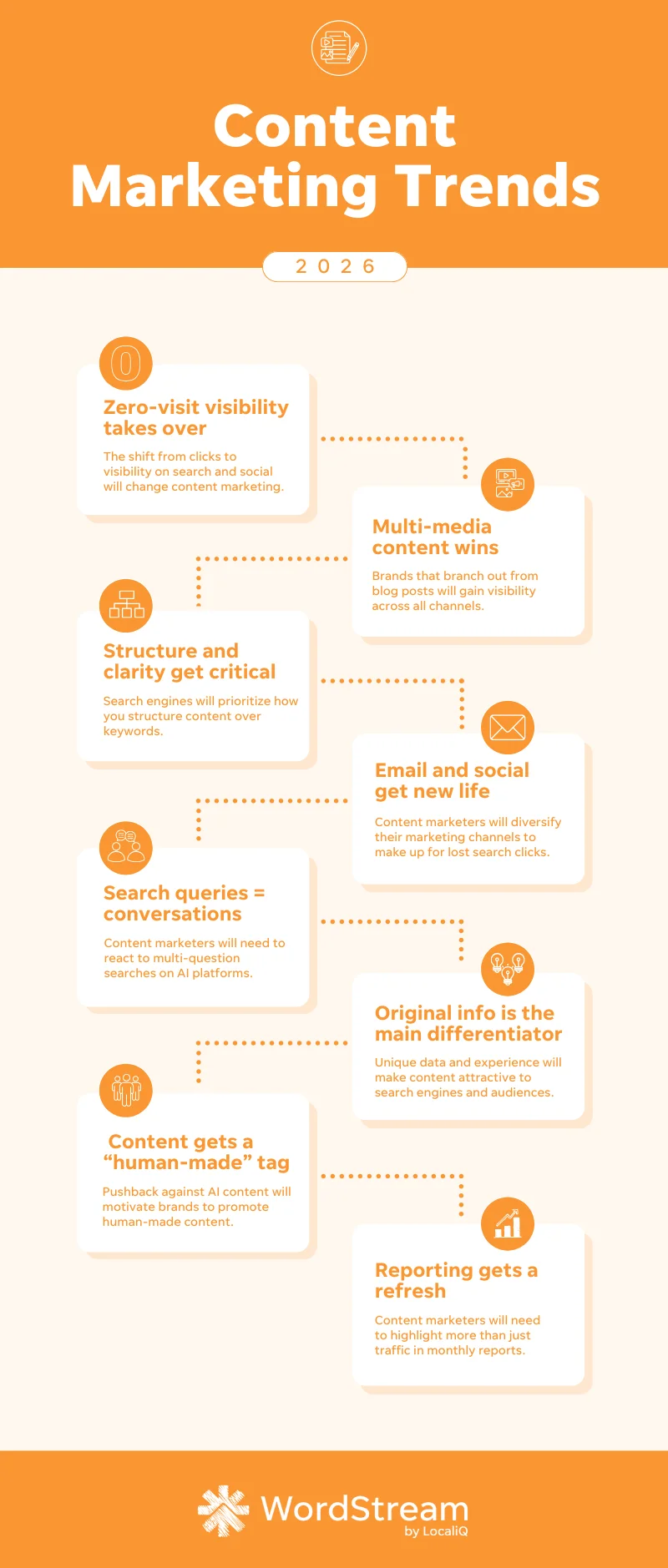
Contents
- Zero-visit-visibility will be the most influential content marketing trend in 2026
- Multi-media content marketing will win the most attention
- Structure and clarity become the most important on-page factors
- Email and social media gain ground against search
- Content marketers shift from answering questions to having conversations
- Information gain becomes the single biggest content differentiator
- We’ll see the “human-made” label pop up more often
- Content teams will rethink reporting
8 content marketing trends that will define 2026
Content marketing is evolving rapidly. Buckle up and review these trends to build a solid strategy this year.
1. Zero-visit visibility will be the most influential content marketing trend in 2026
Rand Fishkin recently projected that “zero-click experiences will become the majority of online journeys.” The data certainly backs it up. Even as Google now processes well over 5 trillion searches per year (and searches on ChatGPT, Gemini, and Perplexity are increasing), organic clicks are in rapid decline.
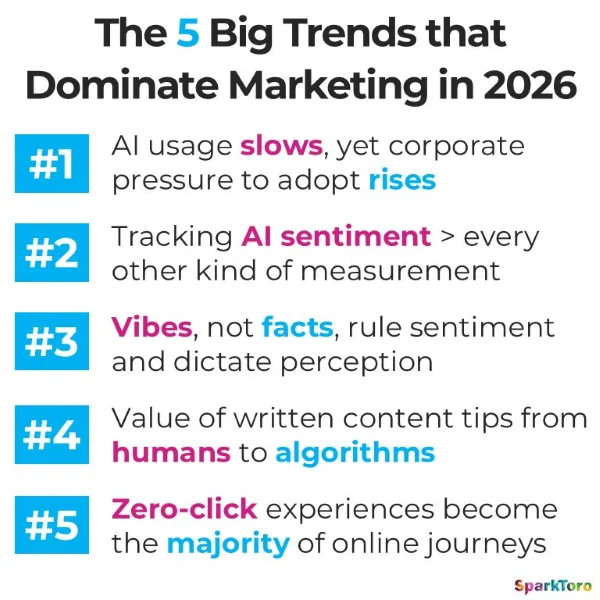
Among other things, Rand Fishkin predicts that the majority of online experiences won’t lead to a click in 2026.
But Rand wasn’t just talking about search. He also referenced TikTok, Reddit, and YouTube as platforms that either “have a bias against—or outright restrict—external clicks.” (We get it, tech giants, you want to keep people on your platforms!).
Clicks aren’t going away entirely (I’ll get into that in a minute). But they’ll be much harder to come by and will be joined by new metrics in our content reporting (also in a minute).
Here’s an example of a typical AI Overview. It gives the complete step-by-step process that used to be the job of a blog post.
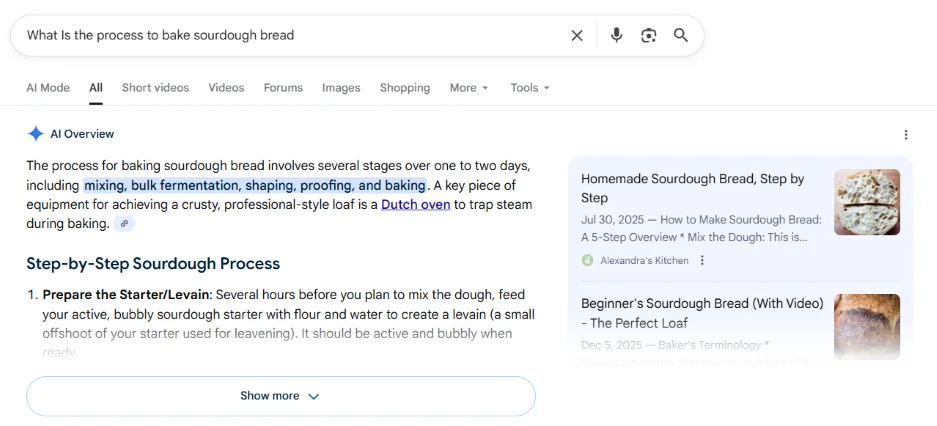
Why click when an AI Overview will give you everything on the results page?
So, in the absence of clicks as the primary goal for publishing content, the game changes to gaining visibility (and hopefully trust) on the platforms where your content is referenced.
“We are witnessing a real-time evolution in trust,” said Colby Flood, founder at Brighter Click. “Users want efficiency, and they are increasingly relying on AI for vetting. Consequently, ‘word of mouth’ marketing is shifting from a human-to-human dynamic to an AI-to-human dynamic.”
In 2026, we will slide (many of us kicking and screaming) further into this new world where zero-visit visibility becomes a significant portion of our content marketing focus.
Why this matters
Not all content is created to get clicks from search and social. But I believe this transition from traffic to zero-visit visibility is the most influential trend in content marketing this year because it will:
- Cause marketers to rethink their channel prioritization.
- Create new rules for on-page optimization.
- Encourage content marketers to branch into more content types.
- Shift blogs into conversion mode.
And as you’ll see, these themes drive most other content trends we’ll contend with over the next 12 months.
How to prepare for this trend
The first step, after anger and grief, is to accept that Google’s probably going to give you less traffic.
From there:
- Decide which metrics beyond clicks are business critical.
- Learn how to optimize your content for AI search (while not forgetting SEO basics).
- Consider expanding beyond basic text posts if you haven’t already.
- Reassess your other channels to see which can fill the click gap.
- Make the most out of every click you do get.
It will take intentional action recalibrate your content strategy. “75% of our agency’s inbound leads are now attributed to our visibility on ChatGPT and similar LLMs,” Colby said. “This surge isn’t accidental. It is the direct result of securing features in the specific content AI uses to rank recommendations, such as “top SaaS marketing agency” lists.
🛑 Want to know how other businesses are planning to succeed in 2026? Download The Big Small Business Website Trends Report: SEO, GEO, & the Future of Traffic.
2. Multi-media content marketing will win the most attention
Producing multi-media content has always been a good play for engaging buyers (89% of them say they want brands to make more videos). What’s changing is the fact that videos—along with images, interactive content, etc.—are now direct factors in getting found on search and social.
There are a few motivating factors behind this trend. First is Google’s deep integration with YouTube, which it has owned for 20 years. There’s now a YouTube citation in nearly 30% of all AI Overviews.
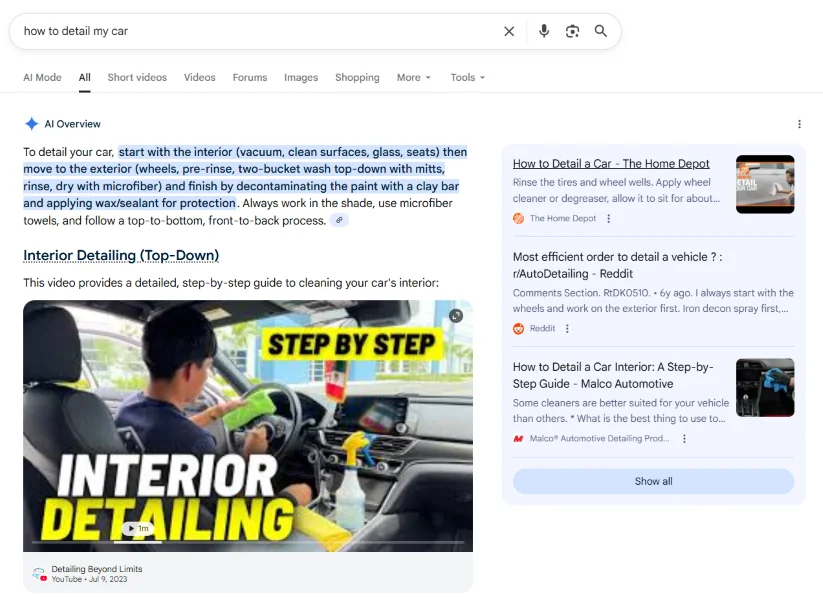
Videos are appearing in more AI Overviews.
Besides Google’s nepotism, additional content types help AI search engines understand and prioritize your content. Properly annotated images, audio explanations, and video scripts provide AI search engines with an abundance of very clear signals that confirm topic and context.
“Multi-media content is more important than ever because it increases your visibility across multiple channels, including search and in AI answers,” said Stephanie Yoder, Director of Content at Rebrandly.
Even better, videos and images let you keep more of your brand visible. “While written content gets chopped up and reprocessed by AI, videos are shared wholesale, which means your branding and messaging still get through to potential customers,” Stephanie said.
Over on social, Meta continues to double down on video as a preferred content type. Video viewership is up over 36% on LinkedIn. And of course, snappy clips are the cover charge of gaining access to TikTok’s audience.
In 2026, brands that create and intertwine a variety of content types will get more visibility across search and social channels.
Why this matters
Video, infographics, and other non-text-only content types have always been great for engaging and educating an audience. But now they’re also ranking factors that help your brand show up on the most trafficked platforms.
Also, content like video and infographics can retain a lot more branding than standard copy that gets read and reworked by AI. So as awareness becomes more important, these content types will do a better job of securing it.
How to prepare for this trend
Luckily, creator technology has kept up with AI search and social algorithms. You can create a quality video with your phone and have an AI tool help edit and caption it. There are also simple solutions in design software that let you mock up an infographic or put together a how-to guide with images in a snap.
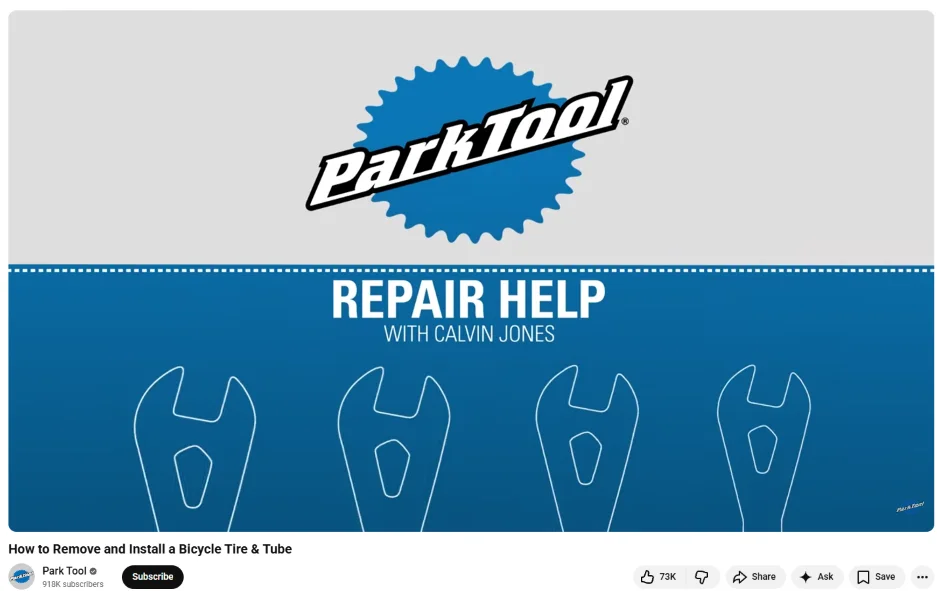
A simple how-to video like this one can also show off what you sell, and AI can’t take that away.
Your topics don’t have to be deep, either. Grab a few clips of the before, during, and after a project. Use screen grabs to show off your online cost calculator. Or post an interactive quiz that crowdsources your next product feature.
While you create, make sure to:
- Include transcripts and descriptive summaries.
- Add timestamps to videos.
- Annotate images with metadata and captions.
3. Structure and clarity will be the most important on-page factors
Search engines used to be librarians, offering suggested reading that matched a query. Now they’re assistants that pull information from sources to provide their own answer. Content that makes it easy for AI to extract data will have a better shot at being cited.
For content marketers, it means less focus on keywords and more focus on structuring content in a way that helps AI answer questions.
“AI isn’t necessarily focused on matching keywords but is more about extracting relationships and synthesizing information from your content,” said Ajdin Perco, Director of Content, Automation/AI, & Ops at Organic Growth Marketing. “Having content that’s properly structured, with sections that indicate importance and order of thoughts, and written clearly and simply, helps AI interpret and cite that same content. Which translates into GEO and AI search visibility that every business is after.”
That shift is already underway. Here’s one of the articles AI cited for the query, “How do I do my taxes as a gig worker?”
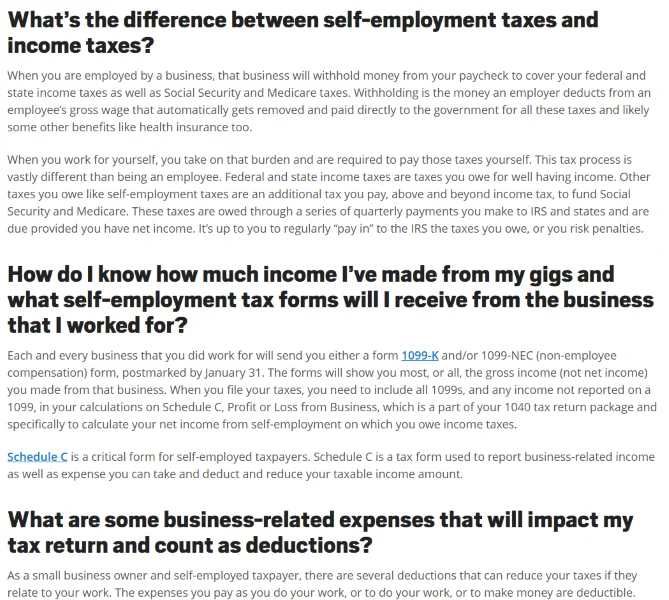
Jackson Hewett is already writing for AI.
Notice how long the subheads are. And each one has a direct answer AI can quickly snatch and share.
This year, expect to see more marketers using natural language questions in subheaders, including scrape-able definitions as section intros, and bundling more entity, audience, and credibility signals at the top of their content.
Why this matters
Google has always said to write for people, not the algorithm. Ironically, it placed AI gatekeepers that read and synthesise our content—meaning it’s AI, not humans, that we need to impress first.
This will motivate more content marketers to write for search engines, especially as answer inclusion becomes the goal. It will matter less that a block of text appeals to humans and matter more that AI can easily extract it.
How to prepare for this trend
First off, do not stop writing for humans. It’ll hurt your brand in the long run. That said, there are a handful of ways you can format your written content so it’s more likely to be included in an AI answer (and even boost your SEO):
- Maintain a logical hierarchy in your articles (Use a single H1, add H2s and H3s that mirror the questions people ask, and include schema markup).
- Lead off section intros of educational content with direct answers to those questions.
- Front-load key info about the audience, topic, and writer.
- Signpost what the content is about with phrases like, “In this guide…”
Here are several more ways to optimize your content for zero-click searches.
💡 Use AI to be cited by AI! Download 200+ Best Prompts Any Business Can Use
4. Email and social media gain ground against search
Gaining zero-visit visibility is a worthy battle. But being seen in an AI Overview is not as valuable as a link click (that’s one of the hills I’ll die on).
That’s why I fully expect content marketers who have seen their traffic from organic search plummet to increase their investments in channels that put them in direct contact with their audience, like email marketing and social media.
I got some validation on this claim when we asked 300 SMBs what their main sources of website traffic were. Social media bested organic search.
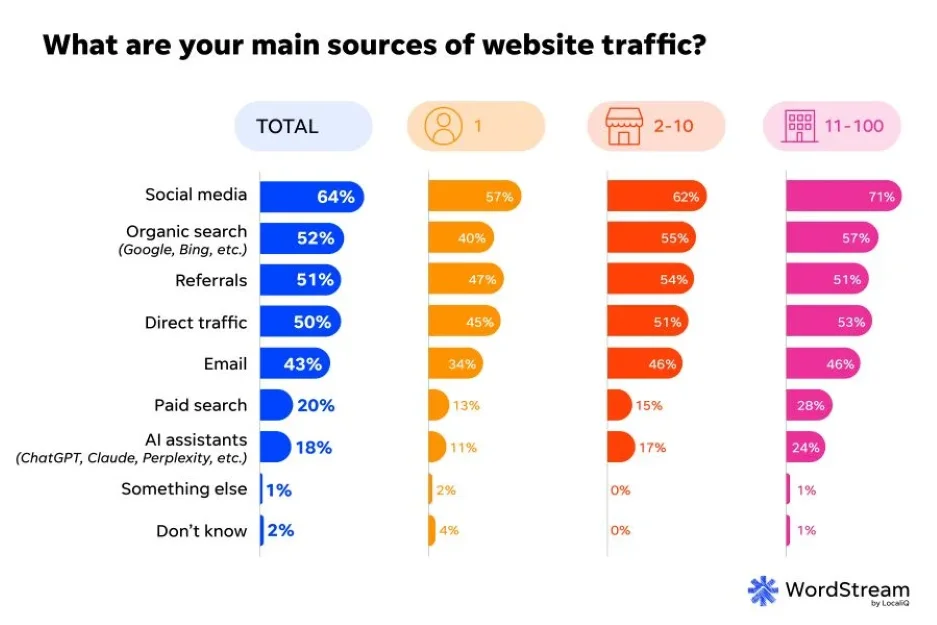
Small businesses tap social media as a leading source of traffic more often than organic search.
As Vova Feldman, the CEO of Freemius, told us, “If Google is sending you less traffic, it’s time to stop relying on one source and build a more resilient strategy. Expanding your reach through other channels helps reduce dependency on organic search.”
Brands will turn to email and social media because they’re accessible, free, and proven to deliver results.
But even for content strategies that focus on search visibility, diversifying your traffic sources will help. AI search engines consider your brand’s full digital footprint when assessing whether your content is trustworthy.
Why this matters
This is another one of those knock-on effects of the shift in search. So it’s worth paying attention to from an academic sense.
For content marketers, it means it’s time to sharpen those social and email skills. There are going to be more brands investing more energy into capturing attention through feeds and inboxes.
How to prepare for this trend
The first thing I’d do is monitor what my competitors are doing. Subscribe to their newsletters and follow their social feeds. It’ll give you a sense of what your audience is reacting to and provide a bunch of inspiration for your own work.
Beyond that:
- Repurpose and promote blog content through new channels.
- Include links where possible to other brand channels (search engines aren’t the only ones that can keep clicks for themselves).
- Experiment with strategies like influencers, even in email, to build credibility and turbocharge audience growth.
5. Content marketers shift from answering questions to having conversations
Google made moves to keep users going down research rabbit holes with its “People also asked” and “People also searched” SERP features. AI chatbots took it to the next level since they’re purpose-built to enable and encourage users to take additional actions.
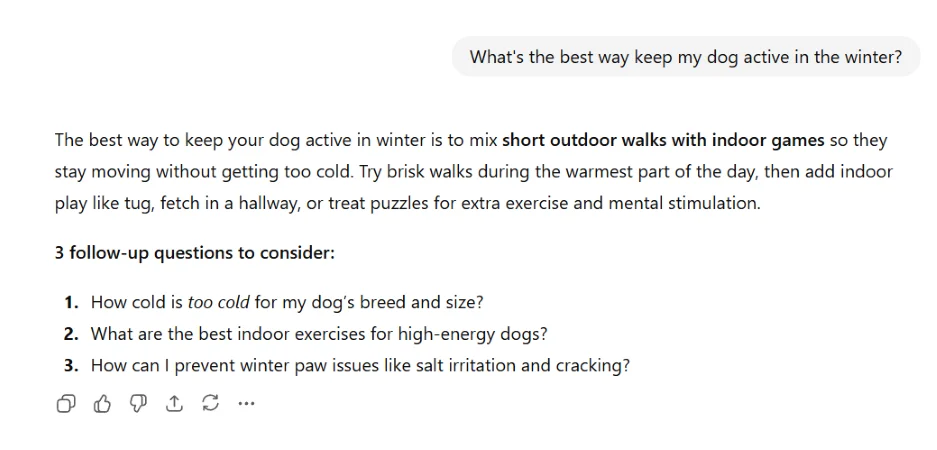
ChatGPT often offers suggestions for the next questions or steps a user can take.
This search behavior is called a query fan-out—when an initial search leads to multiple follow-up questions. It gives users a way to get a broader set of results than a single query would deliver.
During the fan-out, AI has to anticipate the implicit questions embedded in a user’s query. That means content marketers also need to think in terms of a conversation rather than matching the intent of a single keyword.
In 2026, search engine success will rely on a brand’s ability to map query fan-outs and produce content to match them.
Why this matters
There are entire books dedicated to the job of keyword research. Now they’re just the first chapter. Content marketers who focus on search engine visibility will need to learn a whole new set of rules for query expansion patterns.
How to prepare for this trend
Here’s some good news. There are readily available tools that’ll help you map a query fan out. And you don’t necessarily need to create a distinct piece of content for each secondary question.
- Review People Also Ask and People Also Search boxes on the SERPs of your root query to start mapping your fan out.
- Use tools like AnswerThePublic to go a level deeper.
- Ask your AI tool of choice what questions it would likely suggest.
- Build interlinking topic clusters to give AI easy access to secondary answers.
- Include the structural features I mentioned before in your articles (like question subheaders and direct answers).
6. Information gain becomes the single biggest content differentiator
Remember skyscraper posts? I imagine ChatGPT and AI Overviews learned a lot from those exhaustive 10K-word mega-guides. Then they rehashed the info and presented it to users (and MAYBE cited the author).
You know what AI can’t recreate? Original data and first-hand experiences. Which means when AI is looking for data, and you have something unique, it has little choice but to cite you. Plus, that’s the kind of info people can’t get anywhere else, so they’re more likely to click to read more.
“When we analyzed the pages on our sites getting the most traffic from AI sources, we found that articles based around original data or stats accounted for 50% of clicks, while those same pages made up only 5% of clicks from organic search,” said Elisa Gabbert, Director of Content and SEO at LocaliQ. “Tenfold increase shows that AI tools not only link to data sources, but that users also click through to verify the information,” she said.
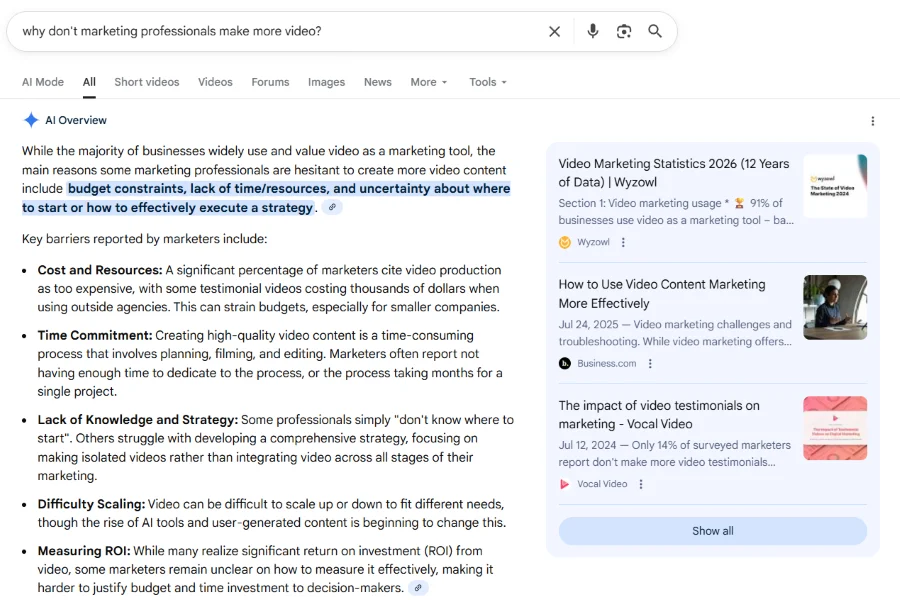
In this example, the brand that published the original research is rewarded with citations.
Publishing your own research and experiences delivers several interconnecting benefits that’ll be important to content marketing success in 2026. That may go double for B2B brands.
For example, data from a single customer survey can get backlinks from other blogs, be mentioned in industry publications, fuel many social posts, and support sales enablement content creation.
That’s why many content pros will be thinking less about creating more and more about creating new this year.
Why this matters
Personal experiences and original data are great at baiting AI search engines and AI-proofing your content. Plus, it’s just really good at positioning brands as experts in their field. Content teams that lean into this trend will position themselves to win on search, social, and—most importantly—with their customers.
How to prepare for this trend
I want to emphasize just how accessible this trend is. You don’t need to commission a thousand-person study (but do it if you can). Even a quick customer survey or peek behind your operational curtain becomes something AI will cite, and customers will respond to.
Here are a few ideas to show you what I mean:
- A CPA could run a quiz on LinkedIn, asking what small business owners hate most about doing taxes.
- A home remodeling business could list the 10 most requested kitchen updates every year.
- A physical therapist could document their own journey of recovering from a sports injury.
7. We’ll see the “human-made” label pop up more often
Coca-Cola took some heat for its awkward AI-generated holiday ad back in 2024 (and again in 2025). H&M and Levi’s also faced backlash for the way they used AI in content. Instances like these were the context behind moves like Meta and European lawmakers creating guidelines around labeling AI content.
This year, brands will flip that script and start labeling non-AI content as “human-made.”
If you flip through LinkedIn, you’ll see that theme mentioned more than before.
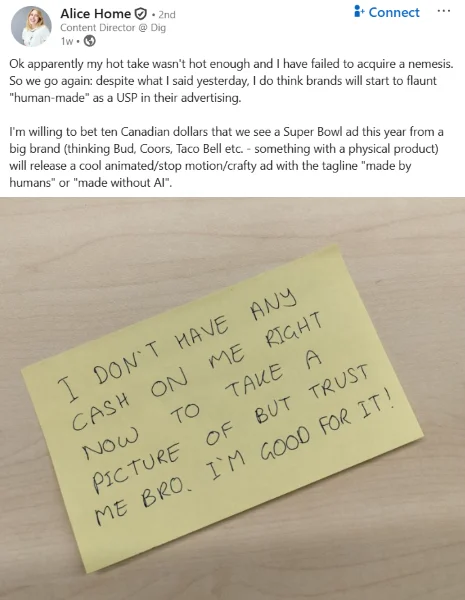
Alice Home, the Content Director at Dig, makes a bold prediction that at least one Super Bowl ad will be tabled with a “Made by Humans” badge.
Consumer preference will add fuel to this trend:
- 52% of consumers say they’re less engaged when they suspect content is AI-generated.
- 57% of consumers want visible labeling to show when a company involves AI in creating content.
- In general, people judge works they believe to be created by humans to be more meaningful and profound.
Copywriter Mel Barfield ran a poll to see if people would read content if they knew it was AI-generated. Most said they would not.
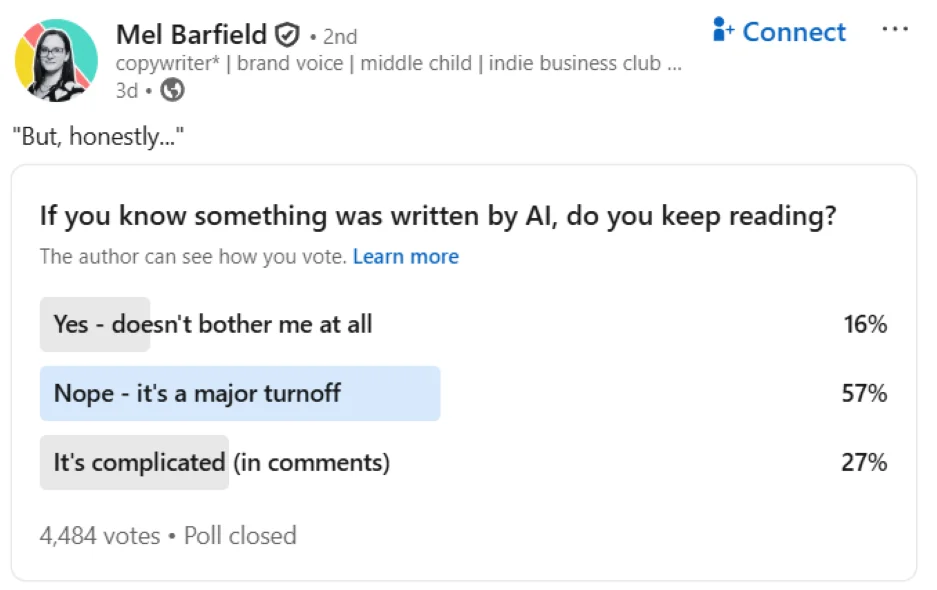
This poll shows that AI-generated content is a turnoff for most people.
Homogeneity is what killed the appeal of AI-generated content and increased support for labeling it as such,” said Reggie Powell, a freelance content marketer and strategist. “Ultimately, no matter what the ‘gurus’ and financial backers of the technology think, people aren’t interested in buying things from AI-generated people, unedited ChatGPT blogs, or voiceovers that do a bad job at being truly human. As AI slop continues to clog the internet, more people will lose patience with lazy content, and labeling AI-generated content will likely become the standard.”
In 2026, the human-made label will be a selling point that content marketers use to signal the quality of their creation.
Why this matters
AI will play an increasingly important role in content marketing. And it has a place in content creation—especially for brainstorming, data analysis, and writing repetitive copy. But brands that promote valuable content assets as “human-made” will generate extra trust with the majority of consumers who prefer it.
How to prepare for this trend
The obvious answer is to start labeling the content you create by hand. But there are a few other actions you can take:
- Confirm every statistic your AI tool provides.
- Spend time reworking any AI copy so it has your brand voice.
- Use AI as a prep cook, not a chef.
- Scrutinize every aspect of any visual asset created by AI.
8. Content teams will rethink reporting
Content marketing has always suffered from an attribution problem. It’s really difficult to know if a buyer was more willing to click on an ad because they read several helpful articles from the brand. The one concrete metric most content teams could point to was website traffic.
Unfortunately, many content marketing teams that made traffic the most important metric in their monthly reports will need to spotlight other measures of success.
Is that a bad thing? I’ll close the Rand Fishkin loop with his take.
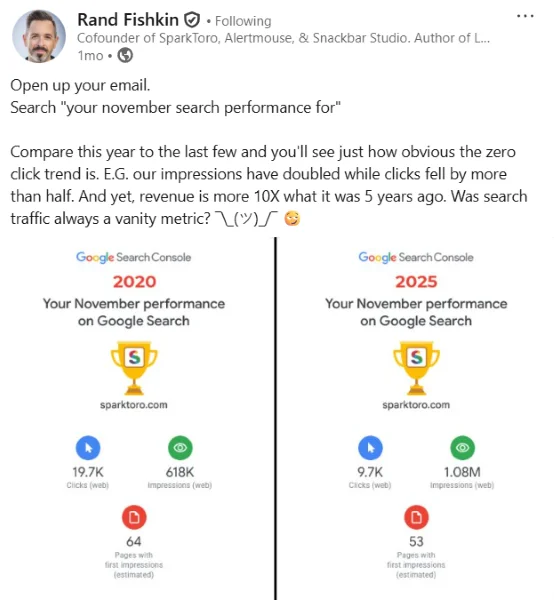
Rand shows that while clicks to the Sparktoro website were down by more than 50% between 2020 and 2025, web impressions blossomed and revenue increased by more than 10-fold.
I don’t know that every brand will have the same positive experience. But as at least some of the focus shifts from clicks to visibility, content marketing reports will reflect that change.
Why it matters
Clicks still matter. In fact, I’d argue that a click is even more important once AI search platforms filter out traffic from low-intent, informational queries.
The challenge is that traffic graphs are going to look abysmal for many content teams. They’ll need to tell a data story around how their work is driving other outcomes, like AI visibility conversions. That’ll change the look of reports and possibly affect the type of content teams produce (e.g., blogs could be filled with more branded, conversion-focused content).
How to prepare for this trend
If your clicks are cratering, I’d start by assessing the type of content you’re producing. Maybe it was great at ranking for a keyword, but it isn’t being cited, mentioned, or driving conversions.
Next, I’d choose two or three core metrics to focus on alongside traffic, like:
- Total Impressions and Average Position in Google Search.
- Brand name searches, also in Google Search.
- Appearances in Featured Snippets, Knowledge Panels, and People Also Ask boxes.
- MQLs, SQLs, and conversions.
- Brand mentions in AI results.
Use these content marketing trends to strengthen your 2026 strategy
Content marketing doesn’t completely revolve around search engines. But they are a significant factor in how we plan, create, and publish content. The goalposts for organic search are shifting dramatically, and that’ll have ripple effects across the entire content marketing practice.
The biggest challenge content marketers face now is balancing creating content that AI can recognize and cite with producing something their customers will respond to. There is some crossover, such as helpful how-to videos that appear in AI Overviews. But the quality chasm will show when AI rewards awkward syntax and formulaic structure over insightful, original content.
The marching orders this year will be to learn, experiment, follow qualified predictions, and, most of all, diversify. Over-reliance on any one third-party channel is a risky long-term bet.
About the WordStream Blog
We've been a trusted source of data, news, and strategy for over 15 years. All of our content is written and reviewed by real people: a dedicated team of professionals with decades of combined experience in marketing and advertising for businesses of all sizes.


Add us as a preferred source on Google
Are you wasting money in Google Ads?

Meet The Author
Rob Glover
Rob is the Senior Copywriter at WordStream and LocaliQ, with over 10 years of experience in paid and organic marketing—including SEO, social media, content marketing, and local search. He’s worked across dozens of industries, from SMBs to enterprise, and now specializes in helping businesses build sustainable growth strategies. His work has appeared in Search Engine Land, eMarketer, and more. Outside of marketing, he loves to travel, camp, and mountain bike with his wife and dog.