About the Author


✨ Quick summary
This article highlights the major ways AI is reshaping marketing in 2026.
Key takeaways
- AI adoption continues growing, with most businesses using AI for content, design, social media, analytics, and more to save time.
- Hyper-personalization and predictive analytics will become standard, letting marketers tailor content and offers in real time.
- Campaign automation and optimization will evolve so AI can continuously test and adjust things without constant human intervention.
- AI will become part of the strategy, not just execution. Marketers will combine AI’s speed with human creativity and judgment at every stage.
- Ethical, transparent AI and first-party data matter more as brands balance personalization with privacy and consumer trust.
AI marketing in 2026 is not about testing new tools; it’s about operating inside an ecosystem where AI shapes how customers search, compare providers, and decide what to do next. Generative engines now sit between your business and your audience, influencing how your brand is interpreted long before anyone reaches your website.
In 2025, we saw how this structural shift began to retire old marketing playbooks.
Now, nearly 800 million people a week use ChatGPT alone to answer questions, compare options, and plan next steps. At the same time, AI-powered search features have reduced organic traffic by 15-64% across categories. Traffic patterns became less predictable, ad behavior shifted, and customers started entering conversations farther along in the decision process.
Many small and medium-sized businesses felt these changes without understanding their cause. The rules changed because the environment changed. AI engines now decide which businesses appear, which details matter, and which signals count as credibility.
This guide breaks down the major AI marketing trends shaping 2026, why they matter for SMBs, and how they are already showing up in real companies. Once you understand the mechanics behind these shifts, you can adapt your strategy before they become permanent.
Contents
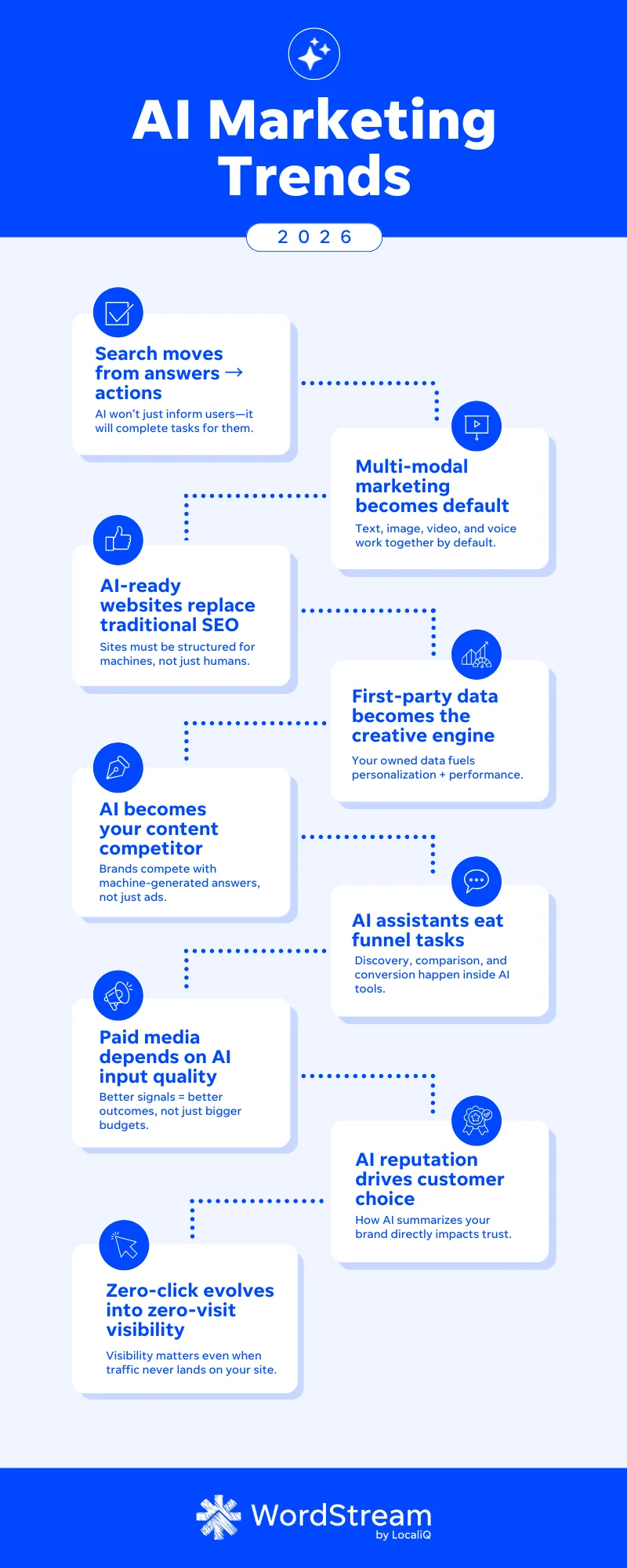
- Search will shift further from answers to actions
- Multi-modal marketing will become the default
- “AI-ready” websites will replace traditional SEO
- First-party data will become the new creative engine
- AI will be your new content competitor
- AI assistants will eat funnel tasks
- Paid media will be determined by AI input quality
- AI reputation will continue to be a huge decisive factor in customer choice
- Zero click evolves into zero visit visibility
9 huge AI marketing trends for 2026
Let’s get into the AI marketing trends you need to know to build your strategy this year.
1. Search will shift further from answers to actions
AI assistants have changed how customers search. Instead of asking for a list of businesses, they ask for a task to be completed. A user no longer searches “plumber near me.” They say “Can you get someone to fix my sink this afternoon?” The assistant does not show options. It selects a provider that it can justify.
Behind that decision is a complex verification process. Assistants rely on structured information pulled from your Google Business Profile, service descriptions, pricing details, reviews, hours, and directory data.
What used to be a ranking exercise has become a confirmation exercise. If the assistant cannot understand what you offer or trust the signals it finds, it chooses a different provider whose information is clearer.
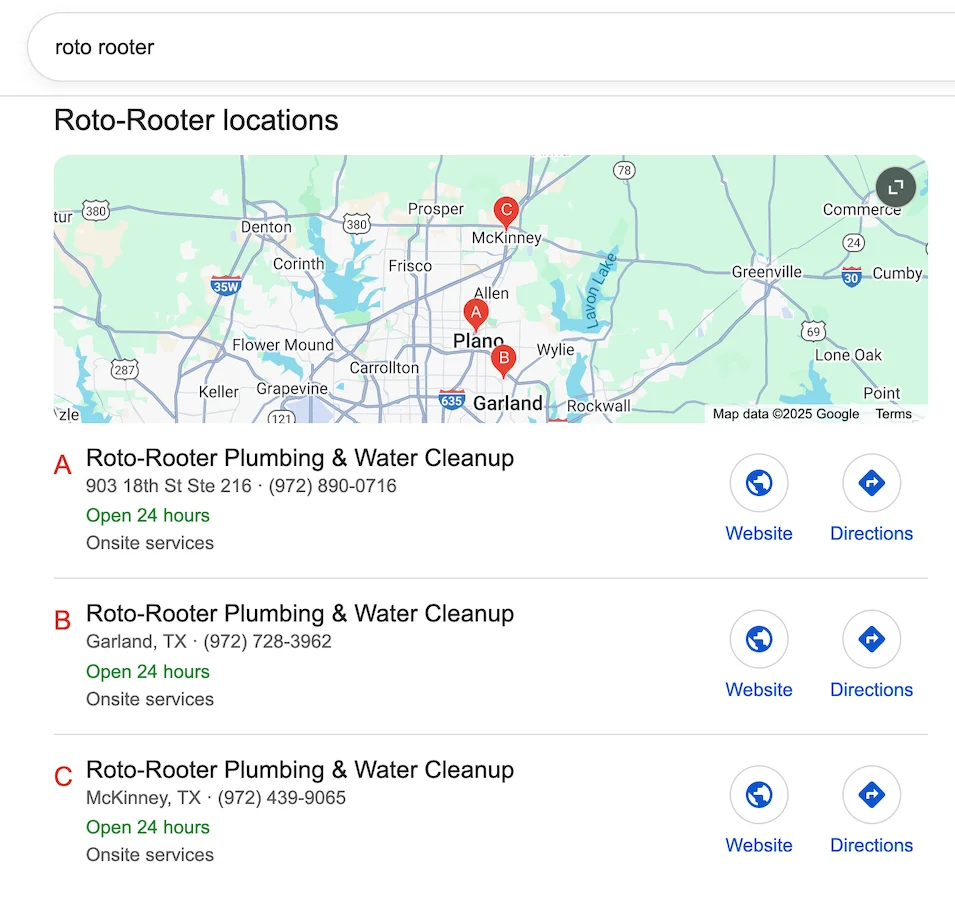
Local Roto Rooter franchises illustrate how this plays out. Their profiles are not glamorous, but they are structured consistently across dozens of listings. Their service categories, hours, and pricing cues match everywhere. When an assistant needs to choose a plumber on behalf of a user, that consistency makes them a reliable option. Many small businesses lose visibility not because their content is weak, but because their information is ambiguous.
Why this matters for your business
Visibility now depends on how easily AI can interpret and reuse your data. Assistants favor businesses that reduce ambiguity. Competitors with cleaner, more structured information become the default recommendation.
What to do
- Add structured product, pricing, and service data that AI systems can read.
- Rewrite the opening paragraphs of core pages to state your identity and purpose clearly.
- Build landing pages with a simple structure and predictable formatting to support AI extraction.
The goal is no longer to optimize for clicks. It is to structure your identity so that an AI system can confidently choose you.
🔎 Need help understanding the modern rules for SEO? Download our free guide >> How to Do SEO Right—Right Now!
2. Multi-modal marketing will become the default
As mentioned above, generative engines have begun prioritizing content that reduces uncertainty. Video, annotated images, and audio explanations provide clearer signals than text alone, so models rely on them more heavily. A short demonstration often teaches an AI system more accurately than a detailed paragraph because it leaves less room for interpretation.
Baker Bettie, a Chicago-based baking educator, illustrates this shift perfectly. Lots of the recipes on her site pair a written explanation with a video walkthrough, annotated images, and a full transcript.
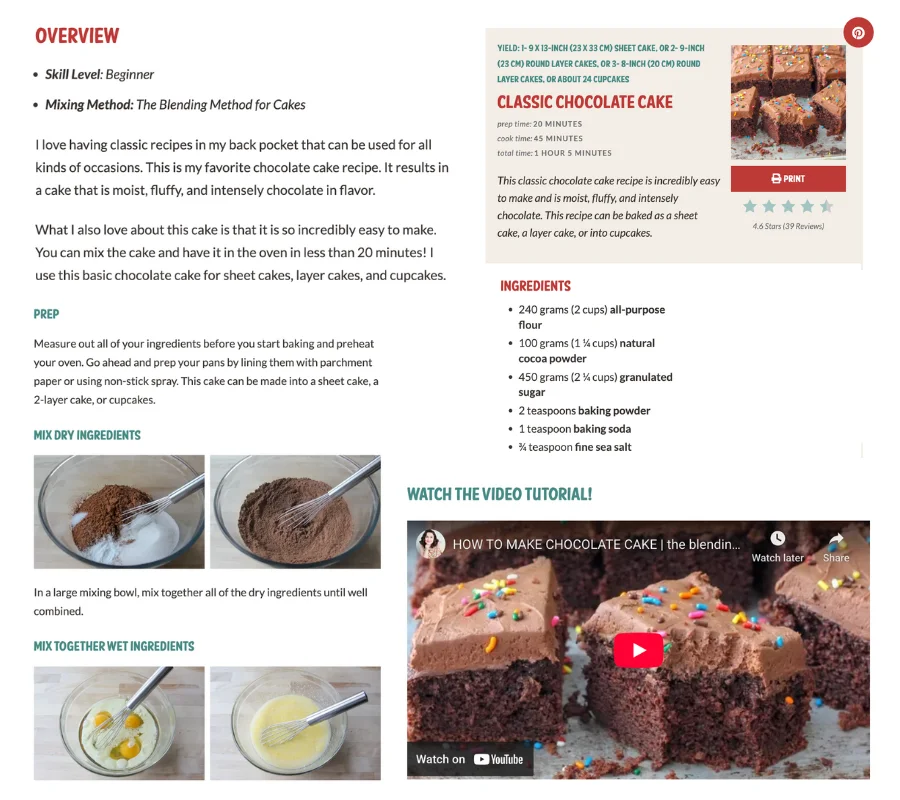
The combination gives AI engines predictable, structured inputs that are easy to parse. Her content is frequently referenced in AI answers, not because it is highly produced, but because it is clear. It shows what is happening, labels it, and reinforces it through multiple formats.
Why this matters
The bar for SMBs is lower than it appears. A yoga studio can film a one-minute breathing demonstration with a phone. A contractor can upload labeled photos of each stage of a repair. These assets give AI more confidence in your expertise than text alone.
Clarity matters far more than production value. AI systems surface content that shows rather than tells, and businesses that create clear demonstrations gain visibility because their content removes ambiguity.
What to do
- Film short explainers for core topics, even with a phone.
- Add transcripts, timestamps, and descriptive summaries so models can interpret each step.
- Pair videos with concise, structured text that reinforces the key concepts.
The goal is to create content that AI can understand easily, not content that tries to impress through complexity.
3. “AI-ready” websites will replace traditional SEO
AI models interpret websites very differently from traditional search engines. They prioritize identity, structure, and clarity over keyword density. The first 150 to 200 words of a page now matter more than many entire articles because that is where models determine who you are, what you offer, and whether your content is usable.
Benjamin Franklin Plumbing illustrates this shift clearly. Their regional service pages open with direct statements about what they do, where they operate, their hours, etc. Nothing is implied. Everything is explicit. Because the structure is predictable, AI systems can parse their pages quickly and reuse them when summarizing plumbing options in local search.
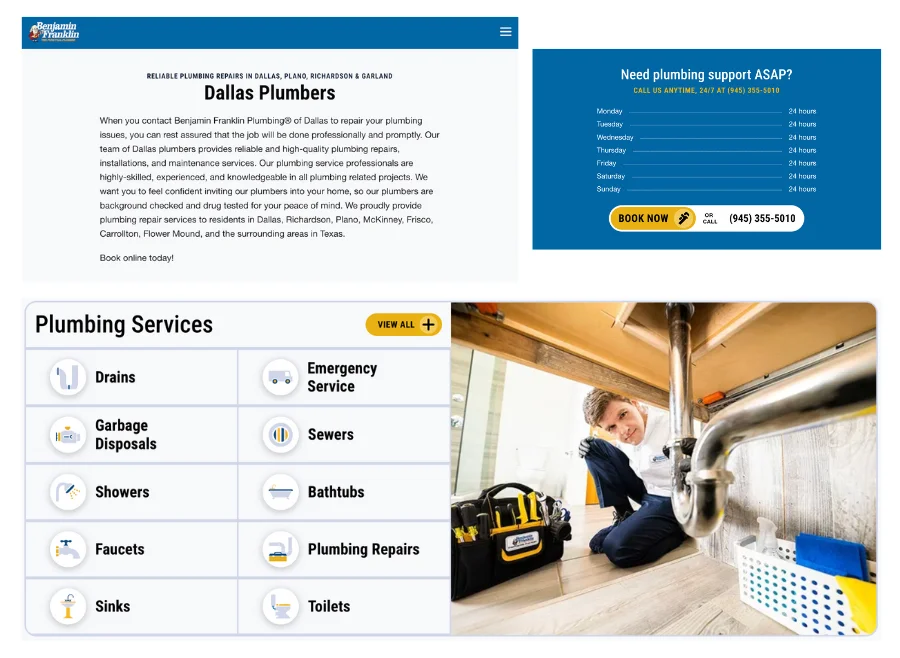
Many small business sites take the opposite approach. Broad slogans such as “Helping you feel confident in your home” offer no concrete information. AI cannot infer whether the business installs windows, repairs wiring, or provides landscaping. The content may look polished, but without clarity, it has little value in an AI-driven environment.
Why this matters
Organic visibility now depends on how easily AI can interpret your identity and expertise. Pages that lack structure or clarity may still rank but will often be ignored in AI-generated answers.
What to do
- Rewrite the first 150 to 200 words of key pages with clear identity, expertise, and intent.
- Add schema markup to FAQs, product pages, service pages, and tutorials to help AI categorize your content.
- Use consistent, descriptive headings and structured formats such as tables or bullets.
- Include author bios and brand identifiers early in your content to reinforce credibility.
AI works best with content it can interpret reliably. Clarity has become the ranking factor that matters most.
4. First-party data will become the new creative engine
AI models are trained on the public web, which means they can already generate most conventional how-to content. What they cannot generate is your lived experience. Original insights, real customer patterns, proprietary methods, and operational data cannot be synthesized from training data, which makes them the most valuable creative assets a business can produce.
Wistia shows how powerful first-party data can be. Their annual State of Video reports use engagement behavior pulled directly from their platform. These statistics appear repeatedly in AI-generated summaries about video marketing because they provide unique facts the models cannot obtain elsewhere.
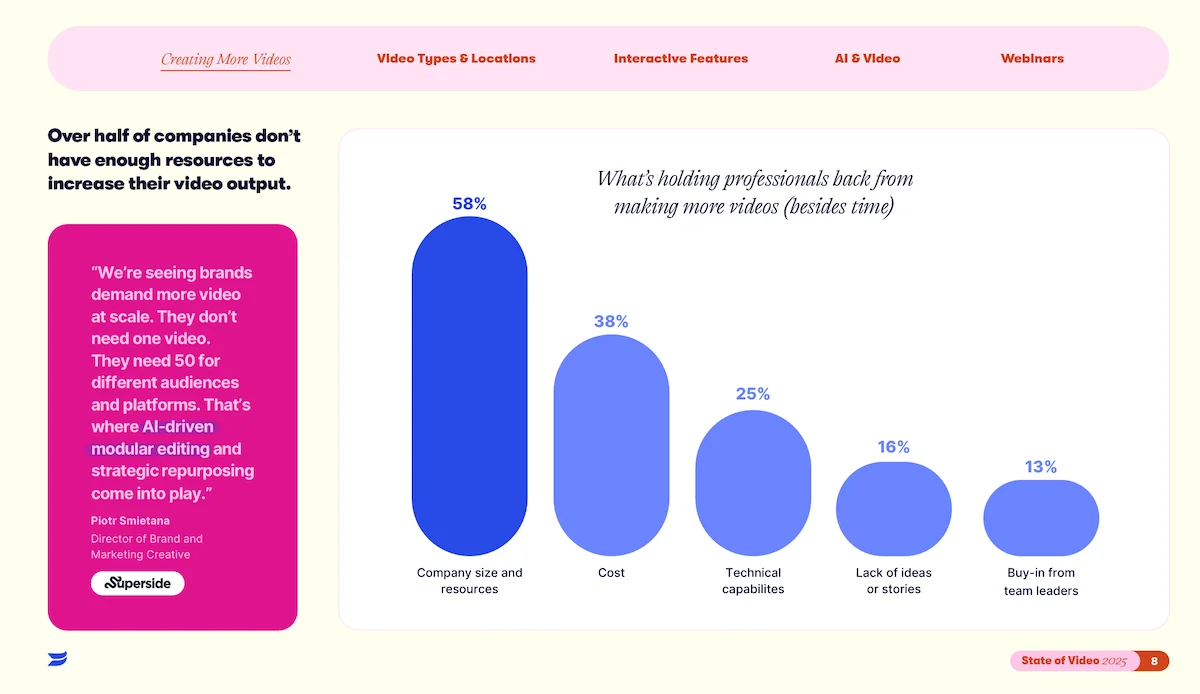
Small businesses often overlook the value of the data they produce. A fitness studio tracks which classes retain members longest. A tax accountant sees seasonal patterns in filing mistakes. A bakery records which pastries sell out first on weekends. These patterns may appear ordinary to the business, but they are original signals that AI systems treat as authoritative.
Oskar Duberg summarized this dynamic well when he said, “AI can summarize what has already been said, but it cannot replicate firsthand proof. Original stories, data, and visuals act as the proof layer.”
Those proof layers now create a competitive advantage because generic content blends together in AI systems.
Why this matters
If your content resembles what AI can generate from its existing training data, it becomes invisible. AI is far more likely to cite or reuse material that contains unique, verifiable insights.
What to do
- Turn CRM or support trends into short research snapshots.
- Document real customer behavior patterns or industry nuances you observe.
- Convert client work into structured case studies that AI can understand.
- Create named frameworks or proprietary methods that anchor your expertise.
Businesses that publish first-party data become candidates for AI citations because models need structured facts to support their answers.
5. AI will be your new content competitor
AI systems now generate long-form answers that include recommendations, comparisons, checklists, and frameworks. This means AI is not just summarizing content. It is producing competing content. Pages that rely on general information lose visibility because the model already produces that information faster and at higher volume.
Mango Street, a photography education brand, demonstrates the right response to this shift. Their content focuses on actual client sessions, lighting challenges, timing decisions, and the reasoning behind creative choices. These details come from direct experience. AI cannot fabricate them convincingly. When models look for high-quality photography explanations, Mango Street’s content carries more weight than generic tutorials.

AI engines treat experiential content as credible because it contains context, constraints, mistakes, and outcomes. Those elements cannot be reconstructed from generic training data. When your content shows the real decisions behind your expertise, you move out of the category where AI can replace you.
Why this matters
Informational articles without lived experience are easy for AI to replicate. The content that survives is the content grounded in real examples and first-person understanding.
AI engines treat this type of content as credible because it contains context, constraints, mistakes, and outcomes. Those elements cannot be reconstructed from generic training data. When your content shows the real decisions behind your expertise, you move out of the category where AI can replace you.
What to do
- Write with specific experience rather than general principles.
- Include examples, commentary, mistakes, and insights drawn from real work.
- Add visuals, screenshots, or step-by-step breakdowns that demonstrate the process behind your advice.
- Build tools, templates, or resources that provide functional value AI cannot imitate.
The competitive advantage now lies in being irreplaceable. Content grounded in real work earns trust from AI systems and customers alike.
✍️ Need help crafting the perfect AI prompts? We’ve got you covered >> 200+ Best AI Prompts Any Business Can Use
6. AI assistants will eat funnel tasks
AI assistants now manage work that once required full marketing stacks. They cluster customer messages, summarize intake notes, outline campaigns, qualify early-stage leads, and create draft content across channels. This shift is not about replacing marketers. It is about processing information across systems far faster than humans can.
Trainual shows how quickly this can scale. Small businesses upload their processes and internal documentation, and Trainual’s AI turns that material into onboarding flows, checklists, and training modules. AI moves from being a tool you use to an operational partner embedded inside your workflow.
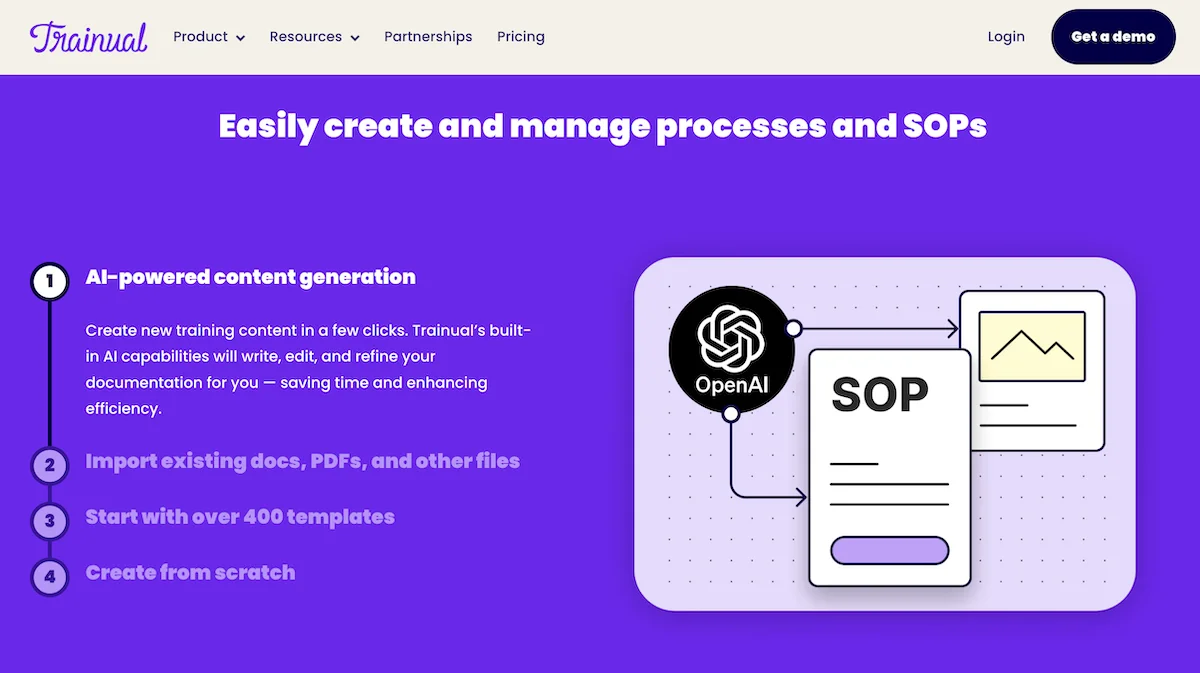
For SMBs, this creates opportunity and risk. AI amplifies whatever structure you give it. Clear processes become leverage. Disorganized knowledge becomes confusion.
As Tamara Omerovic noted, “AI systems learn credibility the same way people do. They notice repeated signals of trust across the web.” The same logic applies internally. Assistants learn from the consistency of your documentation and data.
Why this matters
Execution is becoming automated. The advantage now lies in how well you teach AI to operate inside your funnel. Strategy and clarity (not volume) separate strong performers from everyone else.
What to do
- Create internal guidelines for how your team should use AI and what quality expectations apply.
- Connect your CRM, product data, and analytics to your preferred assistant.
- Train the assistant on brand voice, pricing logic, customer types, and communication rules.
- Use AI for drafts and workflows, then refine the angle and accuracy yourself.
Businesses that train AI to reflect how they operate will outperform those relying on generic out-of-the-box workflows.
7. Paid media will be determined by AI input quality
Automation has rewritten how paid media works. Bid strategies no longer drive performance; the quality of your inputs does.
AI layers inside Performance Max, Advantage Plus, and other automated products also rely on your creative assets, product feed, and landing page structure to understand who you serve and when your ads should appear.
BlendJet demonstrates this clearly. Their product feed includes detailed attributes, multiple image variations, customer reviews, and structured use cases.
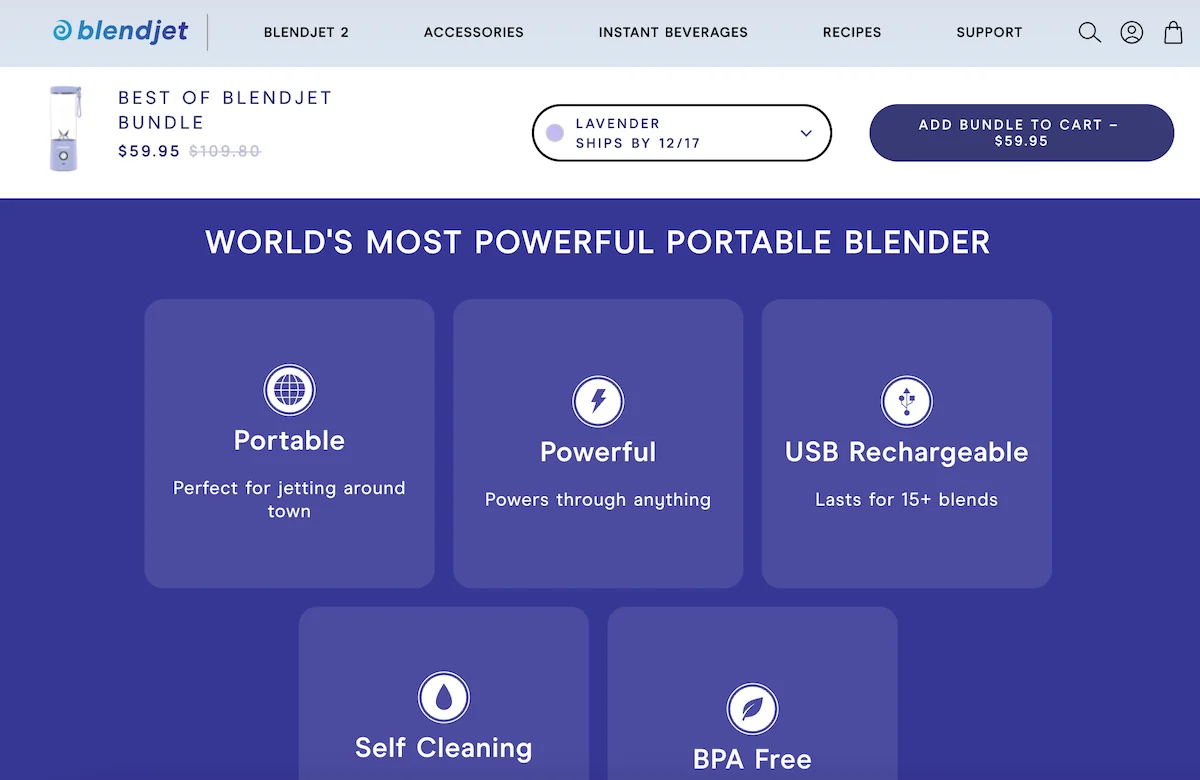
Because the information is rich and consistent, AI systems recognize when a BlendJet is relevant for travel, meal prep, fitness, or camping.
Many SMBs do the opposite and provide too little data, which forces the system to guess and weakens performance.
Paid media in 2026 is not about micromanaging platform settings. It is about supplying clear signals and removing ambiguity.
When automation is the default, clarity becomes the competitive advantage.
Why this matters
Ad performance depends on the strength of your inputs: creative quality, metadata, product feeds, and landing page clarity. If those signals are weak, no bidding strategy can fix the results.
What to do
- Build landing pages that clearly communicate identity, value, and product details so AI can categorize your offer.
- Publish frequent creative variations to help automated systems learn faster.
- Feed PPC platforms with higher-quality first-party data, including audience segments and conversion signals.
- Treat paid media as continuous experimentation rather than a set routine.
Businesses that supply clearer inputs consistently outperform those relying on platform defaults.
🚀 Want to learn how AI can supercharge your ads strategy? Free guide >> 9 Powerful Ways to Use AI in Google & Facebook Ads
8. AI reputation will continue to be a huge decisive factor in customer choice
AI assistants summarize your business. These summaries draw from reviews, local listings, social profiles, press features, and older content across the web. If the signals are inconsistent or outdated, the picture AI presents of your business will be inaccurate, and that will cause various problems.
Mint Dentistry, a Texas-based dental chain, shows the value of consistency. Their Google Business Profile, directory listings, review patterns, and social content all reflect the same identity.
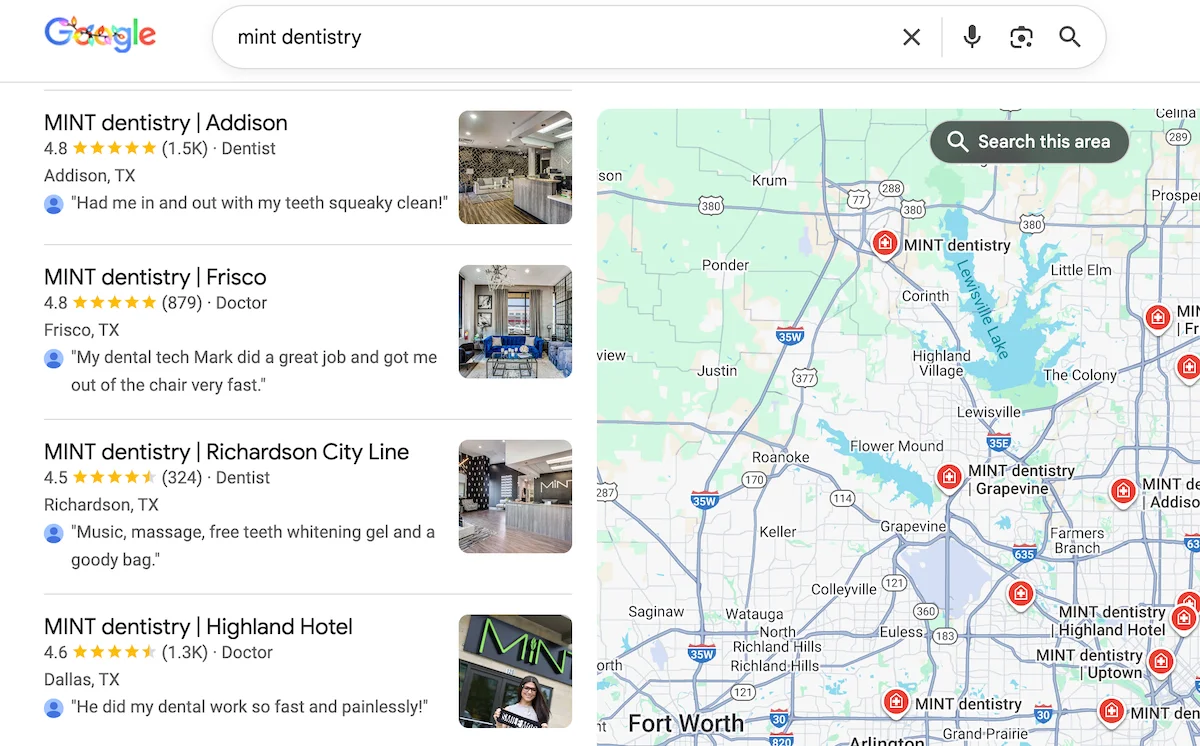
As a result, AI systems reliably describe their services, pricing cues, and specialties.
The opposite happens when a business calls itself “cosmetic dentistry” in one directory and “family dentistry” in another. AI does not reconcile the difference. It adopts the dominant pattern, even if it is wrong.
This mirrors a point Stephanie Heitman made in one of our previous articles: “Author credibility is extremely important. It helps us provide the most relevant and insightful information to our audience.” AI applies the same principle. It rewards businesses whose public footprints are clear and consistent.
Why this matters
Most customers now encounter your business inside an AI interface. If the assistant’s summary is incomplete or incorrect, trust erodes before you have the chance to tell your story.
What to do
- Strengthen your presence on authoritative platforms such as LinkedIn, G2, Google Business Profile, and niche directories.
- Update identity, service descriptions, and product details across the web to eliminate inconsistencies.
- Monitor how AI tools describe your business and reinforce accurate information with stronger, more consistent signals.
- Invest in PR mentions and expert contributions to strengthen external validation.
Your AI reputation is now a core element of your brand. Treat it with the same care as your website or marketing.
9. Zero click evolves into zero visit visibility
Zero-click search is no longer confined to Google. In 2026, it stretches across ChatGPT, Perplexity, Gemini, Bing, and Meta AI. Users ask questions inside these tools, receive instant answers, and often never reach a website. Your content becomes a source rather than a destination.
Bob Vila’s website demonstrates this shift. Their home improvement guides use clear steps, super relevant images, and structured explanations. Because the content is easy for AI systems to interpret and reuse, it appears frequently in generated answers.
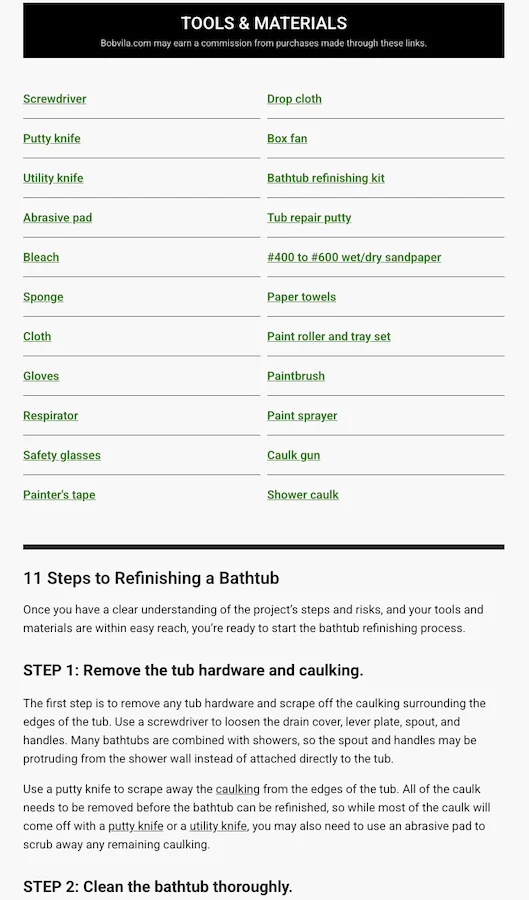
Visibility increases even when traffic does not. Their content wins because it is designed for extraction, not just reading.
For SMBs, this requires a new definition of success. A drop in clicks does not always mean a drop in reach. In many cases, your expertise is being surfaced more often, only in a different format.
Why this matters
Traffic declines can hide the fact that your business is being cited and referenced more inside AI environments. Visibility and accuracy matter more than visits.
What to do
- Track impressions, citations, and branded search lift across AI platforms, not just website traffic.
- Create short, structured definitions and summaries that models can reuse in answers.
- Add extractable one-sentence takeaways to content and landing pages.
- Shift performance reviews toward visibility and brand demand rather than clicks.
You are no longer competing for a click. You are competing for representation in an assistant’s answer.
Consider these AI marketing trends as you build your 2026 strategy
AI has not rewritten marketing entirely. It has rewritten the parts that involve discovery, interpretation, and recommendation. Those changes happen early in the customer journey, long before someone visits your website. For small and medium-sized businesses, the playing field is different but not disadvantageous.
The businesses that thrive in 2026 are the ones that make themselves easy for AI to understand. They publish information that is structured, credible, and rooted in real experience. They maintain consistent identity signals. They create content that clarifies rather than decorates. They document their processes so assistants can help them, not hinder them.
When you shift your focus from ranking to recognition, the AI-driven environment becomes less unpredictable and more interpretable. Your goal is not to beat the algorithm. Your goal is to make your business the clear, reliable option in a system that is designed to choose on behalf of your customers.
About the WordStream Blog
We've been a trusted source of data, news, and strategy for over 15 years. All of our content is written and reviewed by real people: a dedicated team of professionals with decades of combined experience in marketing and advertising for businesses of all sizes.


Add us as a preferred source on Google


Meet The Author
Goran Mirkovic
Goran Mirković is a marketing leader with over a decade of experience in SaaS growth, SEO, content strategy, and demand creation, a freelance contributor for WordStream, and a 2x CMO. With a background spanning both agency and in-house leadership roles, he focuses on AI-era search, the evolution of content marketing, demand creation, and practical strategies that help businesses turn expertise into revenue. Outside of marketing, he is a dedicated cinephile with a particular obsession for horror films.
Recommended for you