About the Author


A few years ago, people searched Google, clicked on your site, and decided what they thought of your products and services. Today, someone scans an AI Overview on Google and judges your business by how the AI summarized it.
And just like that, your thoughtfully crafted product page gets summarized to five sentences, and your purposeful positioning is flattened into a generic description that doesn’t motivate buyers to choose you.
AI’s summaries now sit between your content and your audience. It decides what parts of your page matter, discards what feels repetitive, merges you with competitors who sound pretty much the same, pushes structure over storytelling, and prioritizes clarity over personality.
This article is about fixing that. We’ll break down how AI summarizes your content, why most small business websites don’t hold up to it, and how to restructure your pages so your differentiation survives.
Contents
- How does AI summarize content?
- Why your content is failing under AI summaries
- The five principles of summary-resistant content
- The AI summary test
🔎 Is your business getting seen in AI search? Download The Complete AI Search Toolkit: Practical Strategies to Get Found by AI
How does AI summarize?
Generative AI systems summarize your content by:
- Pulling extractable claims
- Removing repetition
- Merging similar positioning
- Stripping narrative build-up
- Reassembling everything into a short, coherent answer
If you ask AI, “Explain how this company is different,” it doesn’t read your page the way a human does. It scans for:
- Definitions
- Numbers
- Comparisons
- Clear audience statements
- Structured sections
Then it compresses what it finds. Your origin story disappears, your tone becomes neutral, and the best case study you’re super proud of becomes nothing more than a bullet point.
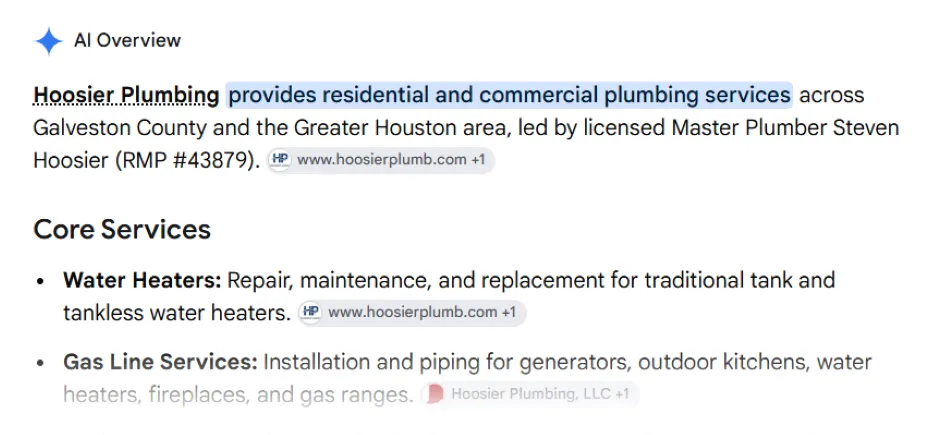
AI compression says what your business does without explaining why it’s great.
In doing so, AI rewards structure. If your page is built on adjectives and vibe, AI reduces you to category-level language.
Stephanie Yoder, Director of Content at Rebrandly, puts it bluntly: “People who used to read three articles to understand a topic now get a synthesized answer in seconds. If your differentiation isn’t structurally obvious, it won’t survive that synthesis.”
Now you’re no longer competing just for ranking. You’re competing to survive interpretation.
🛑 AI visibility starts with solid SEO. Boost yours with How to Do SEO Right—Right Now!
Why your content is failing under AI summaries
There are consistent patterns behind pages that collapse into generic summaries. None of them have anything to do with intelligence or effort. They’re simply devices that work well with humans but get flattened by AI.
1. It relies on adjectives instead of structure
Many business websites, especially in industries like HVAC and lawn care, are filled with language that sounds good in a sales conversation: high quality, reliable, family-owned, trusted, customer-focused. Those phrases help shape tone and signal friendliness. When someone reads your site end to end, they contribute to perception.
Under AI compression, however, they carry almost no weight because they aren’t measurable and don’t structurally separate you from competitors.
If 15 HVAC companies in the same city describe themselves as “trusted” and “reliable,” that language cannot function as a differentiator in a summarized answer.
Imagine a regional HVAC company being asked in an AI prompt: “What makes this HVAC company different?”
If the homepage leans heavily on phrases like:
- Reliable service
- Experienced technicians
- Customer satisfaction guaranteed
An AI summary will likely echo something like: “Provides heating and cooling repair and installation services.”
That description applies to almost every HVAC contractor in the market.
Now compare that to structural differentiation: “We guarantee same-day service for calls placed before 3 PM and provide upfront flat-rate pricing before any work begins.”
Look at what survives compression there:
- A defined service window
- A clear pricing model
- A process commitment
Those are mechanisms. They are operational details. They are much harder to flatten into generic category language.
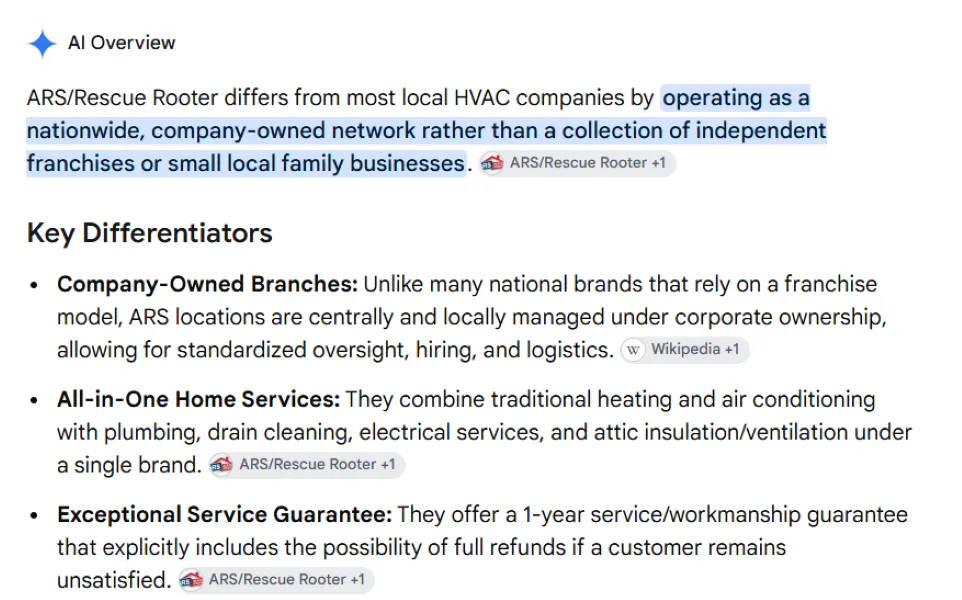
Operational details, not generic descriptors, survive AI compression.
When AI compresses that page, it is far more likely to keep something structurally distinct like: “Offers same-day service with upfront flat-rate pricing.”
If your differentiation lives in adjectives, AI erases it. If it lives in how you operate, AI preserves it.
2. The core differentiator appears too late
AI systems disproportionately pull from:
- The first 150 to 200 words
- Section headers
- Lists
- Tables
- FAQ sections
If your strongest positioning is buried halfway down the page, it may never make the summary.
This is a common pattern in home service industries. A lawn care company might open its homepage with a paragraph about being locally owned, caring about the community, and loving beautiful lawns. Only later does it mention the specific program, guarantee, or specialization that actually makes it different.
AI reads the narrative, doesn’t see anything concrete it can quote, and simply states that the business maintains lawns.
Alternatively, if the high-priority services and differentiators are provided first and often, what survives compression more reliably are structural signals such as:
- A multi-step lawn treatment program
- Scheduled seasonal applications
- National service coverage
- Specific guarantees
Those details communicate scale, systemization, and scope immediately.
For local businesses, your first three sentences must clearly state who you serve, what makes your service model different, and any meaningful boundaries.
For example, let’s take a look at this opening: “We provide HVAC maintenance plans for homeowners in [City] with systems over five years old. Our technicians specialize in high-efficiency units and offer 24-hour emergency response for plan members. We do not service commercial buildings.”
It contains audience, differentiation, and boundaries. Even if AI compresses it, the core positioning survives.
Warm-up paragraphs about your founding story or general industry commentary assume a human reading path that compression does not follow. In a summarized environment, clarity at the top determines whether your differentiation makes it into the answer.
3. It lacks extractable comparison structure
AI favors structured comparison over storytelling. Humans will read narrative explanations, but AI prefers contrast.
When your content explains everything in paragraphs, AI compresses it into vague summaries. When your content compares clearly, AI preserves distinctions.
For example, imagine Basecamp Outdoor describing its products in broad prose about loving the outdoors and curating the best gear for serious adventurers.
An AI summary might condense that into “an outdoor equipment retailer.”
Now imagine the same site presenting a structured comparison between ultralight and traditional backpacking gear, outlining pack weight ranges, trip-length considerations, and skill-level differences.
Here’s how that might look when comparing ultralight vs traditional backpacking gear:
| Feature | Ultralight | Traditional |
|---|---|---|
| Pack weight | Under 20 lbs | 30–45 lbs |
| Trip length | Short/fast | Extended |
| Skill level | Advanced | Beginner-friendly |
This structure contains defined thresholds and clear use cases. Even if the full table is not reproduced, the underlying distinctions are more likely to survive in summarized form because they represent concrete decision logic.
When your content is organized around decisions (when to choose one option over another, which conditions favor a certain approach, who a solution fits best), it becomes easier for AI to preserve the meaningful differences.
4. It avoids clear boundaries
Many businesses hesitate to define who they are not for because they do not want to narrow their audience. In practice, a lack of boundaries makes it easier for AI to flatten you into the broadest possible category.
If Turo were summarized as “a car rental company,” that misses the point.
The structural difference (peer-to-peer marketplace instead of traditional fleet ownership) is what survives compression. That business model distinction is clear, concrete, and operational. Even in short summaries, AI typically retains the idea of “peer-to-peer car sharing platform.”
If you run a regional rental agency and your site just says “affordable car rentals,” compression reduces you to category-level language. If you clearly state “luxury-only short-term rentals in Miami with delivery to hotels,” that boundary survives.
5. It competes in broad categories
Broad prompts produce broad answers. When someone asks for the best bookkeeping software for small businesses, an AI system is likely to default to well-known software brands.
If someone asks “Best bookkeeping software for small businesses,” AI likely lists major software brands. But an option like Bench would disappear if it were framed generically.
A description like this would survive, though: “Bench pairs small businesses with dedicated human bookkeepers and monthly financial reports, instead of self-serve accounting software.”
Now:
- It’s differentiated from software
- The human model survives
- Category contrast survives
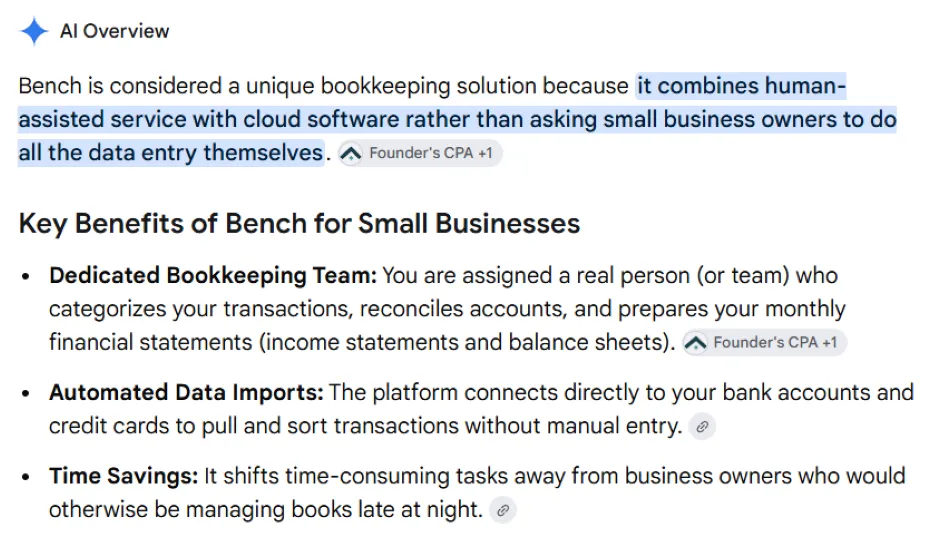
AI compression works in your favor when it can describe what you do to the niche you serve.
AI compression preserves contrast better than category similarity.
If you want to survive compression, stop competing at the broadest level. Define your niche clearly enough that AI can’t flatten you into the default list.
How to create AI summary-resistant content
Now let’s turn this into a practical framework.
1. Lead with positioning, not warm-up
Your opening must answer:
- Who is this for?
- What makes it different?
- What is it not?
No generic intros.
| Bad | Better |
|---|---|
| “In today’s competitive market…” | “We provide done-for-you bookkeeping for ecommerce brands under $5M in annual revenue. We don’t sell accounting software. You get a dedicated team and monthly financial statements.” |
Our better option survives compression.

Real explanations of what you do, how you do it, and who you do it for beat generic statements in AI compression.
2. Replace adjectives with mechanisms
AI strips out adjectives, while mechanisms make it through to the humans you hope to sway.
| Bad | Better |
|---|---|
| Premium ingredients | Ingredients sourced within 150 miles |
| Fast service | Dispatch within 72 hours for service members |
| Best-in-class support | Support response in under 2 business hours |
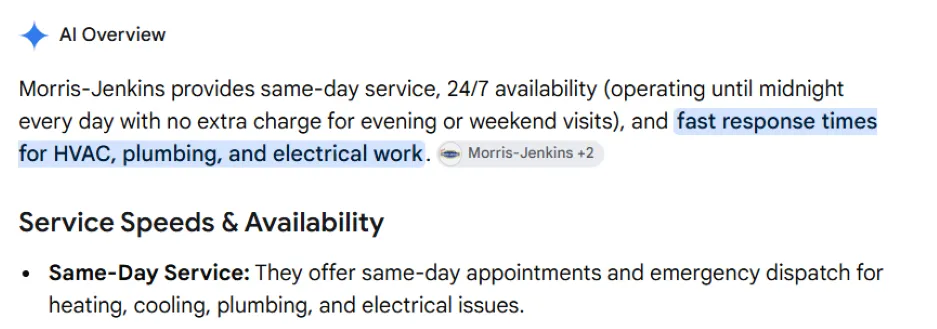
Mechanisms help AI build the case for your business when someone has a specific need.
Mechanisms give AI something stable to extract. They also give buyers something real to evaluate.
3. Use named systems
Generic headings fade when AI compresses your copy. Named constructs persist and become the things that help persuade people to choose your business.
| Bad | Better |
|---|---|
| “Our approach” | The 18–24 Hour Fermentation Model The Human-First Bookkeeping Framework The Ultralight Decision Matrix |
Named systems create memory anchors and improve extraction clarity.
4. Quantify whenever possible
AI extracts:
- Timeframes
- Ranges
- Limits
- Volumes
| Bad | Better |
|---|---|
| “Affordable” | “$3,200–$5,100” |
| “Quick turnaround” | “Delivered in 48 hours” |
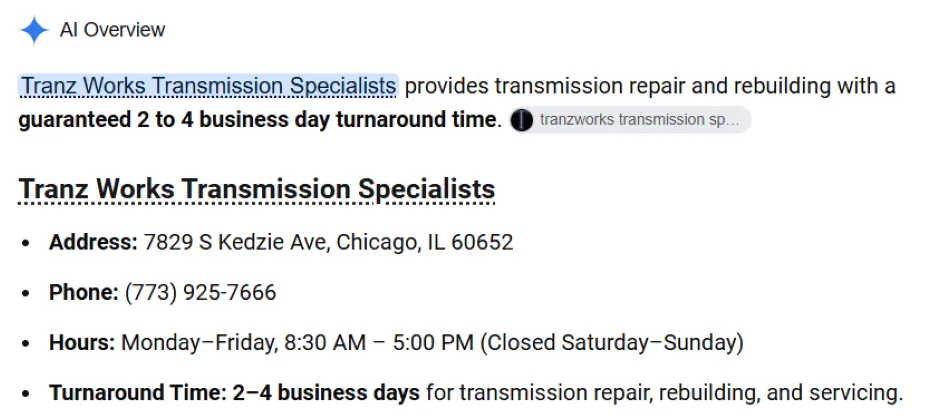
Specifics like a “two-day turnaround time” get picked up by AI when “fast repair” may not.
If you can measure it, write it.
5. Build sections that stand alone
Every section should survive being pulled out of context.
Ask: “If AI lifted only this section, would it still represent us accurately?”
If not, add:
- A scope statement
- A boundary
- A number
- A comparison
Make every section extraction-ready.
The AI summary test
A practical way to evaluate your pages is to simulate compression directly.
Paste your draft into a generative AI tool and ask for a five-sentence summary. Then read that summary critically. Does it still sound like your business? Does it reflect your niche and your operational differences? Or does it sound like a generic description of your category?
If the compressed version feels interchangeable with competitors, the issue is almost always structural. The differentiation is either too vague, too buried, or too similar to industry language.
Adjust the structure, clarify the mechanisms, and run the test again. The goal is not to manipulate the AI, but to make your positioning clear enough that it remains intact when condensed.
Your content can’t afford to be summarized generically
AI summaries are already shaping how buyers evaluate options. It influences early-stage understanding and frames the comparison before your website even enters the picture.
The businesses that maintain visibility in this environment are the ones that write with structural clarity. They are specific about who they serve. They define how they operate. They quantify what they can. They make their decision logic visible.
When your positioning is built on clear, extractable signals, it remains recognizable even after compression. When it relies primarily on tone and broad descriptors, it dissolves into the category.
In an AI-designed search environment, being visible increasingly depends on being representable in summary form. Writing with that reality in mind is about making sure your hard-earned reputation doesn’t get flattened into generic descriptions.
About the WordStream Blog
We've been a trusted source of data, news, and strategy for over 15 years. All of our content is written and reviewed by real people: a dedicated team of professionals with decades of combined experience in marketing and advertising for businesses of all sizes.


Add us as a preferred source on Google
Are you wasting money in Google Ads?


Meet The Author
Goran Mirkovic
Goran Mirković is a marketing leader with over a decade of experience in SaaS growth, SEO, content strategy, and demand creation, a freelance contributor for WordStream, and a 2x CMO. With a background spanning both agency and in-house leadership roles, he focuses on AI-era search, the evolution of content marketing, demand creation, and practical strategies that help businesses turn expertise into revenue. Outside of marketing, he is a dedicated cinephile with a particular obsession for horror films.
Recommended for you