Free tools, calculators, and apps are incredibly useful for engagement and lead generation. But until recently, they were out of reach for most marketers and small businesses (unless you also happen to be an expert coder).
Vibe coding changed all that. Now, a services business can spin up a professional project calculator. A yoga studio can create a one-off webpage to promote their latest new-client special. And an automobile service shop can build a maintenance tracker app that reminds users when their next oil change is due.
In this guide, we’ll share the eight vibe coding best practices pros use to get the best outcomes, and give you a few vibe coding project ideas for marketing to get started.
Contents
What is vibe coding?
Vibe coding means building software and apps by describing what you want in plain language to an AI tool so it can write the code for you. The idea is to build through conversation, where you are the director and tester and the AI tool acts as the coder.
For marketers, it might help to think of how you’d use AI to write copy or create an image. You prompt the AI tool to write something, review the copy, and ask it to iterate until you’re happy with the output. Vibe coding is the same, but the output is an app or program instead of ad creative or a blog post.
For example, you might tell Claude or ChatGPT to “Build me a simple ROI calculator for a local business running online ads.”
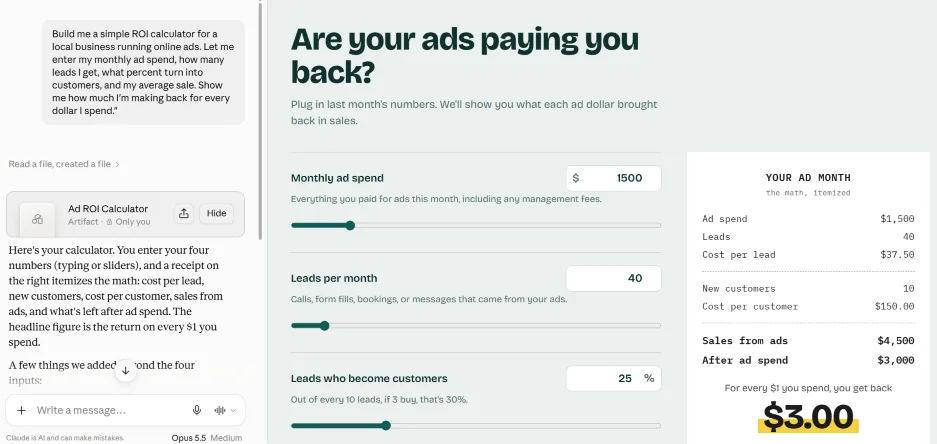
Then you can follow up with prompts like “add a field for my monthly software costs” or “make it look more professional.” No actual coding needed.
👋 Get better output with better prompt inputs. Download 200+ Best AI Prompts Any Business Can Use
8 vibe coding best practices for marketing and beyond
Vibe coding is super simple to start. You can build your basic tool with a single-sentence prompt. But to create apps and tools capable of complex work, and that you’d be proud to show in public, there are a few more steps to take.
These best practices will help you become a pro vibe coder. They come from three professionals who have collectively vibe coded dozens of marketing assets.
1. Give AI room to brainstorm
I like the word “vibe” in vibe coding. It gives you a sense of a freewheeling thought exercise instead of a rigid programming process.
It’s that, um, vibe that Josh Hobson, Website Developer for LocaliQ, said you should keep intact.
“Start with stating your end goal in a broad way that allows AI to come up with multiple varied solutions,” he explained. “Try to avoid tying yourself to a specific action or tool here; only state your intended outcome for the project.”
One way to do this is to explain the problem you’re facing instead of asking for a specific app.
Let’s say you work for a landscaping company. You could ask for “a quote calculator for my landscaping company’s website.” The AI will build exactly that. It might be great, or it might be the wrong tool for the problem.
Here’s an outcome-first prompt that lets AI spread its wings:
I own a landscaping company, and my office manager spends hours every week answering calls from people who just want a rough price. I want to cut down on those calls and get more serious leads coming through my website. What are a few different things we could build to help with that?
With that, you might get:
- A quote calculator that gives a price range based on yard size and services.
- A short quiz that recommends a service package and collects contact info at the end.
- A photo upload form where customers send pictures of their yard for a faster, more accurate estimate.
- A pricing FAQ page that answers the most common cost questions before anyone picks up the phone.
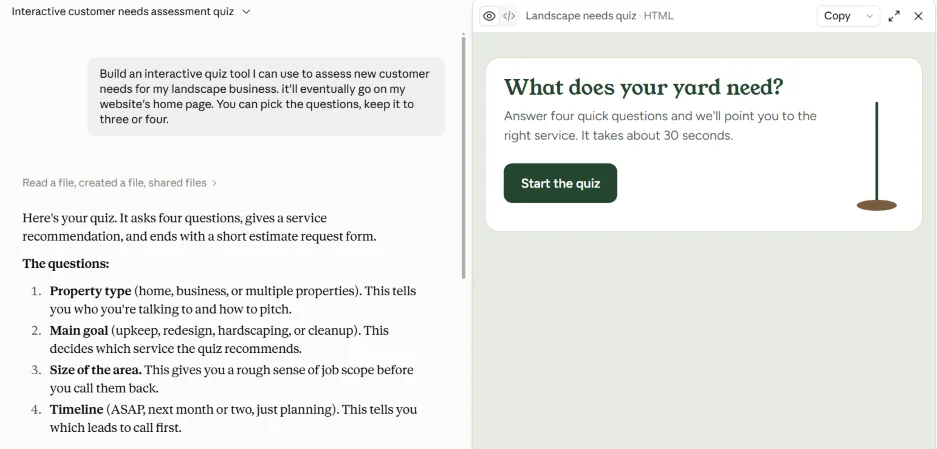
Since vibe coding is so fun, you may just build all of them.
3. Start with your platform in mind
There’s a lot to be said for just playing around in Claude Code to see what’s possible. But when you need it to work in a professional setting, it has to fit into the technology jigsaw your platform is built around.
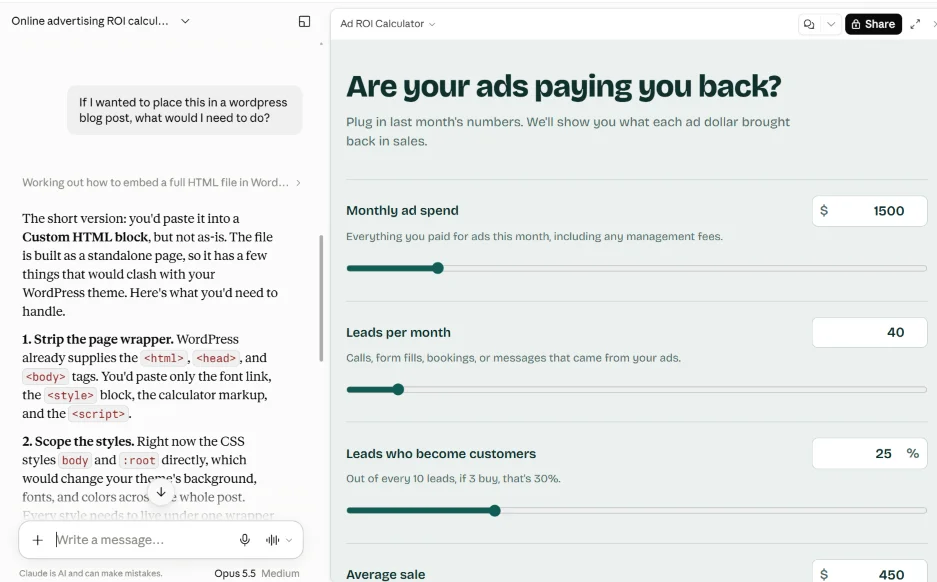
“Where your app is going to live and what that platform can and can’t support is something you should consider early on in the project,” Josh said. “For example, it’s important to tell your AI tool if the end result will wind up on WordPress, Squarespace, Wix, or something else so the AI builds something that works within the architecture of that platform.”
It can get pretty complex in the backend. But if you have a clean start, your vibe coding tool will take care of all that. “The best rule of thumb is to keep it simple,” Josh added. “Before it starts building, ask your AI tool what approach will work best for your platform. When in doubt, a tool or app built with the simple front-end web stack (HTML/CSS/JS) can go a long way, since most website platforms let you embed it.”
And don’t worry. Your AI tool will know how to build with the right front-end web stack if you tell it where you plan to publish.
3. Learn from your vibe coding
One of the knocks on using AI for creating anything is that it reduces the need to think through processes. It doesn’t have to throttle your own development, though.
“Get a good understanding of what your code is doing,” Josh said. “These tools can accomplish a lot for you and can teach you just as much.”
That can mean asking follow-up questions about how the AI decided to do what it did or what you can do next.
“Additionally, once you start scaling your applications, it will become essential that you know how it works,” Josh said. “Ask questions about how your application is working, what and why it is doing what it is doing, and learn from it. One of the most valuable things that AI can do for me personally is teach me things.”
🛑 Is your search strategy AI-ready? Get The Complete AI Search Toolkit: Practical Strategies to Get Found by AI
4. Let AI interview you
Katie Parrott is a staff writer at Every. She uses AI to build skills and tools that support her work writing about AI, so I was really interested to hear her best practices.
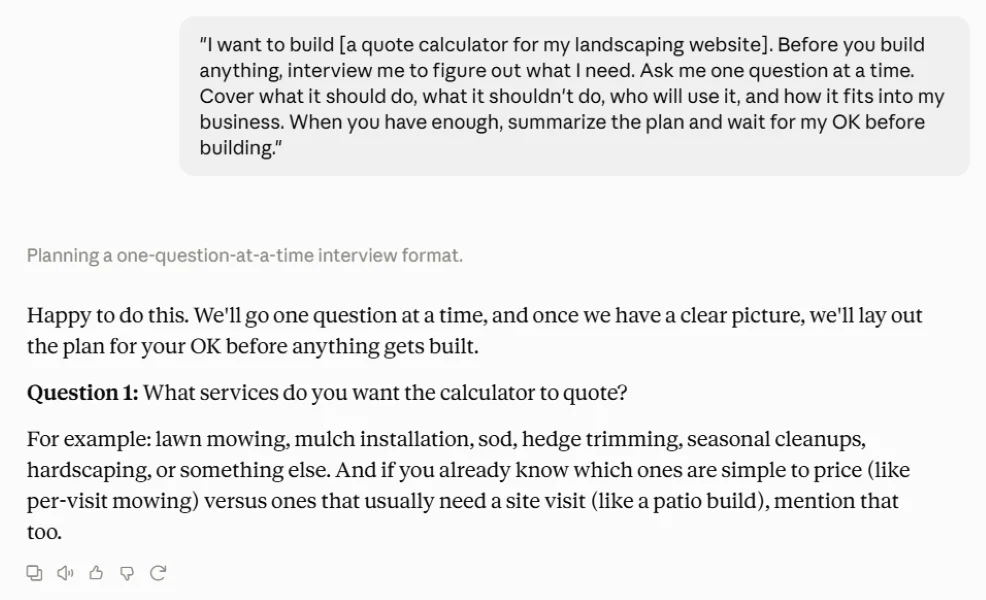
The first one she shared is so simple but extremely useful. Instead of trying to craft a prompt that perfectly encapsulates the app she’s trying to code, she has AI ask her questions about the job.
“Let AI interview you to draw out your specifications for your project,” she said. “What you want it to do, not do, how it fits into your workflow. And then let AI help you plan the project.”
Here’s how you can play this out in a prompt:
I want to build [a quote calculator for my landscaping website]. Before you build anything, interview me to figure out what I need. Ask me one question at a time. Cover what it should do, what it shouldn’t do, who will use it, and how it fits into my business. When you have enough, summarize the plan and wait for my OK before building.
5. Add (a lot) more context
One way AI is similar to a human coworker is that its output gets better when you give it more details.
And that’s something Katie said is critical to her work. “Context, context, context: the more you can share with AI about your brand, customers, messaging, etc., the easier it is to keep the model in line with those guidelines.”
Here are the types of details Katie included while creating a new writing support tool.
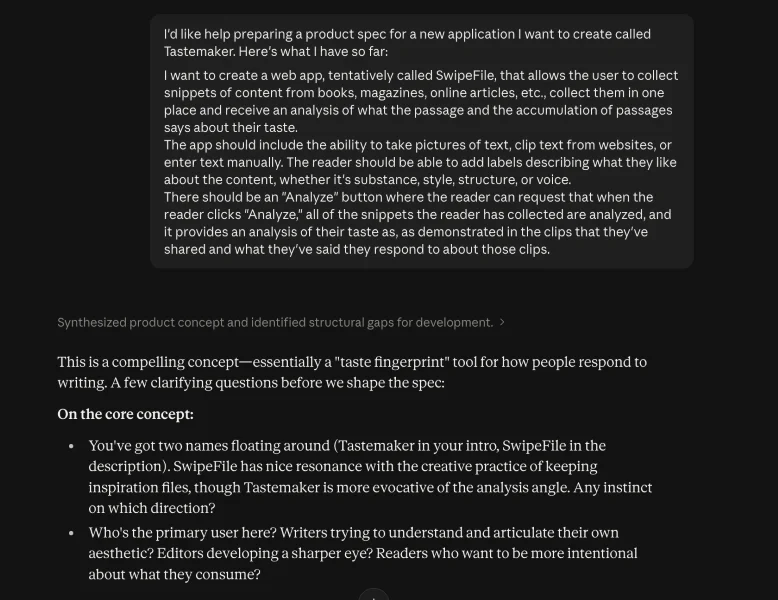
You can always add more context in follow-up prompts. You can also save a lot of time by saving details for repeat use.
“If you keep that context somewhere the model has access to, you don’t have to repeat yourself every time,” Katie added.
Place your examples, brand guidelines, competitor research, and other context in a project or reference file. And make sure to tell your AI tool to reference it.
6. Own your lack of experience
Vibe coding opened the app development door to people who have never dreamed of coding their own online tools. One of the great things about working with AI is that it doesn’t judge you for your lack of knowledge (yet).
“Don’t be afraid to tell AI that you’re new to coding and have it explain things to you in simple terms,” Katie said.
The more your coding partner knows about your experience, the better it can tailor its answers. After a few projects, it’ll know to explain things step by step.
7. Start small and set a specific goal
Vibe coding is fun. But it can also be a bit overwhelming at first. Anna Burgess Yang, a freelance content marketer and journalist, has a couple of tips to help keep the work from getting out of hand.
“Start small,” she said. “Don’t overhaul your entire website on day one. A simple page with low stakes should be your first project, so you get a feel for how it works.”
You could create what developers call a “sandbox” at first. It’s a safe space to build and test without real-world implications. That may be a non-published webpage, for example.
Besides not taking on too big a project on your first vibe coding session, Anna suggests setting a boundary to avoid whiling away hours when the goal is to save time.
“Decide what ‘done’ looks like,” she said. “Vibe coding can be really fun once you get the hang of it, and you could spend forever tweaking a page. You’ve got to know when you’re ready to ‘ship’ the page you’ve created and come back to make more changes later.”
8. Bring examples
AI isn’t truly creative. Not the way you are. If you want it to build something that looks like the thing in your imagination, give it something to reference.
“Coding tools are not designers and not imaginative,” Anna said. “They code. Bring a reference, such as screenshots or even a mockup you’ve sketched on a piece of paper, so your coding tool knows what to build.”
I really like that bit about sketching on a piece of paper. It’s a good reminder that you don’t need to have a sophisticated design to get started. A simple reference point will do. Then you can iterate from there.
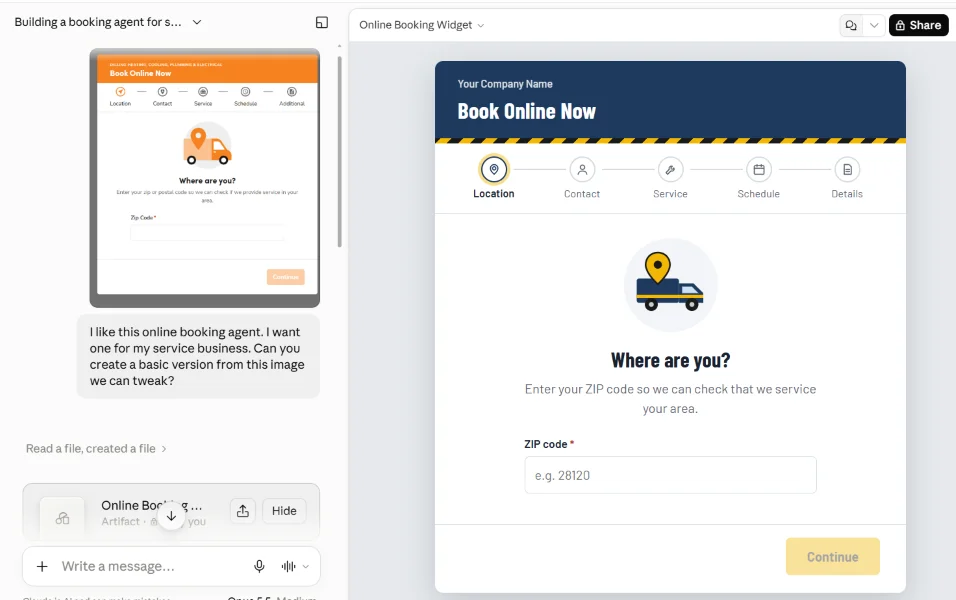
A screenshot is enough to kickstart your vibe-coded project.
Vibe coding projects to get started with
There are few limits to what you can vibe code. Our experts each suggested a project to get you started.
A popup for your website
Why not make your first vibe coded project something that helps convert customers?
“I think a good place to start with vibe coding would be a web page element like a popup or a gallery section,” Josh said. “These are great for testing the waters for what your AI can generate for you and give you simple elements you can test with and edit.”
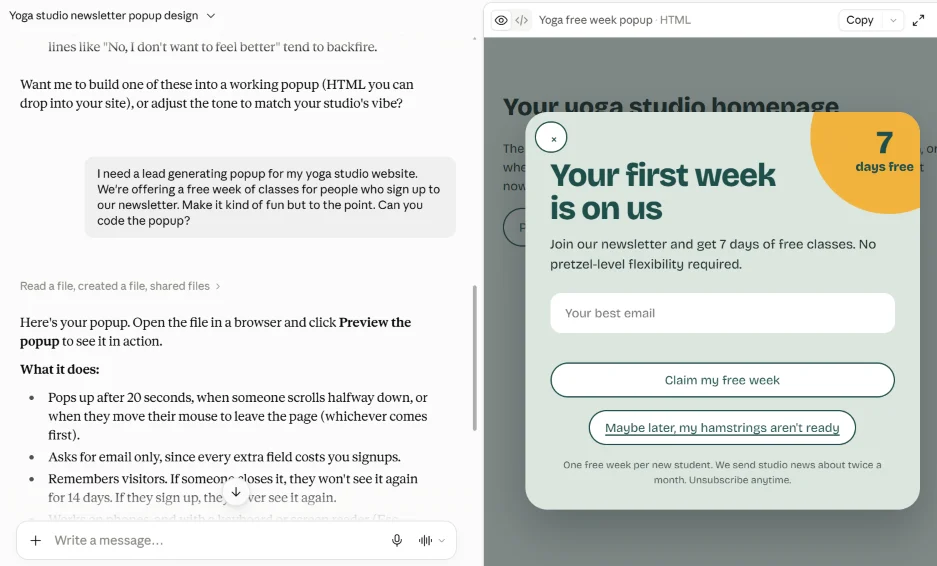
“Once you have a good feel for that, small web applications like calculators and generators can be a great addition to your site,” he added. “We have been having a ton of fun with all that AI can help us create in this realm.”
Custom dashboards
AI is great at parsing and pulling insights from data. Take it a step further, and you can vibe code a way to visualize that data.
“One of the best early vibe coding projects I see is building custom dashboards that pull data from your team’s major sources and surfaces, and putting it together in a way that makes sense for your unique use case,” Katie said.
Here’s an example Katie shared of an OKR (objectives and key results) dashboard she vibe coded.
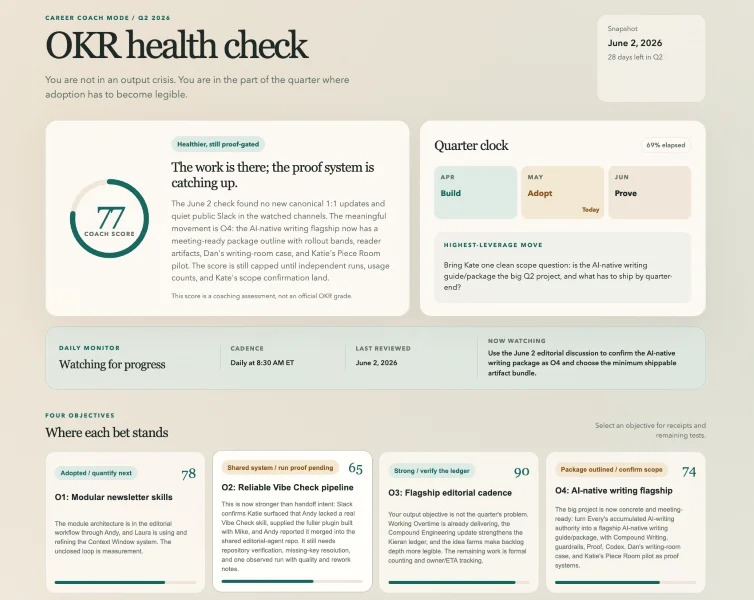
It has built-in progress scores, calendars, and reviews of recent activity. What process could you visualize with vibe coding?
A one-off webpage
A great web designer makes sure that your site is user-friendly, optimized for search, and built to generate business. But sometimes you need a single page that promotes an event or short-term offer. That’s a perfect use case for your new vibe coding skills.
“It’s so easy to spin up single pages that may not otherwise ‘fit’ onto your website,” Anna said. “For example, I host webinars twice a month. For each webinar, I create a single page that recaps the talking points in a visual format, rather than simply sharing my slides with attendees.”
She also vibe coded a landing page for people interested in her vibe coding checklist.
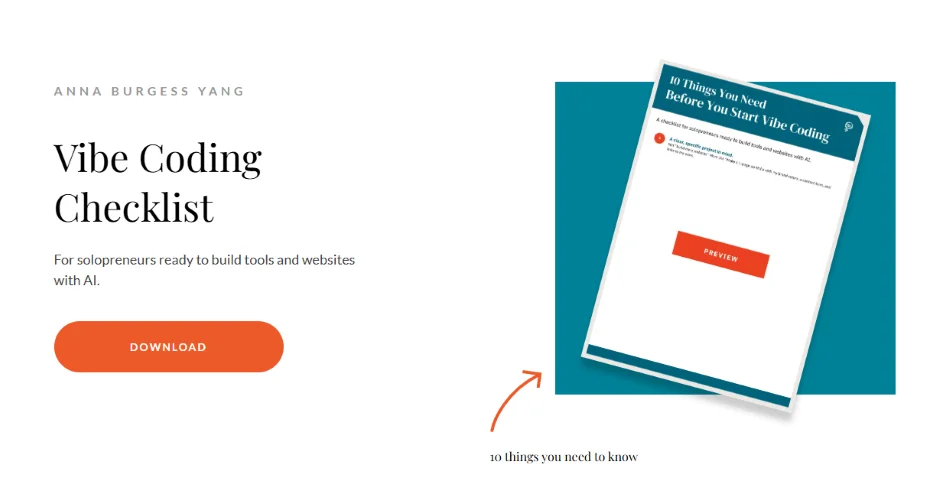
“That’s something that simply wasn’t possible before vibe coding and provides a much more useful resource for my audience,” she said. “Landing pages, signup pages, or announcements for a specific launch are all great vibe coding projects.”
Use these vibe coding best practices for faster results
Many marketing ideas wither because there aren’t enough developer resources to make them a reality. Vibe coding solves for that. It lets you work through the building process naturally without learning the very intricate task of piecing together complex code.
But as our pros showed, it goes beyond the backend techy steps of generating an app. With the right best practices, vibe coding can help you refine your ideas, come up with novel solutions, and even learn how it all works.
About the WordStream Blog
We've been a trusted source of data, news, and strategy for over 15 years. All of our content is written and reviewed by real people: a dedicated team of professionals with decades of combined experience in marketing and advertising for businesses of all sizes.


Add us as a preferred source on Google


Meet The Author
Rob Glover
Rob is the Senior Copywriter at WordStream and LocaliQ, with over 10 years of experience in paid and organic marketing—including SEO, social media, content marketing, and local search. He’s worked across dozens of industries, from SMBs to enterprise, and now specializes in helping businesses build sustainable growth strategies. His work has appeared in Search Engine Land, eMarketer, and more. Outside of marketing, he loves to travel, camp, and mountain bike with his wife and dog.
Recommended for you