About the Author


The businesses getting recommended by AI aren’t always the ones ranking highest on Google, and most businesses have no idea where they stand.
When customers ask ChatGPT or Perplexity things like “best HVAC company near me” or “who do people recommend for emergency dental care in Tampa,” some businesses consistently appear in the answers, and others don’t.
That’s because AI recommendations can pull information from more sources, and in a few different ways, than traditional search algorithms. So while SEO best practices provide a solid GEO (generative engine optimization) foundation, there’s more you can do to improve your standing with AI search engines.
The bigger problem, though, is that most businesses can’t see what AI thinks of them. Google Search Console won’t tell you if AI systems trust your business enough to recommend it. Your SEO tools won’t show when competitors start appearing in AI-generated answers instead of you.
This guide will help you benchmark your AI visibility, understand the signals that appear to influence AI recommendations, and identify the gaps that may already be costing you exposure.
Contents
- What’s hurting your AI visibility and how to fix it
- AI visibility priorities by vertical
- How to benchmark your AI visibility
- What to expect: A realistic timeline for increased AI visibility
🛑 Need the whole plan? Get The Complete AI Search Toolkit: Practical Strategies to Get Found Online
What’s hurting your AI visibility and how to fix it
AI search is still pretty new. And there are a LOT of visibility signals that are just being discovered. It’s understandable that many businesses haven’t mastered it all yet.
There are four patterns that come up repeatedly:
- Vague positioning
- Thin reviews
- Inconsistent local data
- Websites AI can’t retrieve from
Any one of them hurts. Many local businesses have all four.
Vague positioning
AI systems recommend businesses they can clearly categorize. The more generic your description, the harder you are to retrieve.
“We provide quality home services” gets passed over. “Emergency HVAC repair for older homes across Denver” is specific enough to match a prompt.
The difference is how AI reads and classifies what you do.
A roofing company in Phoenix that describes itself as “emergency and residential roofing across the Phoenix metro” is much easier to recommend for “best emergency roofer in Phoenix” than one that says “we handle all your roofing needs.”
Most businesses have slightly different descriptions on their website, their Google Business Profile, their Yelp page, and their various online business listings. That inconsistency makes AI less confident about what you actually do. Confident signals win recommendations.
The fix: Tighten your positioning everywhere
Start with a quick audit. Pull up your homepage headline, your Google Business Profile description, your title tags, and three or four directory listings. Read them in sequence. If they describe your business differently, different services emphasized, different geography, or different language, that’s the first thing to fix.
Pick one clear, specific description of what you do, where you do it, and for whom. Something like “pediatric dentistry and orthodontics in South Tampa, serving families since 2008” or “24/7 emergency HVAC repair across the Denver metro.” Make that the consistent thread across every surface. The specificity is what makes you retrievable.
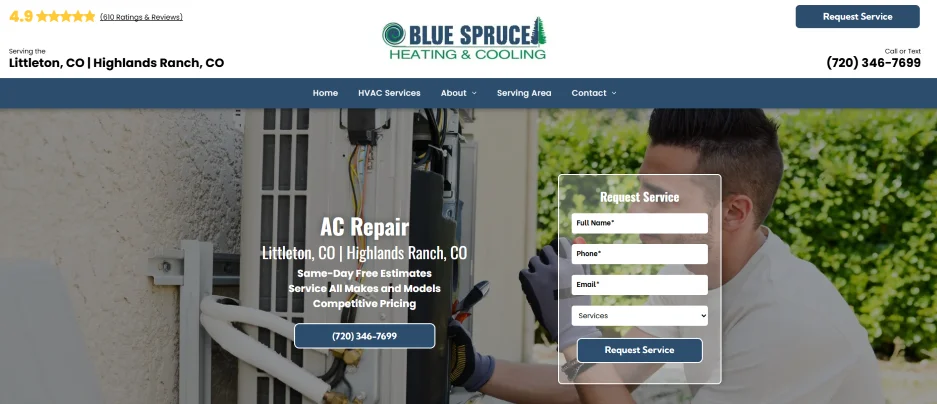
Make sure your key value propositions are clearly noted on your website and beyond.
Thin or generic reviews
Volume still matters, but AI pays closer attention to what reviews actually say. A review that reads “Great company, highly recommend!” carries almost no informational weight. A review that says “They replaced our AC unit the same day it died during a heat wave—had cold air by 6 PM” tells AI the service type, the urgency, the location context, and the outcome.
The second review teaches AI something the first one doesn’t. It makes it easier to recommend for “emergency AC repair in Austin” because the signals all point to that specific capability. Multiply that across dozens of reviews, and the difference in how a business gets described and recommended becomes significant.
The fix: Adjust your review strategy
The goal isn’t to script reviews. It’s to help customers understand what’s actually useful to mention. After a completed job, you might ask for a review by saying: “If you have a moment to leave us a review, it helps other families in Tampa find us—especially if you mention what brought you in and how it went.”
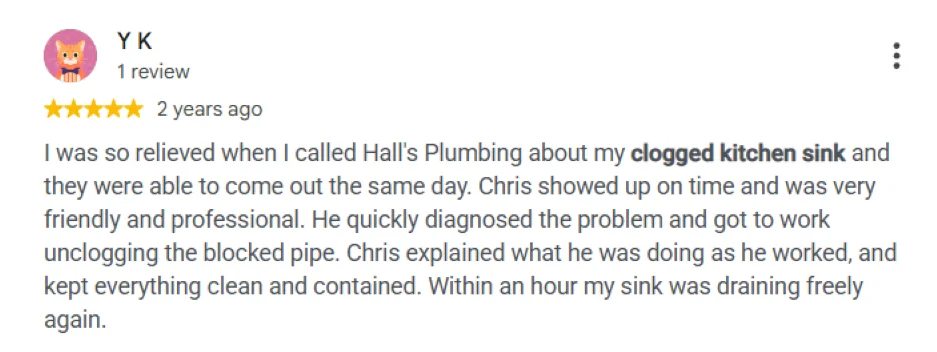
Ask reviewers to mention the service provided in their review so AI platforms are more likely to recommend you to them in the future.
That framing doesn’t tell them what to write. It just reminds them that specifics matter. Most satisfied customers default to generic praise because no one has told them otherwise.
One firm rule: don’t offer anything in exchange for reviews. Every major platform prohibits it, and the risk of getting flagged outweighs any short-term gain.
Inconsistent local signals
Conflicting addresses, old phone numbers, and directory listings that don’t match your current information are among the most common and most fixable problems in AI visibility.
AI systems build confidence through verification. If your name, address, and phone number appear consistently across your Google Business Profile, Yelp, local directories, and your own website, AI has a cleaner picture of who you are and where you operate.
Unfortunately, it’s a common occurrence. Over on LocaliQ, we recently reviewed 100 random home services business listings and found that 85% of them had incorrect or incomplete information.
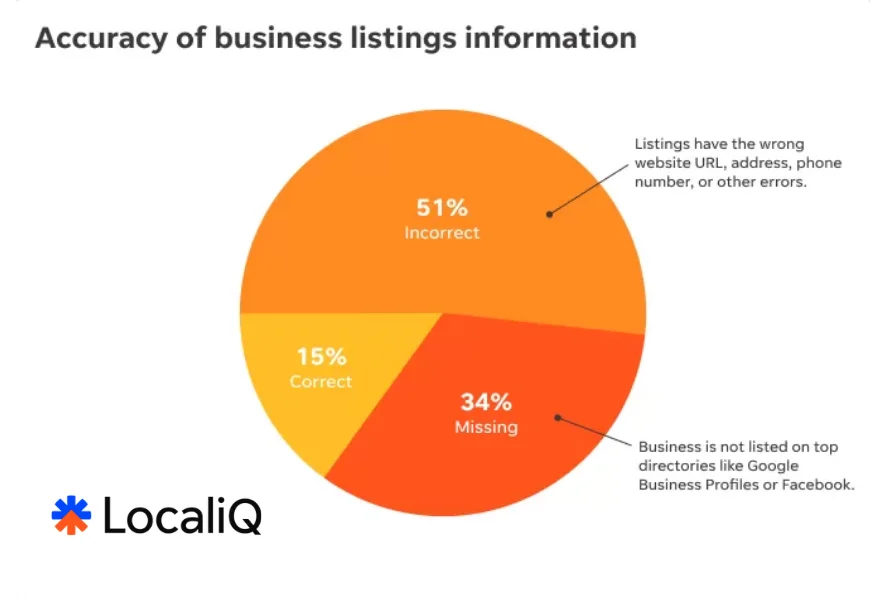
Businesses with messy local data don’t get penalized in an obvious way. They just get passed over in favor of businesses AI can confirm more easily.
The fix: Build consistent local authority signals off your website
As mentioned, AI systems trust businesses that appear repeatedly across independent sources. I mentioned the need to keep consistent information across business listings. But you can take this a step further by going beyond directories.
A mention in the local paper, a guest spot on a regional podcast, a sponsorship of a neighborhood event, a helpful post in a local Facebook group or subreddit. Each of these creates an off-site signal that AI can verify independently.

In-person appearances promoted online are additional trust and understanding signals for AI visibility.
This doesn’t require a PR campaign. A plumbing company in Chicago that answers a question in r/Chicago about preventing frozen pipes in winter has created a citation that ChatGPT can draw from. A dental practice that gets mentioned in a Tampa parenting blog has built a trust signal that Perplexity can reference. A lawn care company that sponsors a local high school sports team and gets mentioned on the school’s website has become slightly easier for AI to confirm as a legitimate, community-connected business.
Websites that aren’t retrieval-friendly
Most business websites are built for humans to browse, not for AI to retrieve–as they should be. But because of this, they can lack FAQs, service comparisons, pricing context, and neighborhood or city-level specificity that would actually be really helpful for potential customers as well as AI systems. These are exactly the content types AI draws from when forming recommendations.
A dental practice with a page titled “Emergency Dental Care in Tampa” that explains what to do, what to expect, and approximate costs is far more likely to surface than one with a generic “Services” page listing treatment names. A plumbing company with a page answering “How much does emergency plumbing cost in Chicago?” has given AI something to cite.
A company with only a homepage and a contact form has given AI nothing to work with.
The fix: Create content built for recommendation prompts
Most SEO content is written to rank for short keywords. AI searches are longer and more conversational, and the content that does best matches that structure directly.
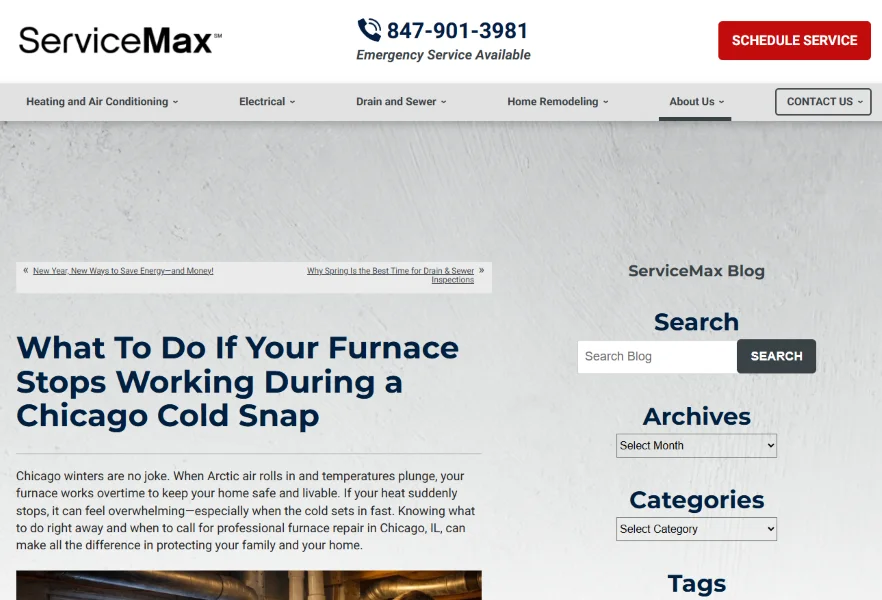
- An HVAC company in Denver that publishes “What to do when your furnace stops working in winter” or “Heat pump vs. gas furnace: what makes sense for older Denver homes” is targeting the exact prompts their customers run.
- A law firm in Austin that writes “What to expect from your first divorce consultation in Texas” or “How to choose between a general attorney and an immigration specialist” is creating content that directly answers what AI gets asked.
- A car rental company that publishes “Renting vs. rideshare for a week in Phoenix: what actually saves money” owns a comparison query their competitors haven’t touched.
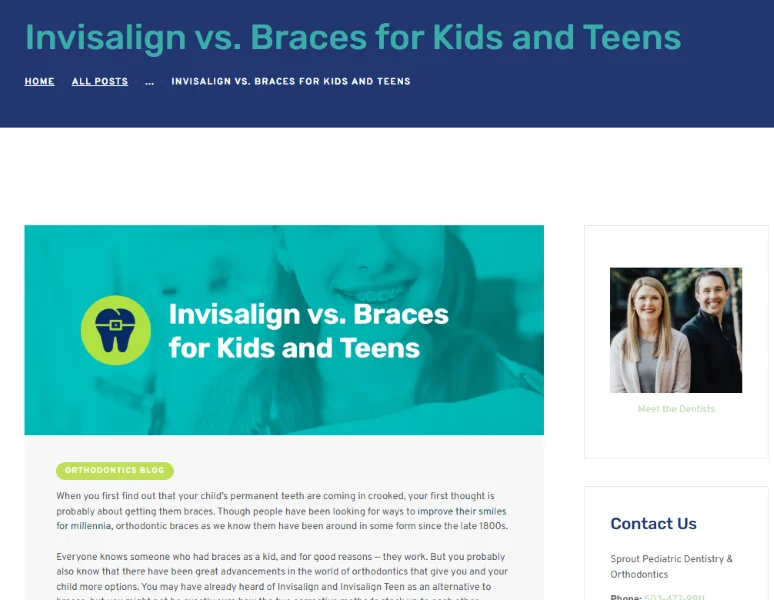
Specific, local, practical, comparison-based content consistently outperforms generic service pages in AI search. It’s about being more useful than a competitor who wrote “HVAC Services in Denver” and called it a page.
“The businesses that do well in AI search are the ones that made their expertise legible to a machine,” says Stephanie Yoder, Director of Content Strategy at LaunchSquad. “Consistent signals, real specificity, and content that actually answers something. That combination is hard to fake and hard for a competitor to undo quickly.”
AI visibility priorities by vertical
Buyers add more personal context to their AI prompts than they do traditional searches. Those differences should reflect in how you address AI visibility.
Here are a few things to consider based on which type of business you need to get found.
Dentists
Dental practices should focus on treatment-specific pages, review volume and recency, insurance clarity, and local trust signals.
A page titled “Invisalign for adults in South Tampa: what it costs and how long it takes” or “What to expect from same-day emergency dental care” does more work than a generic services list.
Patients ask specific questions before they commit to a dentist. The practice that answers those questions gets recommended to the ones who ask them.
Home services businesses
Home services businesses should prioritize emergency service visibility and service-area specificity.
Review recency matters more in these verticals than almost any other because urgency is built into the query. When someone asks “Who can fix my furnace today,” AI leans toward businesses with recent, specific reviews that demonstrate they’ve done exactly that, not businesses with 50 reviews from three years ago.
Med spas and clinics
Med spas and related clinical practices should invest in treatment comparison pages, before-and-after proof, review sentiment, and local authority.
Content like “Botox vs. fillers: what to know before your first appointment in Scottsdale” or “What to expect from your first med spa visit” maps directly to how first-time patients research their options. In this vertical, trust signals matter as much as visibility.
AI is less likely to recommend a clinic with no external mentions than one that appears in local wellness publications, even if both have similar review counts.
Law firms
Legal firms benefit most from practice-area specificity and FAQ content.
A page that answers “What to expect from a divorce consultation in Texas” or “Immigration attorney vs. general attorney: what the difference means for your case” maps directly to how prospective clients actually research before they pick up the phone.
Authority mentions in local publications, a quote in a regional business journal, or a contribution to a bar association newsletter add the off-site credibility that Perplexity and ChatGPT weight heavily.

How to benchmark your AI visibility
The benchmarking process has three parts: running real customer prompts, recording what you find, and scoring yourself against competitors. Start with the prompts.
Run real customer prompts across AI platforms
The first step is simple: ask what your customers would actually ask. Not keywords. Full questions, the way a person types them when they need something.
- For an HVAC company in Denver: “Best HVAC company in Denver” or “Most reliable AC repair near me.”
- For a pediatric dentist in Tampa: “Best pediatric dentist in Tampa” or “Who do parents recommend for kids’ dentistry in Tampa?”
- For a plumbing company in Chicago: “Best emergency plumber in Chicago” or “Who fixes burst pipes fast near me?”
Run these across ChatGPT, Perplexity, Gemini, and Google AI Overviews. Each platform treats sources differently, and the results often look nothing like your Google rankings.
| Platform | What it tends to favor |
| ChatGPT | Reddit threads, forums, broadly repeated community consensus |
| Perplexity | Publisher authority and direct citations |
| Gemini | Google-indexed authority and entity clarity |
| AI Overviews | Structured content, EEAT signals, and query confidence |
A dental practice might appear consistently in Gemini because it has strong Google Business Profile signals but disappear entirely from ChatGPT because no one on Reddit or in local forums has ever mentioned it. A law firm might rank in Perplexity because a regional publication covered them, but get skipped in AI Overviews because their site lacks structured FAQ content. Both are useful data points.
One test that reveals the most: comparison prompts. Ask “best HVAC companies in Denver” or “top-rated dentists in South Tampa.” These force AI to make a shortlist. The businesses that appear here are the ones AI trusts enough to recommend outright.
Record what you find
As you run each prompt on the various platforms, keep track of the responses.
For each prompt, note four things:
- Whether your business appears at all.
- Which competitors show up repeatedly.
- How AI describes your business when it does appear.
- Where you land when a customer runs a side-by-side comparison.
The description piece matters as much as the mention. If AI is describing your HVAC company as a “general contractor” or your dental practice as “a family dentist” when you specialize in pediatric care, that misclassification is costing you recommendation matches.
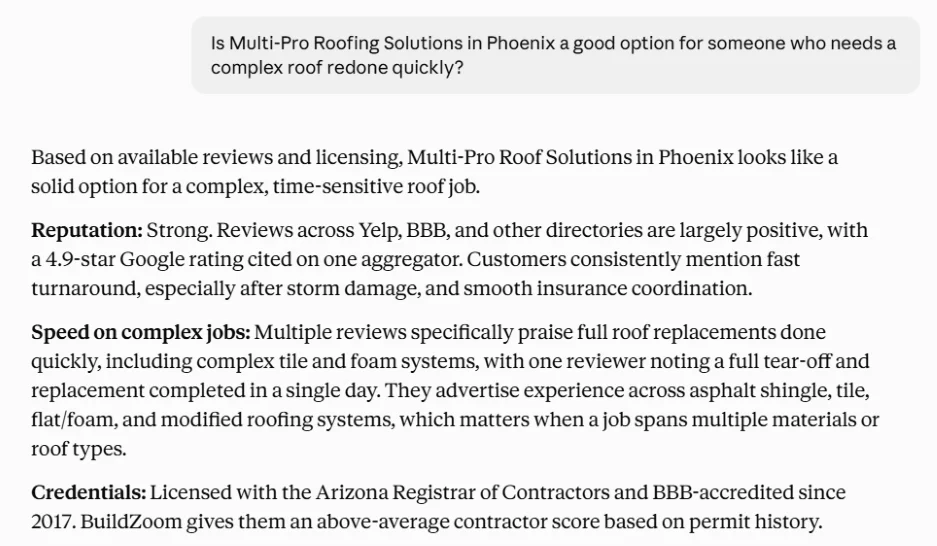
Ask AI what it thinks of your business and record what it says.
Build a simple AI visibility scorecard
Score your business on each signal below from 0 to 5. Then do the same for your top two competitors. The gaps tell you where to focus first.
| Signal | Your score | Competitor A | Competitor B |
| Mentioned in top 3 recommendations | 0–5 | ||
| Properly described | 0–5 | ||
| Cited with source attribution | 0–5 | ||
| Appears consistently across engines | 0–5 | ||
| Wins comparison prompts | 0–5 |
A score below 10 usually means foundational problems: positioning or citation gaps that need to be fixed before anything else.
Between 10 and 17, you’re partially visible but inconsistent.
Above 17, you’re in decent shape but likely still losing specific prompt types to competitors who’ve been more deliberate about this.
What to expect: a realistic timeline for increased AI visibility
AI visibility builds through consistency, and it compounds over time rather than flipping overnight.
In the first 30 days, fixing your positioning and cleaning up your local data creates cleaner signals for AI to work with. You’re not adding new content or reviews yet. You’re removing the friction that’s causing AI to skip over you in favor of businesses it can confirm more easily. This is the lowest-effort, highest-return work on this list.
Between 60 and 90 days, with sharper reviews coming in and a few pieces of content targeted at recommendation prompts, your mention frequency in AI answers typically starts to improve. Comparison prompts start going your way more often. Local trust signals get stronger as new reviews mention specific services, locations, and outcomes.
At 3 to 6 months of consistent work, you should see recurring inclusion across multiple AI platforms, stronger comparative visibility, and a broader authority footprint across independent sources. The gap between a business that started this work six months ago and one that’s starting today is already meaningful, and it keeps widening.
The businesses AI recommends
The businesses winning in AI search are the ones easiest for AI to understand and trust.
That comes down to five things: specific positioning, strong and detailed reviews, consistent local data, repeated mentions across independent sources, and practical content that answers the questions customers actually ask.
Each signal reinforces the others. Reviews confirm positioning. Off-site mentions confirm reviews. Content gives AI something to cite when a customer asks the exact question your page was written to answer.
Traditional SEO forms the foundation of success in AI search. The best AI visibility then requires optimizing the entire digital footprint: the reviews, the listings, the off-site mentions, and the content all telling the same clear story. The businesses that get that right first build an advantage that takes competitors a long time to close.
About the WordStream Blog
We've been a trusted source of data, news, and strategy for over 15 years. All of our content is written and reviewed by real people: a dedicated team of professionals with decades of combined experience in marketing and advertising for businesses of all sizes.


Add us as a preferred source on Google


Meet The Author
Goran Mirkovic
Goran Mirković is a marketing leader with over a decade of experience in SaaS growth, SEO, content strategy, and demand creation, a freelance contributor for WordStream, and a 2x CMO. With a background spanning both agency and in-house leadership roles, he focuses on AI-era search, the evolution of content marketing, demand creation, and practical strategies that help businesses turn expertise into revenue. Outside of marketing, he is a dedicated cinephile with a particular obsession for horror films.
Recommended for you