About the Author


You can look at your expenses and see you’re spending money on marketing. But some of those dollars may not be helping you achieve your business goals. When that happens, you have a budget leak.
A budget leak is any gap between marketing activity and business value. And even small ones can become expensive fast, especially when 52% of SMBs have monthly marketing budgets under $2,500. Every dollar needs to work, and every tactic needs to earn the right to spend.
Budget leaks can appear during planning, between an ad and its landing page, or after the first sale. Increasing the budget before fixing the underlying problem just increases the waste.
In this guide, I’ve identified nine of the most common and costly leaks and how to fix them so you don’t waste another dollar.
The 9 marketing leaks draining your budget:
- You start spending before defining the win
- You spread a small budget across too many channels
- You target everyone and convince no one
- You pay for clicks with no buying intent
- Your ads make promises your website doesn’t keep
- You pay for content, then leave it stranded
- You confuse automation with management
- You let a winning design age into wallpaper
- You keep buying new customers instead of keeping the current ones
1. You start spending before defining the win
“Get more traffic” sounds like a solid goal until the traffic arrives and nobody knows if it helped. The same applies to “increase engagement” or “build awareness.” Those directions can’t tell a small team if a campaign deserves another $500.
Without a clearly defined, measurable outcome, the nicest metric wins the debrief meeting. A campaign with lots of clicks looks successful (even without any qualified leads). These weak tactics keep running because nobody agrees on a finish line.
Do this instead: Give each campaign one primary business outcome. Set a baseline, target, deadline, budget limit, and decision rule. SMART goals can turn “get more leads” into “generate 30 qualified calls below $50 per lead within 60 days.”
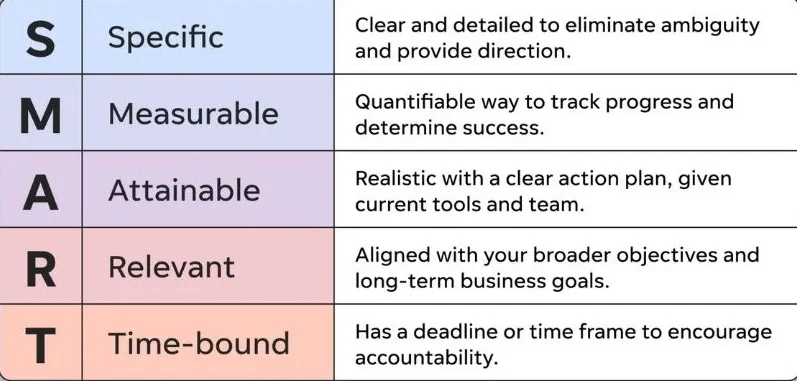
Connect that goal to a simple marketing plan covering costs and expected returns. A budget without a destination is like a taxi with the meter running.
🛑 Don’t miss your best chance at a sale. Download Marketing Gaps That Cost You Customers (& How to Fix Them)
2. You spread a small budget across too many channels
Search, social, email, video, podcasts: Every channel comes with a convincing reason to use it. Trying them all may look like diversification but usually leaves a small team fragmented instead.
Each channel gets too little money for reliable data and not nearly enough time and attention to improve. The team spends its week resizing creative, checking dashboards, and feeding calendars while nothing gains momentum.
Do this instead: Choose two or three channels based on where customers spend time and how they buy. Put most of the budget behind the channels showing real promise, then protect a smaller amount for experiments. Give each test enough time and money to teach you something.

Cross-Channel Maturity Assessment
Answer 7 questions about your current setup. We'll tell you whether you're actually running multi-channel, cross-channel, or omnichannel, and what to fix first.
Use this Cross-Channel Maturity Assessment to see how well coordinated your marketing channels are.
This focus helps stretch a marketing budget without shutting down every new idea. Spread the money too thin, and every campaign ends up running on fumes.
3. You target everyone and convince no one
Broad targeting makes reach climb quickly. Unfortunately, a large audience can include plenty of people with no realistic path to becoming customers.
The waste continues in the messaging. An ad designed for everyone usually becomes too vague to matter to anyone. You pay for a larger audience while giving each person a weaker reason to care.
Do this instead: Build campaigns around your highest-value customers. Look at location, needs, buying triggers, lifetime value, and the language they use to describe the problem. Define exclusions as carefully as inclusions.

This ad specifically targets pet owners who work from home.
Audience targeting determines who sees the ad. A landscaping company that serves local homeowners wastes audience spend when its ads reach renters or people outside its service area. With the wrong targeting, you’ve just built a digital confetti cannon: impressive coverage, terrible aim.
4. You pay for clicks with no buying intent
Search intent reveals what someone wants in the moment. The same landscaping company can reach a perfectly matched local homeowner who is searching for “DIY lawn care tips” rather than looking to hire someone. That click carries very little commercial intent.
Broad match can uncover valuable searches when someone reviews the queries and adds the right guardrails. If nobody reviews the queries triggering your ads, irrelevant clicks can drain the account for months. After all, a custom bakery shouldn’t pay for people searching for free cake recipes.
Do this instead: Review the search terms report weekly while a campaign is new. Add irrelevant phrases as negative keywords, group valuable keywords by commercial intent, and make sure your match types balance reach with control.
Regular negative keyword research helps protect the budget from searches that won’t produce business. Every irrelevant click is a tiny invoice from someone who was never shopping.
🚀 Turn more visitors into loyal customers. Get 14 Super-Fast Ways to Boost Conversions >>
5. Your ads make promises your website doesn’t keep
You paid for the right click from the right person. Then you sent them to a slow homepage with seven navigation options, three calls to action, and no mention of the offer.
That disconnect wastes the intent you paid to create. The visitor now has to work out where they landed, if the offer applies, and what to do next. Most people won’t bother.
Do this instead: Use a dedicated page with one goal. Match its headline and offer to the ad, explain the value quickly, add proof, and remove distractions. Strong landing page copy answers practical questions and makes the next step predictable.

Social proof, a clear offer, and a stand-out CTA button will turn visitors into customers.
The page also needs to feel fast, responsive, and stable on every screen. Google’s Core Web Vitals measure loading performance, responsiveness, and visual stability. Check the page on mobile and desktop, then fix slow-loading content, laggy interactions, and elements that jump around while the page loads.
6. You pay for content, then leave it stranded
Good content costs money before anyone reads a word. Interviews, research, strategy, writing, editing, design, and expert review all take time, effort, and expertise. So businesses hire an experienced writer, publish the piece, and move straight to the next brief.
The writer did their job, but the distribution plan never existed. Great articles then get written off (pun intended) after one lonely launch post. And when performance disappoints, the writing takes the blame for an audience problem.
Do this instead: Plan distribution before commissioning the piece. Put the audience, channels, owner, schedule, and success metric in the brief. Turn one article into an email, social posts, sales talking points, a short video, and internal links from high-traffic pages.

Repurpose the initial content to gain traction across multiple social media channels, email, and more.
Resurface evergreen content when its topic becomes timely. Update proven pieces before replacing them. These content distribution strategies can help each asset travel further. Paying for great content without distribution is like hiring a brilliant chef, plating the meal, and leaving it under the heat lamp. The work is finished, but nobody gets to enjoy it.
7. You confuse automation with management
Advertising platforms automate bids, placements, targeting, and budgets. They can’t understand priorities you never configured, notice that sales hates the leads, or account for changing cash flow.
If a campaign is optimized for cheap form fills, the platform will find you cheap form fills. It won’t care that half of them contain fake phone numbers. Broken tracking, irrelevant searches, and budget drift continue spending when nobody checks.
Do this instead: Run a short weekly performance check and a deeper monthly review. Inspect spend, conversions, search terms, locations, devices, creative, and lead quality. A recurring Google Ads audit can show you structural problems that daily dashboards miss.
Keep a simple change log so you can connect performance shifts to actual decisions. Automation is useful, but Jurassic Park remains a solid reminder that the control room still needs a responsible adult.
8. You let a winning design age into wallpaper
Even a strong ad loses power after the same audience sees it day in and day out. The image becomes familiar, the hook stops interrupting attention, and yesterday’s winner blends into the background.
Panicked optimization creates another leak. Some teams change the headline, visual, audience, bid, and page at once. Performance moves, but nobody knows why. And the next campaign starts with the same guesswork.
Do this instead: Build each experiment around a clear hypothesis. Test one meaningful variable like the hook, offer, image, or CTA. Choose the winning metric before launch, and give the test enough time and budget to produce useful data.

Your best ads, emails, and posts come from the results of A/B testing.
Disciplined A/B testing turns creative spending into reusable knowledge. Record what worked, what failed, and what you learned. A smarter creative process turns one winning ad into better decisions for every campaign that follows.
9. You keep buying new customers instead of keeping the current ones
Acquisition gets attention because new customers are easy to count. Previous buyers receive a receipt, a generic newsletter (here are some not-generic newsletter ideas), and the marketing equivalent of being left on read.
That creates an expensive loop: continually paying to acquire strangers while people who already know and trust the business drift away. That missed opportunity is hard to ignore when a 5% increase in customer retention can raise profits by 25% to 95%.
Do this instead: Reserve some budget for the relationship after the first sale. Use email nurture, post-purchase education, remarketing, reviews, referrals, and loyalty offers to create another reason to engage. Track repeat purchase rate and customer lifetime value alongside acquisition cost.
Practical customer retention strategies help the original acquisition spend keep producing value. Marketing that only funds first dates gets expensive fast.
Start with the leak costing you the most
For a small team, the important question here is, “Where is the money escaping, and which repair will matter most?”
Review the last 30 days of campaigns and content investments, noting the business result each one was meant to create, how much it cost, where prospects stopped moving forward, and when someone last reviewed or distributed it. Use that snapshot to identify the simplest credible fix for each leak.
Rank the leaks by money at risk, confidence in the diagnosis, and ease of repair. Plug the biggest hole first, and you’ll find that the budget you already have can suddenly do a whole lot more for less, leaving your strongest marketing more room to grow.
And if you’d like help making sure each marketing dollar is optimized for business growth, reach out. We’ll show you how our marketing solutions keep customers coming efficiently.
About the WordStream Blog
We've been a trusted source of data, news, and strategy for over 15 years. All of our content is written and reviewed by real people: a dedicated team of professionals with decades of combined experience in marketing and advertising for businesses of all sizes.


Add us as a preferred source on Google
Are you wasting money in Google Ads?

Meet The Author
Oskar Duberg
Oskar is a Swiss-based Swede—a freelance writer, content marketer, and brand consultant who helps B2B tech, agencies, and creative companies communicate with clarity and personality. He’s spent over a decade turning complex ideas into content that connects, creating strategies, stories, and brand identities for global players and respected publications. Above all, he loves writing and believes that every great brand starts with words that sound human.
Recommended for you