About the Author


If you’re looking for a natural digital marketing companion to your social media, email, and display ads, OTT advertising may be the perfect option.
OTT ads, or over-the-top ads, show up when people watch their favorite content on streaming apps, YouTube, and more. Not only do OTT ads get you in front of a huge audience, but they also offer modern features, like interactive experiences, that help you capture leads, gather data, and convert viewers into customers.
In this guide, we’ll show you five OTT advertising examples that make use of traditional marketing techniques and modern ad platform features. Then we’ll dig into the details of OTT as an advertising platform so you can run high-performing ads of your own.
Contents
- 5 outstanding OTT advertising examples
- What is OTT advertising?
- What are OTT devices?
- What are OTT services?
- What is OTT advertising?
- What are the benefits of OTT advertising?
- How is OTT advertising priced?
- Tips from OTT video examples
5 outstanding OTT advertising examples
OTT advertising gives you several ways to engage and convert customers that traditional television ads don’t. Let’s look at a few examples to explore how you can take advantage of these powerful features.
The best aspect of all of these OTT ads is that they’re available to any business, big or small. Meaning, a local dentist or car dealer can easily copy the strategies of these big brands.
🚀 Looking for more conversions? Download 14 Super-Fast Ways to Boost Conversions
T. Rowe Price: OK to email
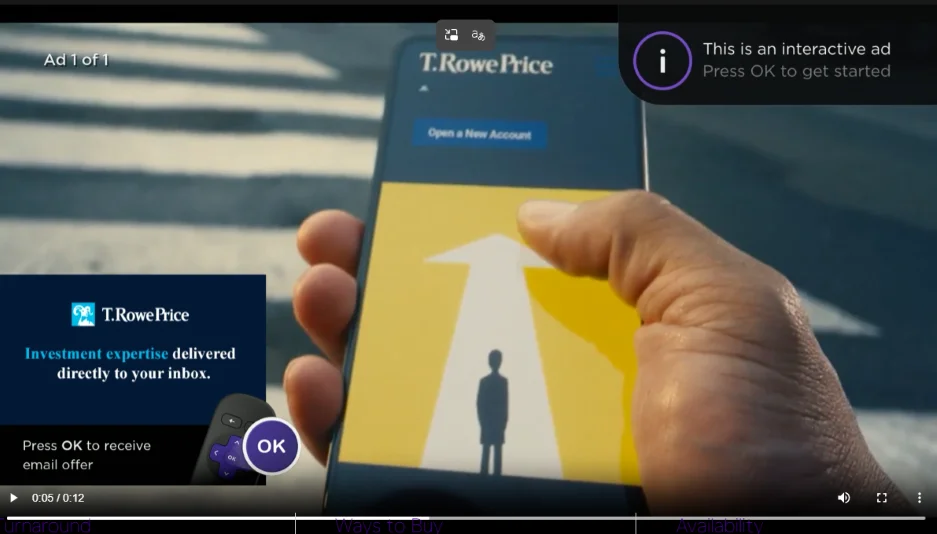
Advertising during your audience’s favorite shows has always been a good option to capture attention. But T. Rowe Price uses an innovative feature of OTT advertising to turn viewers into actionable leads.
The brand did it by letting viewers get more information sent directly to their email inbox simply by tapping the “OK” button on their ROKU streaming device.
Why this OTT advertising example works
This ad removed friction for the viewer. They don’t have to go to a different device or stop enjoying their program to take the next step in their path to purchase. Reducing friction is a great way to improve lead generation and conversion rates.
Ring Camera: Add to cart
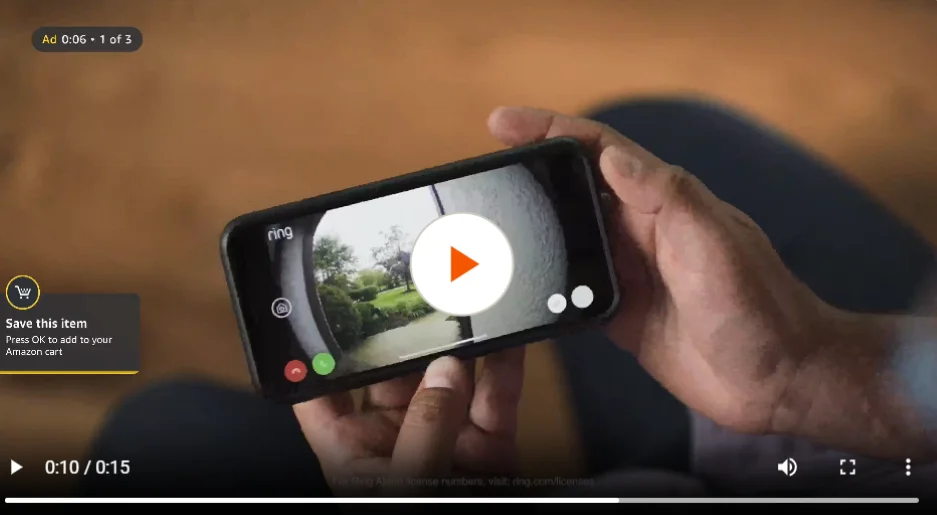
TV-era marketers would absolutely drool over this OTT advertising example. In it, Ring created a shoppable ad experience by including a way for viewers to add an alarm system to their Amazon cart right from their viewing device.
Why this OTT advertising example works
Immediate gratification is a powerful emotional driver in consumer marketing. This ad gives viewers the immediate satisfaction of placing a product they just saw in their shopping cart (putting it one click away from shipping). This type of OTT ad would be a perfect pairing for your limited-time sales promotions and sense of urgent advertising.
Volvo: Ad Selector
Most businesses, regardless of size, can benefit from segmenting their audience. Doing so makes it possible to send super-relevant messages to groups of people who share common characteristics, needs, and interests.
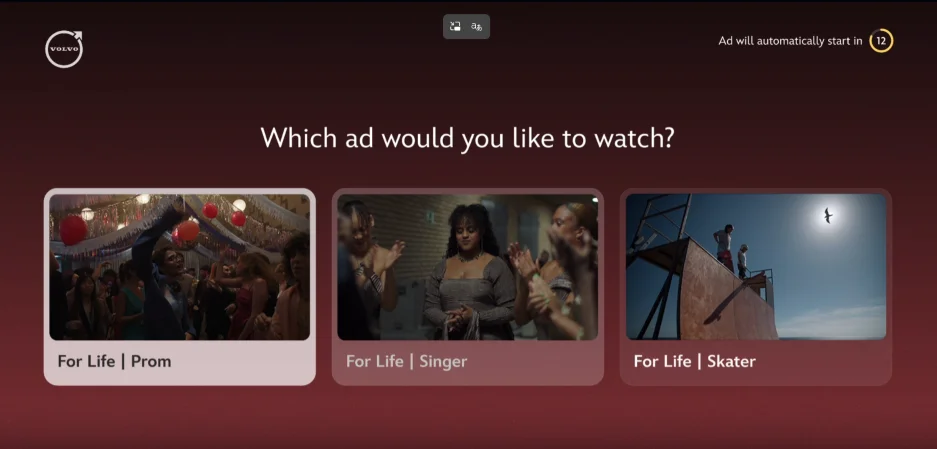
Volvo appealed to three different market segments by creating three separate video ads. Then it used the Disney platform’s Ad Selector feature to let viewers choose which option they prefer.
Why this OTT advertising example works
Volvo’s ad worked for two reasons. First, it made the ad experience much more relevant for each viewer. And second, it gave the brand a way to gather valuable first-party data about its audience. If most people chose the “Skater” option, Volvo could double down on that audience in its social media and display ads.
Maybelline: Binge Ad
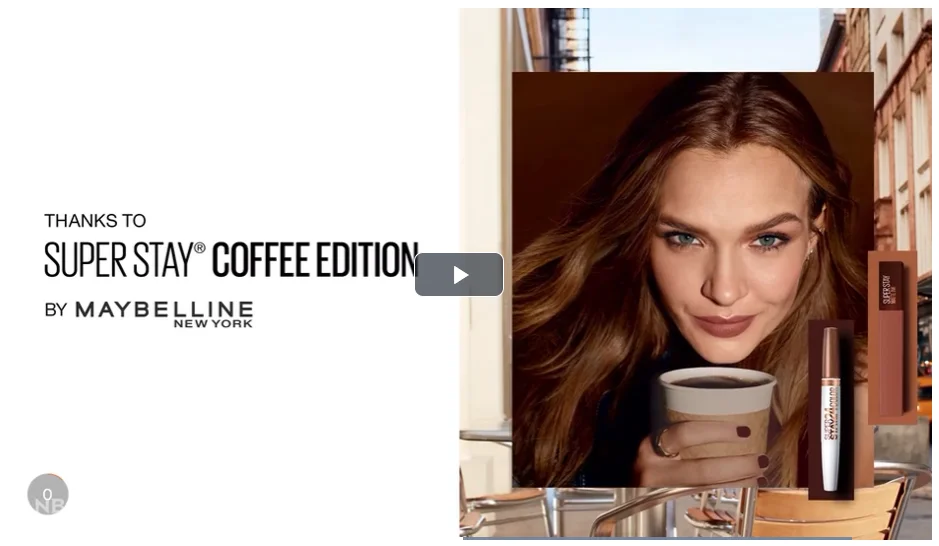
Binge Ads are a type of OTT ad offered by several streaming services that allow brands to sponsor an ad-free episode for viewers. They typically show up after someone has watched two or three episodes of a show in a row.
Beauty brand Maybelline used this type of OTT ad on the Peakcock app to promote its Super Stay Coffee Addition lipstick line.
Why this OTT advertising example works
Building brand awareness is as important as it’s ever been. And giving your buyers something valuable is a good way to generate positive awareness for your brand and products. It’s the backbone of many organic social media and SEO strategies. Now, you can apply it to OTT advertising.
NewYork-Presbyterian Hospital: In-Stream ad
Great storytelling is the heart of an effective ad. That goes doubly true for video ads people will see as they’re watching an entertaining or educational video on an OTT service.
In this example, the Och Spine Center at NewYork-Presbyterian Hospital used its YouTube In-Stream ad to tell the story of how they helped a patient recover from a debilitating spinal tumor.
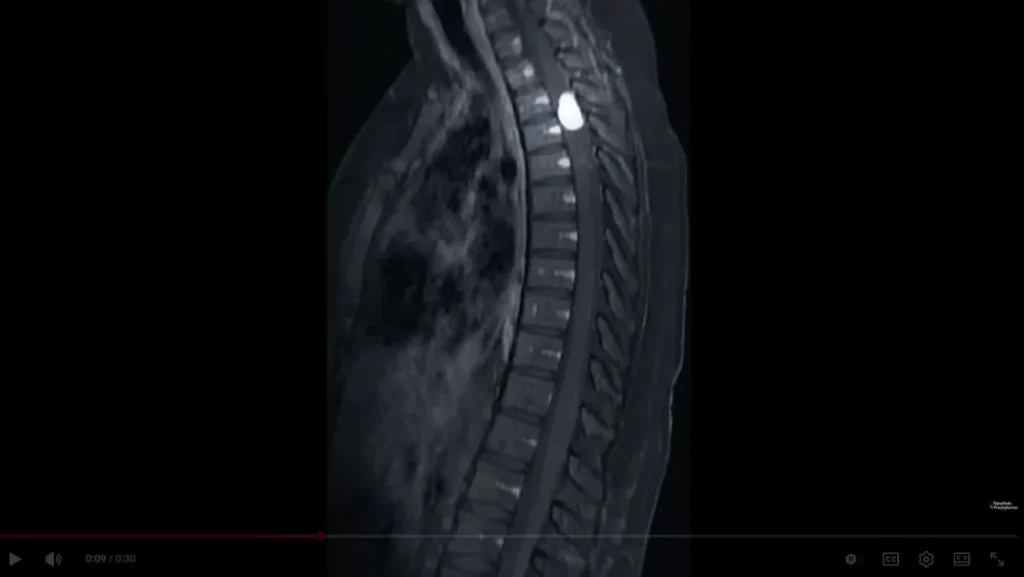
Why this OTT advertising example works
The ad tells a compelling story in just 30 seconds. That’s brief enough to keep people from skipping, but still enough space to create a connection with the hospital’s target audience. These types of customer stories are fantastic topics for in-feed video ads.
Now, let’s get into the details of OTT advertising so you’re fully prepared for success.
🛑 Never miss out on another customer. Learn 10 Marketing Gaps That Cost You Customers (& How to Fix Them)
What is OTT?
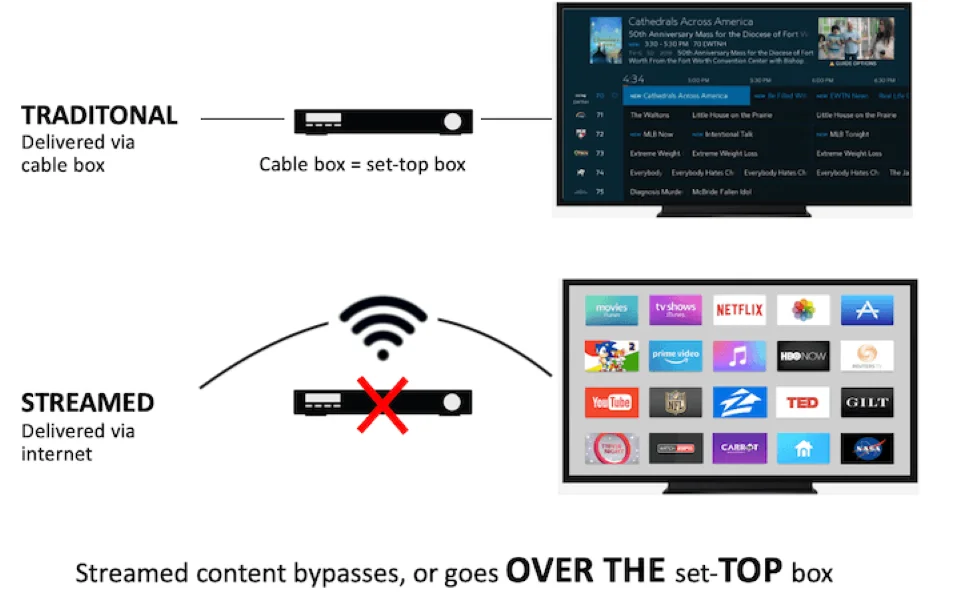
OTT (over-the-top) is video content delivered via the internet rather than traditional cable or satellite. It’s called “over-the-top” because the content goes directly to viewers over their internet connection, bypassing the traditional TV provider entirely.
Here’s a little more behind the name. The actual term for a cable box is set-top box. Because back in the day, when TVs were big clunkers and cable boxes were small, they sat on top of the TV. But even when screens became flat, and cable boxes got placed elsewhere, the term set-top box remained.
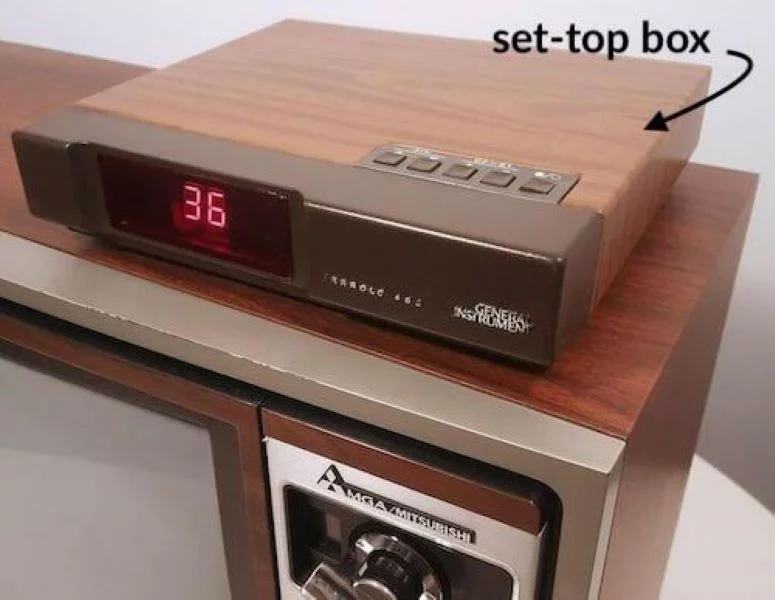
Memories, anyone?
Streamed content, on the other hand, does not require a cable box because it’s delivered via the internet. It bypasses, or goes over, set-top boxes. Hence, the term over-the-top.
What are OTT devices?
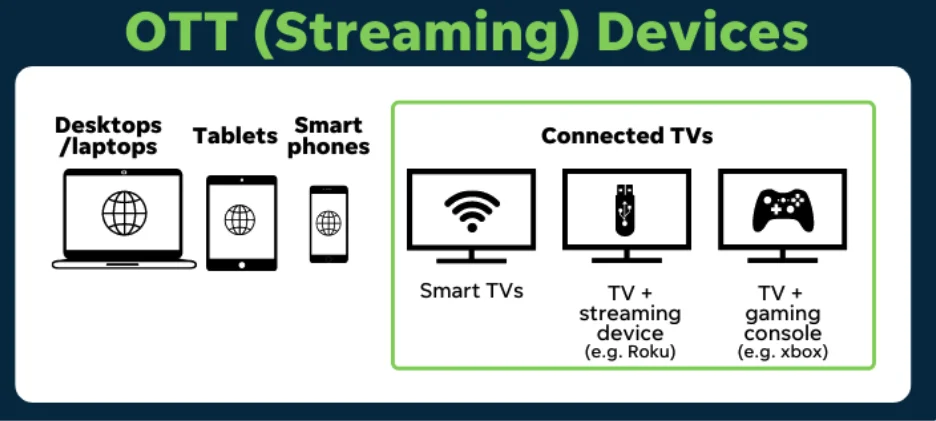
Basically, any device that displays video and connects to the internet is an OTT device. This includes:
- Smartphones, computers, tablets, and laptops.
- Connected TVs
- Smart TVs (Apple TV, Amazon Fire TV, Android TV).
- Regular TVs using a device (Roku, Amazon Fire TV Stick, Chromecast).
- Regular TVs using gaming consoles.
- Wi-Fi Blu-ray players.
Is OTT the same as connected TV?
OTT and connected TV (CTV) are sometimes used interchangeably. They are not the same, though. CTVs are just one device on which you can watch OTT media.
What are OTT services?
OTT services are the apps that stream over-the-top content to your device.
There are several OTT services and apps out there, and they follow various models.
Transactional video on demand (TVOD)
- This is where you pay for individual pieces of content.
- Examples of TVOD streaming services include iTunes, Google Play, Vudu, and Vimeo.
Advertising-based video on demand (AVOD)
- Here, you can access streamed content for free, but with ads.
- Examples of AVOD streaming services include TubiTV, YouTube, and Hulu Ads.
Subscription video on demand (SVOD)
- For those who don’t want to see ads, you can pay for a subscription to see ad-free content.
- Examples of SVOD streaming services include Disney+, Hulu+, Amazon Prime Video, and Netflix. (Note: many of these services now show ads at the lower paid tiers).
Multichannel video programming distributors (MVPDs)
- These are streamed content providers where you pay for a combination of both streamed and broadcast content.
- Examples of MVPDs include DirecTV, Sling, and YouTube TV.
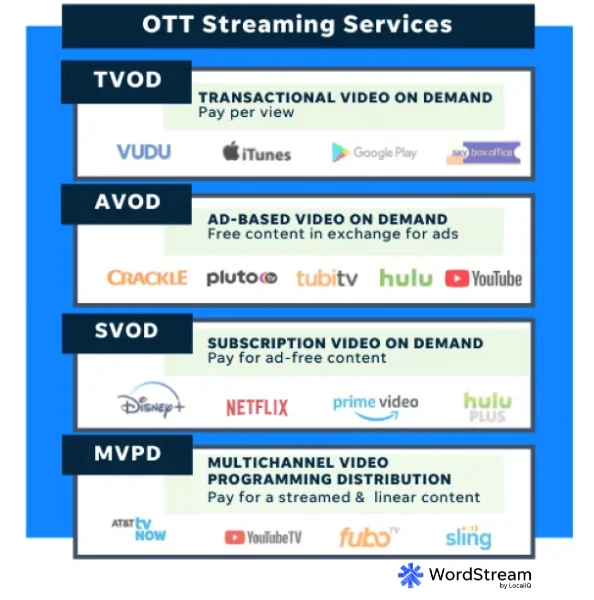
To recap: You watch OTT (streamed) content (Schitt’s Creek) on an OTT device (iPhone) through an OTT streaming service (Netflix).
What is OTT advertising?
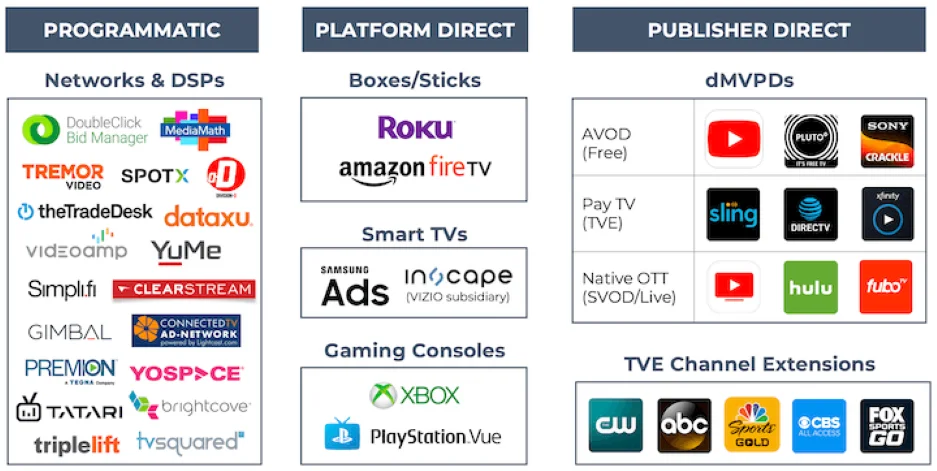
OTT advertising t is the practice of showing ads to consumers when they’re watching streamed (OTT) media. You can do this in a few different ways:
- Programmatic: Here, automation is used to serve OTT ads across multiple networks through demand-side platforms (DSPs) like Rocket Fuel, MediaMath, AppNexus, TubeMogul, and more. (This guide to programmatic advertising explains it in-depth)
- Platform direct: This is where you would purchase ads directly from the provider of the OTT device (such as Roku or Amazon Fire TV from our connected TV illustration).
- Publisher direct: Here, the exchange happens directly with the OTT service provider (our OTT streaming services above).
What are the benefits of OTT advertising?
There are many reasons advertisers, especially at local businesses, are turning to over-the-top ads as an effective means of generating revenue.
The OTT audience is growing
More people are watching TV through streaming services than ever before, while fewer are watching traditional cable.
Cord-cutters now make up nearly half of all US internet households (about 56 million homes), with another 12% who never had cable to begin with. The OTT streaming market reflects that shift, growing from $221 billion in 2025 to a projected $264 billion in 2026.
OTT ads offer better targeting
With traditional cable TV advertising, the only way to target is by choosing a designated market area (DMA). There are just 210 DMAs across the entire U.S., meaning you’ll inevitably be reaching locations you don’t need (or want) to.
But with OTT advertising, you can target:
- Zip codes (much like with PPC geotargeting)
- Devices
- Demographics
- Behaviors
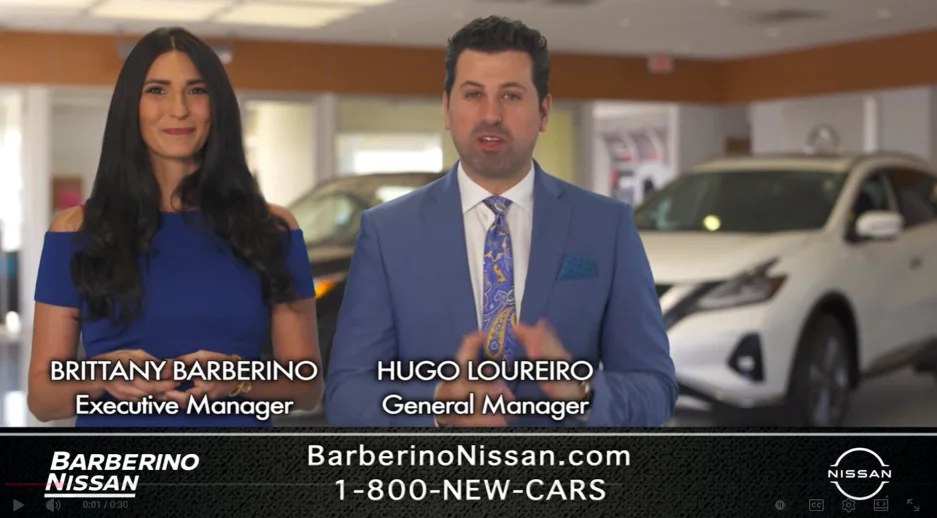
Local businesses can target OTT ads for their markets.
OTT advertising works without third-party cookies
Not only is streamed content becoming more popular, but it also provides opportunities for cookieless targeting. Here’s how:
- First, there’s contextual advertising—which does not require cookies because you’re targeting categories of TV/video content rather than individuals.
- Second, streaming subscription services collect sufficient first-party data from users (through registration and logged-in activity) to enable effective targeting.
- Third, there are still ways to report on the effectiveness of your OTT ads using IP addresses and timestamps.
OTT video ads have high completion rates
Viewers cannot skip OTT ads, install ad blockers, or change the channel (they’re only on one). And when served an ad, they complete watching it 95% of the time.

Short, unskippable OTT ads have a high completion rate.
Yes, they could leave the room, but with consumers viewing content on mobile devices (on the train or in the car, for example), this is less likely.
How is OTT advertising priced?
To help you get even more familiar with this form of video marketing, here are some OTT pricing models and metrics to understand:
- CPM: Cost per thousand impressions.
- CPV: Cost per view, meaning how much you’ll pay for every time a video ad starts.
- CPCV: Cost per completed view. Here, you only pay for ads that have finished playing all the way through.
- VCPM: Cost per viewable impression, which is when the ad is viewed for at least two seconds.
- CPH/CPS: Cost per hour, cost per second. Here, you pay for the total time 1000 viewable impressions generate.
- CPE/CPI: Cost per engagement/cost per interaction, such as with a lightbox ad.
Tips from OTT video ad examples
When you pay attention to OTT ads, you’ll see a few best practices show up in the best ones. Use them to make your next ad more successful.
Target your personas
When you know your audience well, you can use language, images, and topics that resonate with the individuals in your audience. Be sure to consider all of your customer personas when coming up with OTT video ad scripts and ideas.
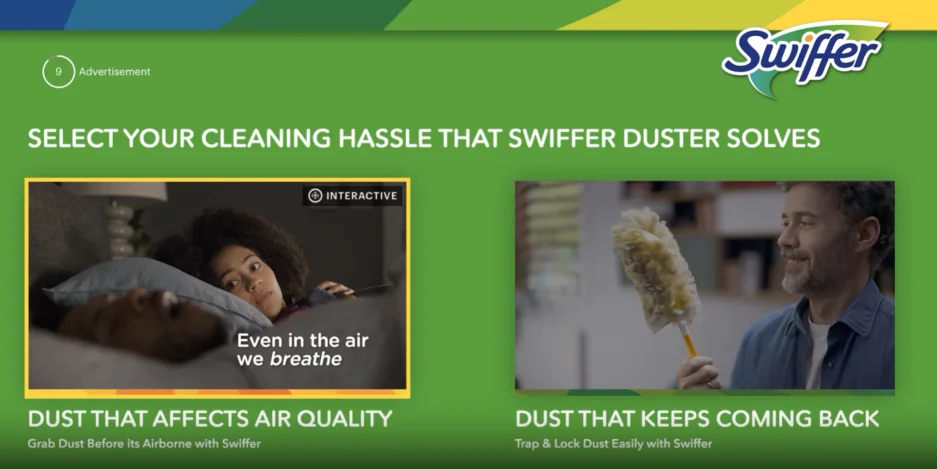
If you’re not sure which segment of your audience to target, just ask them.
Be relatable
For the most part, traditional TV commercial ads feel “distant” from us. We feel like a brand is advertising to us. With online video ads and personalized targeting, viewers expect more relatable and personable content.
Market with emotion
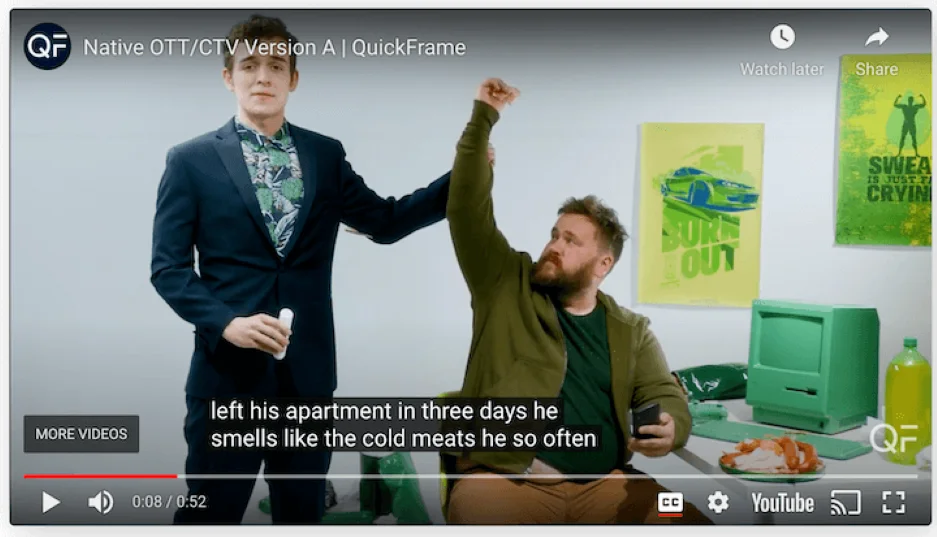
This is a best practice for any form of marketing, but video is the most effective medium for marketing with emotion. Use emotional images, emotional music, and emotional words to have a memorable and meaningful impact on your viewers. Can I say emotional one more time? (Yes.)
And yes, humor is an emotion.
Use voice-overs
It’s a best practice with social media video ads to make it so that the message is communicated without the sound on. This is true for OTT ads, but you also have to remember that even though people can’t skip your OTT ad, they can tune out, switch to a different device while it’s playing, or go in the other room. So it’s important to have a voiceover in your ads that conveys the message with sound, as this will still afford your brand some form of exposure to your viewer.
Copy these OTT advertising examples
OTT advertising gives you the audience attention of traditional TV ads with the advanced targeting, tracking, and conversion tools of modern digital marketing. The examples and tips we’ve included in this guide will give you a great start on trying out this valuable channel.
When you do get started, remember what the best brands do with their OTT ads. They use interactive features, focus on storytelling, and get to know their specific audience so their messages are extremely relevant. With those ideas in mind, you’ll generate the best ROI from your OTT ads.
About the WordStream Blog
We've been a trusted source of data, news, and strategy for over 15 years. All of our content is written and reviewed by real people: a dedicated team of professionals with decades of combined experience in marketing and advertising for businesses of all sizes.


Add us as a preferred source on Google


Meet The Author
Kristen McCormick
Kristen is the Head of Marketing at Hatch, a customer communication platform for service-based businesses. She was previously the Senior Managing Editor at WordStream. Her cat Arnold has double paws on every paw, and she finds life to be exponentially more delightful on a bicycle.
![46 Must-Know YouTube Statistics [Infographic]](https://www.wordstream.com/wp-content/uploads/2026/03/youtube-stats-feature.jpg)