There was a lot of buzz when OpenAI first announced it would start selling ads on ChatGPT in February of 2026. The AI platform has a huge and growing audience of 1.2 billion weekly users who actively turn to it for product and service recommendations.
That’s a promising start for any new marketing channel.
But advertising on ChatGPT, and AI search in general, has nuances that make it better suited to certain businesses and industries.
In this guide, I’ll break down the basics of the new ad options, explore their pros and cons, and share insights from experienced marketers to help you decide if ChatGPT ads are worth your investment now.
Contents
- Are ChatGPT ads worth it?
- What are ChatGPT ads?
- How ChatGPT ads work
- What are the pros and cons of investing in ChatGPT ads?
- How much do ChatGPT ads cost?
- Who should consider ChatGPT ads?
- ChatGPT ads FAQs
🛑 Are your Google Ads delivering the best possible results? Find out with the Free Google Ads Grader
Are ChatGPT ads worth it?
ChatGPT ads can be worth it for businesses willing and able to experiment. To narrow it down further, ask these questions to see if they’re a smart play for your business now:
- Are my customers using AI search to research the problems my products or services solve?
- Can ads there reach and convert customers cost-effectively for my business?
- Do I have the time or budget to experiment with another marketing channel?
“There is an advantage to getting in early because advertisers can start learning what messaging works in this environment,” said Katia Hausman, VP of Product for LocaliQ. “But I wouldn’t test it just to say you are there. It makes the most sense when your customers are already using AI as part of how they research, compare options, and make decisions.”
As you’ll see, some businesses and industries are a natural fit for ChatGPT ads, while others are better off spending elsewhere. Let’s dig into the details to see which group you’re in.
What are ChatGPT ads?
ChatGPT ads are paid placements that appear during conversations in the app. They’re based on the context of the current conversation and—when a user has personalization enabled—previous ChatGPT experiences.
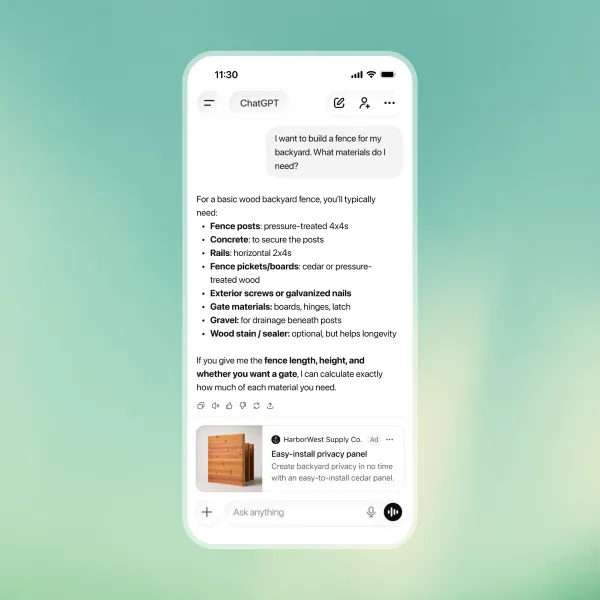
For example, when you ask ChatGPT to give you a project list for a new fence, it may show an ad for ready-made fence sections.
How ChatGPT ads work
ChatGPT ads work on a bidding system like other paid digital placements, but their ability to understand conversational context makes them unique.
Here’s how these ads work from both the users’ and advertisers’ perspective to help you decide if they fit your marketing goals.
Placement
ChatGPT ads show up below the conversation you’re having on the platform. As you’ll see, there are a few versions, but they’re all clearly separated from the organic answer and labeled as an ad.
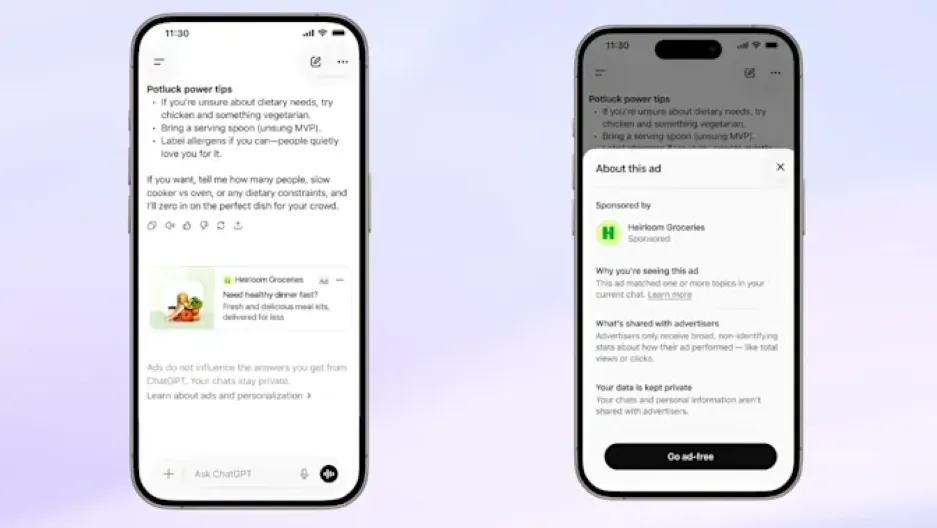
ChatGPT ads appear below and are separated from organic answers.
Visibility
ChatGPT ads only appear for users on the Free and ChatGPT Go tiers. People paying for Plus, Pro, Business, or Enterprise subscriptions do not see ads on the platform.
Users also have some control. They can dismiss individual ads, turn off personalization, and clear their data history to change which ads they see.
Ad formats
There have been as many as six variations of ChatGPT ads documented.
The standard format includes a headline with a favicon (logo), a brief description, and a visual creative.
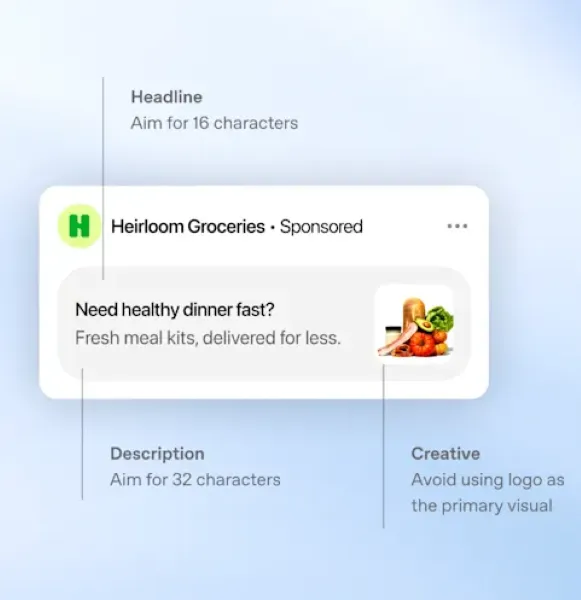
OpenAI is already expanding the ad types available. They’ve recently added a scrollable carousel allowing you to display several products side-by-side.
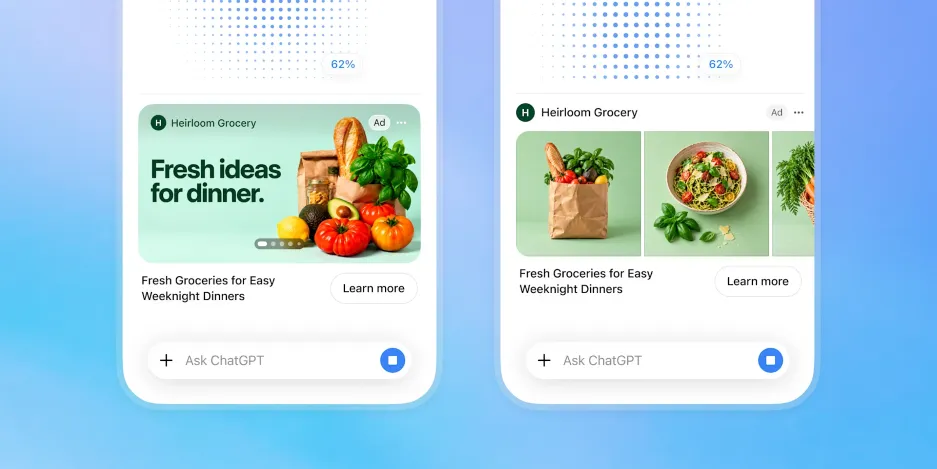
Expect the options and variations to change quickly in the early stages of ChatGPT ads as both OpenAI and users learn what works best.
Targeting
ChatGPT ads use something called context hints instead of keywords to target ads. Context hints are one- or two-sentence descriptions you give OpenAI’s Ads Manager to tell it when and where your ad will be relevant.
This is one of the biggest differences between ChatGPT ads and traditional search ads. Search ad platforms rely on literal keyword overlap. ChatGPT uses semantic embeddings to understand the underlying meaning of your context hint.
For example, you might bid on the term “emergency plumber” in Google Ads. In ChatGPT ads, you’d give it a context hint like, “Homeowner dealing with a burst pipe, flooding, or water leak who needs a plumber fast, often outside business hours.”
OpenAI then matches ads with the context hints you gave it to the user’s current conversation, past chats, and past interactions with ads. Advertisers never see those details, though.
Safeguards and privacy
There are a few safety nets built into ChatGPT ads. For example, ads do not show for users known to be under the age of 18. Ads are also automatically suppressed in conversations involving sensitive topics like health and politics.
OpenAI also says it keeps users’ chats private. They won’t share chat history, names, precise locations, etc., with advertisers.
Bidding and budgeting
ChatGPT ads run on an auction. You choose a goal like views (CPM or reach) or clicks (CPC) and set a maximum bid at the ad-group level.
There is a “conversion” option, too, but it’s based on optimized cost per click (oCPC). That means you pay for clicks from users likely to take an action (subscribe, buy, etc.) instead of paying for actual conversions.
The highest bid doesn’t automatically win. OpenAI uses a relevance-weighted, second-price auction. A more relevant ad can beat a bigger bid, and the winner usually pays just enough to beat the next ad (learn about paid search strategies here for comparison).
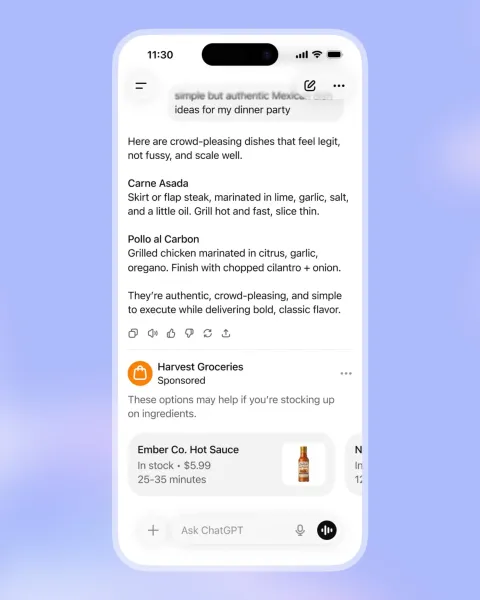
OpenAI considers an ad’s relevance to the conversation as well as the bid amount when placing ads.
OpenAI recently added automated bidding options and view-through conversions to see when a buyer converts within a day of seeing an eligible ad.
👋 Buying ChatGPT ads won’t boost your organic visibility there. This will: The Complete AI Search Toolkit: Practical Strategies to Get Found by AI
What are the pros and cons of investing in ChatGPT ads now?
ChatGPT ads are still new and evolving quickly. There can be benefits to being an early adopter. But early volatility and a still somewhat niche shopper base mean not every business can take advantage. Here is the good and the bad of trying ChatGPT ads now.
Pros
Here’s what you get for jumping into ChatGPT ads now.
High-intent engagements
ChatGPT ads show up right when people are actively looking for a solution. Your product or service fits organically into the conversation, maybe even before the buyer knew they needed it.
“What makes [ChatGPT ads] interesting is that you are reaching people while they are working through a problem or decision,” Katia said. “Sometimes that’s before they’ve even turned that need into a traditional search.”
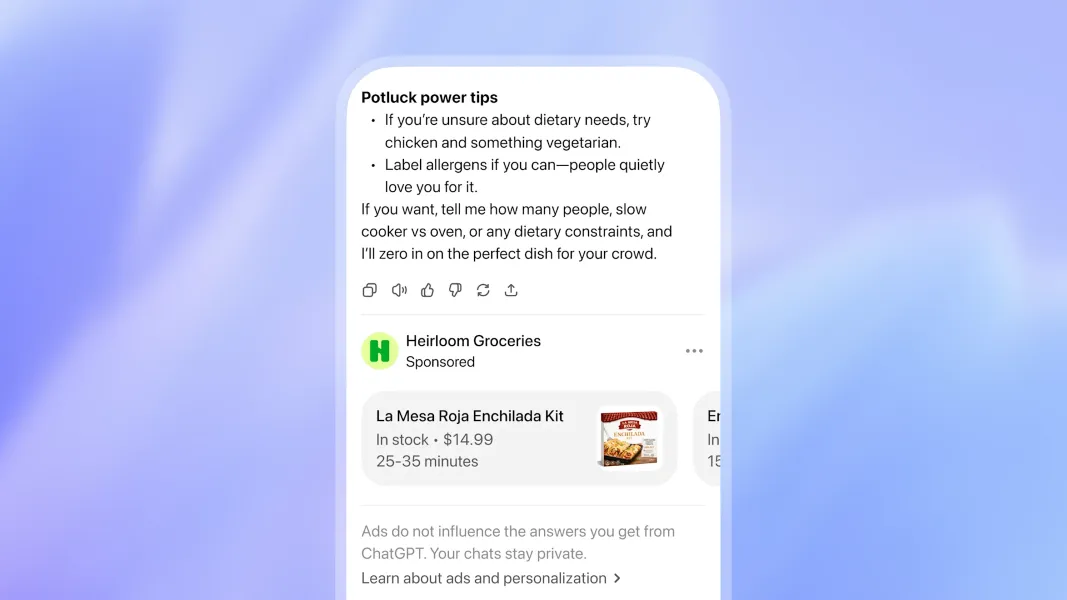
ChatGPT ads fit into the context of the conversation to help improve conversions.
Simplified research
Keyword research sits at the center of a successful search ads campaign. It’s a pain to do. You can spend hours digging through tools, figuring out search intent, and building lists that are out of date as soon as customer behavior changes.
ChatGPT ads semantic matching cuts out a lot of that work.
“ChatGPT Ads aren’t based on exact-match keywords like Google,” said David Meerman Scott, author, speaker, and expert in fandom marketing. “Instead, advertisers tell the system context hints that describe the conversations, topics, or keywords where their products or services may be relevant. That means there isn’t as much research required to get going.”
Instead of a spreadsheet full of potential keywords, you can think about what you would ask if you were your customer. And it may even be easier than that. “You can just point to a landing page and let the ChatGPT Ads AI take it from there,” David added.
Early-mover advantage (less competition)
Depending on which source you trust, the businesses advertising on ChatGPT number in the 10 to 10s of thousands. It’s closer to 7 million on Google.
Lower competition means you’ll have a fighting chance at surfacing for your ideal customer. That’s not likely to be true forever.
“As marketers gain experience with ChatGPT ads and OpenAI figures out ways to show a positive ROI, I expect advertising costs to increase significantly,” David said. “Now is the time to experiment.”
Cons
There are downsides to getting into a new marketing channel early. Especially one that’s used for deeper research instead of a quick search.
ChatGPT ads are still in beta
OpenAI’s help docs refer to the platform as Ads Manager Beta. Meaning, you’ll be advertising on a platform that’s still being built.
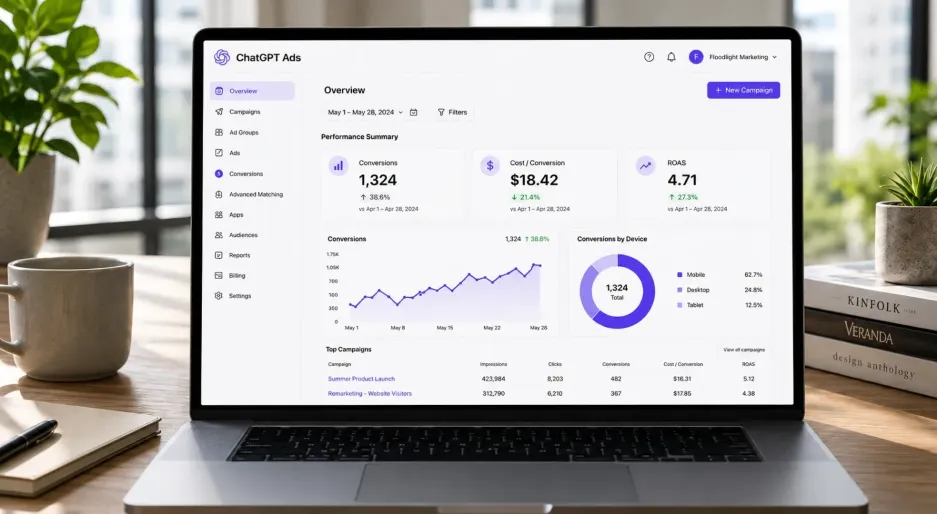
OpenAI continues to add new features to ChatGPT ads, like conversion-optimized bidding.
The result is a frequently changing platform. There have already been several updates to rules, features, and ad types. What works right now may not in a few weeks as these updates roll out.
Results are not stable
Google Ads has years of experiments and campaigns to back up best practices there. ChatGPT has a few months of early data, and it seems to vary greatly by advertiser.
On Reddit, advertisers talk about a mixed bag of results. Some say they’re getting cheaper clicks for local services, while others complain about low-quality leads and platform glitches. One advertiser said visitors from ChatGPT ads were only sticking around for 5 seconds on average.
Even with good initial results, it’s difficult to budget for long-term impact as the platform matures. There’s also not a reliable playbook yet from other marketers to test and prove what works.
They have a relatively narrow audience reach
You can’t reach all ChatGPT users with ads. And many people won’t use an AI tool like ChatGPT for high-value, fast-conversion searches.
Unlike Google, which has a pretty universal reach (most users see ads), only some people who frequent ChatGPT do.
“A significant drawback to the ChatGPT ad program is that the ads are only shown to the free tier of ChatGPT users,” David said. “That means that many business users who pay for the premium plans won’t see ads. That’s a problem for B2B marketers.”
Also, many people will prefer Google Maps and Apple Maps for a quick search of “Coffee shops near me” or “Home improvement stores open now.” AI search platforms like ChatGPT are great for deeper research, but they can’t compete with the convenience of quickly searching a map app for immediate needs.
How much do ChatGPT ads cost?
There’s a wide range of costs in advertising, even for established channels like search ads (we see search ad CPCs from under $2 to nearly $10 depending on the industry in our benchmarks reports).
Digiday reported CPMs of around $25 in April.
They seem to be falling and, depending on your industry, competitive with other platforms.
“I’m seeing about 0.5% click-through rates and about $10 CPMs via ChatGPT ads,” David said. “I remember way back in the early days of Google Ads when these sorts of costs were the norm. Now many high-value keywords on Google are fabulously expensive!”
There’s not enough historical data to have a high level of confidence in ChatGPT ads costs. The best bet is to run a controlled test.
Who should consider ChatGPT ads?
There’s a lot up in the air about what will work on ChatGPT ads. If you have the budget, you may find a lucrative new source of leads.
“Any business that is already prioritizing paid advertising on social networks, or Google, or other online channels should experiment right now,” David said.
That’s particularly true if you sell something people need to research before buying.
“I think the businesses that should be testing ChatGPT Ads now are the ones where customers naturally come to ChatGPT to make a decision,” Katia said. “Travel and hospitality, retail and ecommerce, and home services are good examples because people are already using ChatGPT to plan trips, compare products, research repairs, and figure out what to do next.”

Travel ads work well in ChatGPT because people use AI to research their next trip.
You should consider trialing ChatGPT ads if you:
- Sell into an approved category: Check OpenAI’s ad policies to see if your industry and topics are approved.
- Already track your leads and sales: If you can measure calls, forms, and purchases on other channels, you’ll be able to tell whether ChatGPT is delivering results.
- Have budget you can afford to lose: There’s no minimum spend, but benchmarks are thin, so treat your first campaign as a learning cost.
- Sell something people research before buying: Ads show up below relevant conversations, so they fit best when someone is comparing options.
- Can run a small, focused test: Pick one service, one location, one budget cap, and a clear “keep going or stop” number before you launch.
ChatGPT ads FAQs
There’s a lot of new information to learn about ChatGPT ads. This quick list of FAQs will help you get a handle on it all.
When did ChatGPT launch ads?
OpenAI announced its ad plans on January 16, 2026, and began testing ads with US users on the Free and Go plans on February 9, 2026. The self-serve Ads Manager opened to all US businesses on May 5, 2026.
What are ChatGPT ads like?
ChatGPT ads appear at the bottom of an answer when there’s a relevant sponsored product or service. They’re clearly labeled as an ad and visually separated from the regular response. OpenAI picks which ad to show by matching advertisers’ ads to the topic of the conversation, the user’s past chats, and their past interactions with ads.
Do ChatGPT ads affect organic mentions?
No. OpenAI’s “answer independence” principle means ads do not influence the answers ChatGPT gives users. You can’t buy your way into ChatGPT’s recommendations, so your listings, reviews, and website content still determine whether you get mentioned.
Should you invest in ChatGPT ads?
ChatGPT ads are new. But with so many users engaging with a high buying intent, they’re also very tempting.
If your customers tend to ask more than one question about a product in AI search, you sell something OpenAI has approved for advertising, and you can spare the budget if the return isn’t great, then ChatGPT ads could be worth experimenting with.
About the WordStream Blog
We've been a trusted source of data, news, and strategy for over 15 years. All of our content is written and reviewed by real people: a dedicated team of professionals with decades of combined experience in marketing and advertising for businesses of all sizes.


Add us as a preferred source on Google
Are you wasting money in Google Ads?

Meet The Author
Rob Glover
Rob is the Senior Copywriter at WordStream and LocaliQ, with over 10 years of experience in paid and organic marketing—including SEO, social media, content marketing, and local search. He’s worked across dozens of industries, from SMBs to enterprise, and now specializes in helping businesses build sustainable growth strategies. His work has appeared in Search Engine Land, eMarketer, and more. Outside of marketing, he loves to travel, camp, and mountain bike with his wife and dog.
Recommended for you