About the Author


“But how can I steal my competitor’s customers?”
This is a common request I hear from business owners, whether they’ve been running Google Ads for years or they’re setting up their first campaign. How can you “crush the competition” with your Google Ads strategy?
Sometimes, this request is rooted in a good old-fashioned competitive spirit. Sometimes, it’s because the competitor is already advertising on your brand name, so you want to retaliate. Whatever the reason, we’re going to explore what “traditional” competitive conquesting is in Google Search. Then, I’ll share three different competitive conquesting strategies that you can try today–without breaking the bank.
Contents
- What is competitive conquesting in Google Ads?
- Why is competitor conquesting so expensive?
- 3 ways to do competitive conquesting without breaking the bank
What is competitive conquesting in Google Ads?
The dictionary definition of “conquesting” is “the act of taking control of a place or people by using force.” Sounds a bit extreme for a digital marketing strategy, right? In Google Ads, competitive conquesting refers to the tactic of placing ads on searches for your competitors.
For example, let’s say you are Anthropic (makers of the popular Claude LLM). If you were to use [claude] as a keyword in your Search campaign, that would be a branded search strategy. If you were to use [chatgpt] as a keyword in your Search campaign, that would be competitor conquesting.
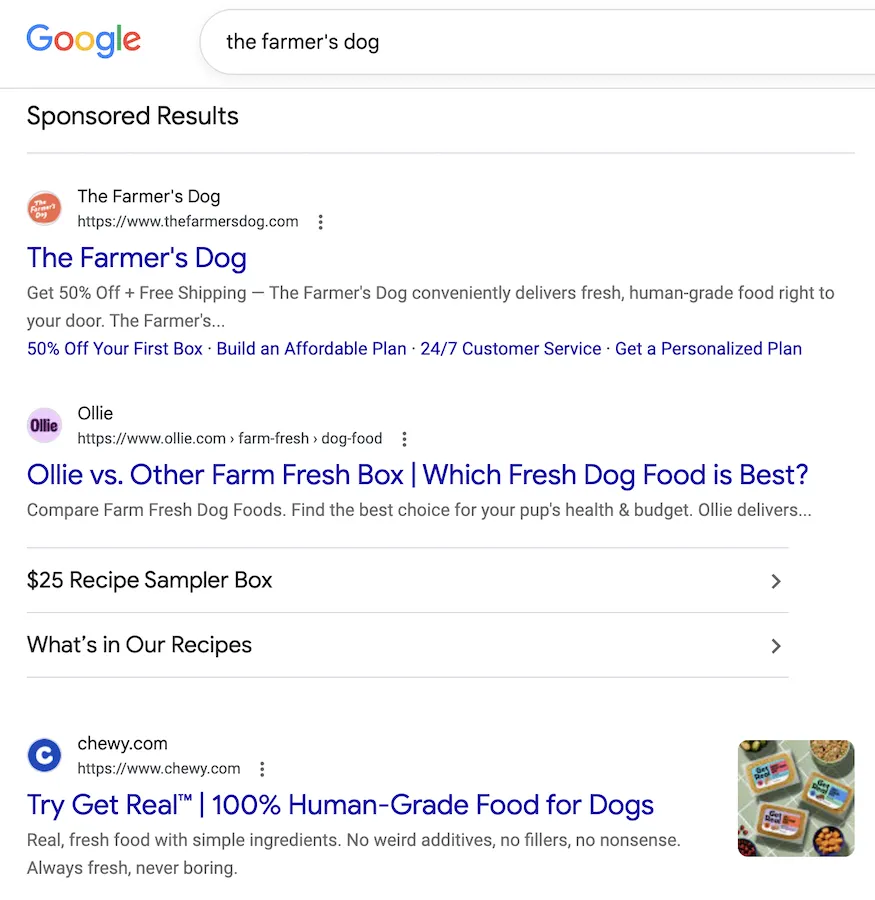
Here’s an example in the wild. A search for The Farmer’s Dog yields results for other businesses clearly targeting their brand keyword.
🛑 Before you try to overtake the competition–get a real read on how your Google Ads are performing right now. Find out with a free, instant audit: Google Ads Performance Grader >>
Why is competitive conquesting so expensive?
Competitive conquesting typically comes with a double whammy of high CPCs and low conversion rates, which means poor ROI. Why?
First, when a user is searching for a competitor, that means they already know exactly what they’re looking for. So even if they do click on your ad, many will bounce once they realize that you are Claude, not ChatGPT. That leads to poor conversion rates.
Second, while you can use your competitor’s name as a keyword, you can’t always put their name in your ad copy. While most practitioners focus on the potential trademark issues involved with putting another brand’s name in your ad copy, the more pressing Google Ads policy is actually “Unacceptable business practices.”
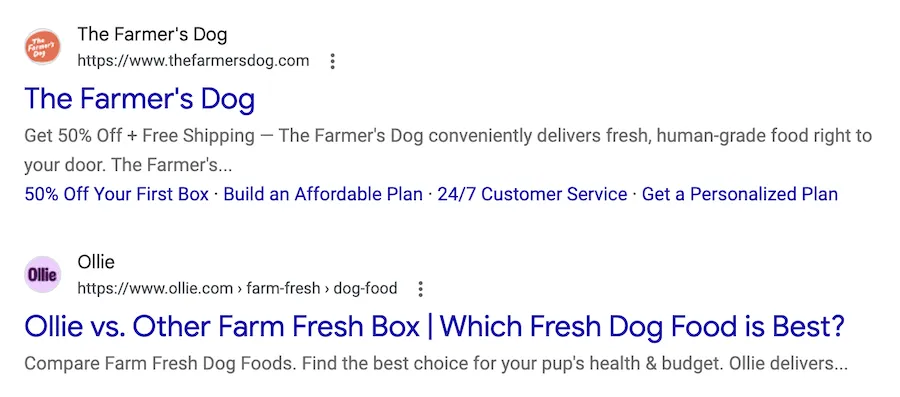
Other Farm Fresh Box? I see what you did there.
To quote Google’s Advertising policies about Misrepresentation, one of the unacceptable business practices (that can lead to account suspension, if not remedied) is “Impersonating other brands or businesses in your ads or on your website to hide your identity or imply connections or qualifications.”
In plain English, you can’t pretend to be another brand. For example, Marcus Bawden, Managing Director at T-mex Express, recently posted a screenshot on LinkedIn of a competitor using the ad headline “T-mex”
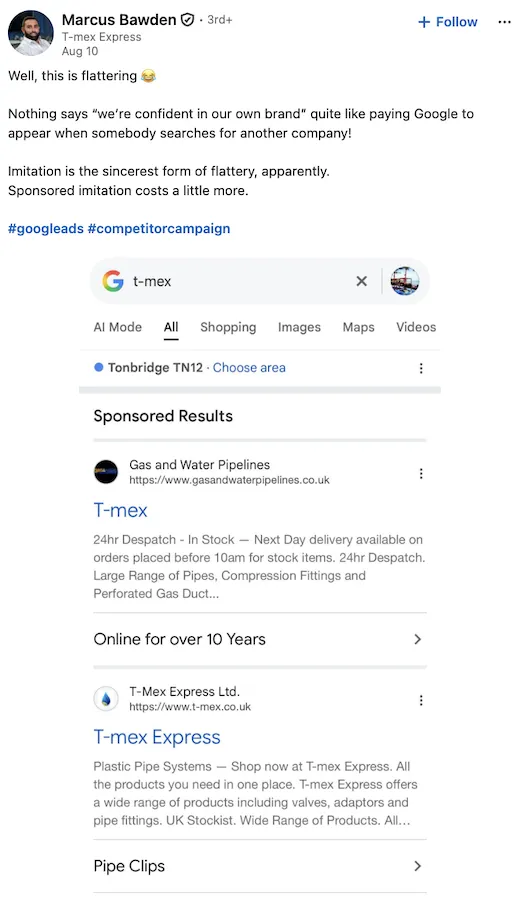
See Marcus’s full post here.
Regardless of trademark usage, and regardless of consumer protection laws in the UK (where Marcus is based), this other company was violating Google Ads policy because the headline implies that they are T-mex, when they are not. Don’t do this!
And because you aren’t doing this, you will usually have a low CTR if you advertise on your competitor’s name, which means poor ad quality, and therefore high CPCs. This is the other reason that search conquesting is usually prohibitively expensive.
🚨 Want to know what CPCs your competitors are seeing in Google Ads? Download our latest Google Ads Benchmarks to find out!
3 types of competitive conquesting strategies for Google Ads (+how to do them)
So what’s a savvy Google Ads advertisers do instead of true competitive conquesting? Here are three options that I developed for you to help you see better results than a conquesting campaign would net you.
1. Audience-based custom segments
Instead of paying a premium to show an ad at the exact moment a user searches for a competitor, you can show ads to people who have recently searched for your competitor–as they’re doing other things online. This strategy is cost effective (since you don’t have the poor ad quality/high CPC issue), and allows you to proactively get in front of people searching for the competition.
How to do it
- In Google Ads, go to Tools > Shared Library > Audience Manager > Custom segments and create a new custom segment.
- Be sure to select “people who searched for any of these terms on Google,” then type in your competitors’ names.
- Add this audience to a Demand Gen campaign or a Video campaign to reach people who’ve been searching for your competitors.
- Because this type of custom segment is only compatible with Google-owned properties, ensure that you have the Display network and/or Video partners turned off
- Also ensure that you have optimized targeting (in Demand Gen) and/or audience expansion (in Video) turned off, so that you are only showing ads to your custom segment.
2. Comparison search ads
While you can’t pretend to be your competitor, you can absolutely draw fair comparisons between your offerings and theirs. To clarify, it is acceptable within Google’s policies to use a headline like “Claude vs. ChatGPT” because you are not pretending to be ChatGPT, so you are not misrepresenting your business.
While laws vary by region, it is also acceptable by many consumer protection agencies to compare yourself to the competition. As always, this is not legal advice; consult with a lawyer before launching any type of competitive strategy.
Assuming that your legal department gives you the “okay,” you’re going to start running comparison search ads rather than competitor conquesting ads. What’s the difference?
Competitor conquesting is advertising on searches for “chatgpt” with ad copy that says “Try Claude today” or “Top AI Chatbot Claude.” Competitor keyword with no competitor name in the ad copy.
Comparison search ads are when you advertise on searches for “chatgpt vs. claude” with ad copy that says “ChatGPT vs. Claude: Which one?” or “Choose Claude vs. ChatGPT.” Comparison keywords with matching comparison ad copy. See the difference? You’re positioning yourself in front of users who are actively comparing you to your competitor.
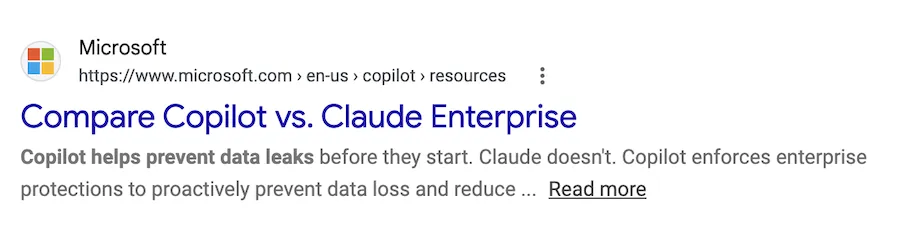
This is an organic result, but Microsoft could run it as a comparison ad and be in the clear.
Rather than serving a regular branded ad, or a regular competitor ad, create a hybrid ad group (or campaign) to specifically serve these comparison searches.
I tested this strategy with one of my coaching clients, who runs a subscription software business. After reviewing the search terms together, I advised them to add comparison keywords and comparison ad copy to their existing competitor conquesting campaign. The results? 8% higher ROAS (and 7% lower CPA) from comparison keywords vs. competitor keywords.
Here is how the key metrics landed over the last year for comparison keywords (for example, [chatgpt or claude]) vs. competitor keywords (for example, [claude]):
- Comparison keywords saw 2.7x higher CTR than competitor keywords (8.2% vs. 3.1% CTR)
- Comparison keywords saw 2.1x higher CPCs than competitor keywords ($8.81 vs. $4.10 CPC). Remember, high CPCs are not the enemy, low quality traffic is!
- Comparison keywords saw 2.3x higher conversion rate than competitor keywords (5.6% vs. 2.4% CVR)
- Comparison keywords saw 7% lower CPA than competitor keywords ($159 vs. $171 CPA)
- Comparison keywords saw 8% higher ROAS than competitor keywords (0.93 vs. 0.86)
How to do it
- First, make sure you have a landing page that is ready to convert this traffic. My client created a comparison page that directly compares their software to a competitor’s. Without a customized landing page, you’ll be hard pressed to drive such a high conversion rate.
- Next, build your keyword list. Your existing search terms report from your branded search and/or search conquesting campaigns may already have some inspiration for you. We started with six exact match keywords; continuing with Claude and ChatGPT as our illustrative example, they are:
- [chatgpt claude]
- [claude chatgpt]
- [claude or chatgpt]
- [chatgpt or claude]
- [claude vs chatgpt]
- [chatgpt vs claude]
- While there is some redundancy amongst these exact match keywords (only three of these six keywords received impressions in the last year), we wanted to ensure our bases were covered.
- Then, craft your comparison ad copy. I will reiterate that you should consult with a lawyer to clarify the law in your jurisdiction around comparison advertising. In the country where this client operates, “fair” comparisons with objective information were deemed acceptable by the client’s legal team.
- Finally, be sure you’re using a conversion-based Smart Bidding strategy (preferably Target CPA or Target ROAS) with properly implemented conversion tracking. This will ensure that your campaign focuses on driving business value from these comparison queries.
3. Non-brand search conquesting
Instead of fighting over your competitor’s brand name, why not steal the non-brand searches that are driving traffic to their website?
I coined the name “non-brand conquesting” for this strategy, because you are specifically conquesting your competitor’s non-brand traffic, rather than their brand traffic. In doing so, you don’t have the low CVR/high CPC issues that plague standard competitor conquesting–and you’re not risking any policy or legal violations.
How to do it
- In Google Ads, go to Tools > Planning > Keyword Planner > Discover new keywords > Start with a website.
- Instead of entering your own URL, as usual, enter your competitor’s website URL. You can do their entire site, or start with a specific page.
- Keyword Planner will show you all of the non-brand search terms that Google associates with your competitor’s site. Take the most relevant non-brand keywords from this list and add them to your Search campaigns as exact match keywords.
- Now, you’ll be showing ads above your competitors’ organic results, and alongside their search ads (assuming they are advertising on Google Search)–stealing a share of the non-brand traffic that’s currently bringing them business!
You can also use the WordStream Free Keyword Tool for this!
Conquer your competitors in Google Ads
These competitive conquesting alternatives allow you to spend less while still targeting your competitors’ customers. Try these out and see which works best to steal your competitors’ traffic.
For more help conquering Google Ads, reach out to see how we can help.
About the WordStream Blog
We've been a trusted source of data, news, and strategy for over 15 years. All of our content is written and reviewed by real people: a dedicated team of professionals with decades of combined experience in marketing and advertising for businesses of all sizes.


Add us as a preferred source on Google
Are you wasting money in Google Ads?

Meet The Author
Jyll Saskin Gales
Jyll Saskin Gales is a Google Ads Coach, and the founder of the Inside Google Ads course, podcast, and bestselling book. She advises business owners, agencies, marketers, and freelancers across industries, helping them get the best ROI from their marketing. Jyll worked at Google for 6 years and has an MBA from Harvard Business School. You can find her on LinkedIn and YouTube @the_google_pro.