About the Author


Alec McClennan started Good Nature Organic Lawn Care in 1999 with only a handful of clients in Cleveland, Ohio. 27 years later, the company serves thousands of homeowners across Cleveland, Akron, and Columbus, and holds a 4.9-star rating across nearly 300 Google reviews, and shows up in local search for all the right queries.
But when a Cleveland homeowner searches “organic lawn care near me,” the first thing they see is not Good Nature’s website. It’s a Map Pack with review stars and a one-tap call button. The homeowner who hires Good Nature probably never clicked a single link.
That is a win. But also a warning.
A business owner tracking only keyword rankings and organic sessions would look at that exact scenario and see problems:
- Traffic is flat
- The blog barely got a click
- The SEO report looks underwhelming
The ranking did its job, the customer found them, but the measurement system missed it entirely.
This is what SEO looks like right now for a lot of small businesses. Rankings still matter, but they are no longer the finish line. They are the entry fee.
This article breaks down why traffic has decoupled from rankings for many businesses and what the metrics that actually predict business outcomes look like now.
Contents
- Why rankings no longer drive traffic they way they used to
- What rankings still tell you (and what they don’t)
- The new measures of SEO success
- What to actually optimize for now
- A quick self-audit for SEO in the zero-click era
Why rankings no longer drive traffic they way they used to
Let’s get this out of the way: Google hasn’t stopped rewarding good rankings. It’s just built a lot more things between the ranking and the click.
Four things are responsible for most of the damage:
1. AI Overviews are answering before users scroll
For informational queries like “how often should you replace a furnace filter” or “what causes low water pressure,” Google now synthesizes an answer at the top of the page.
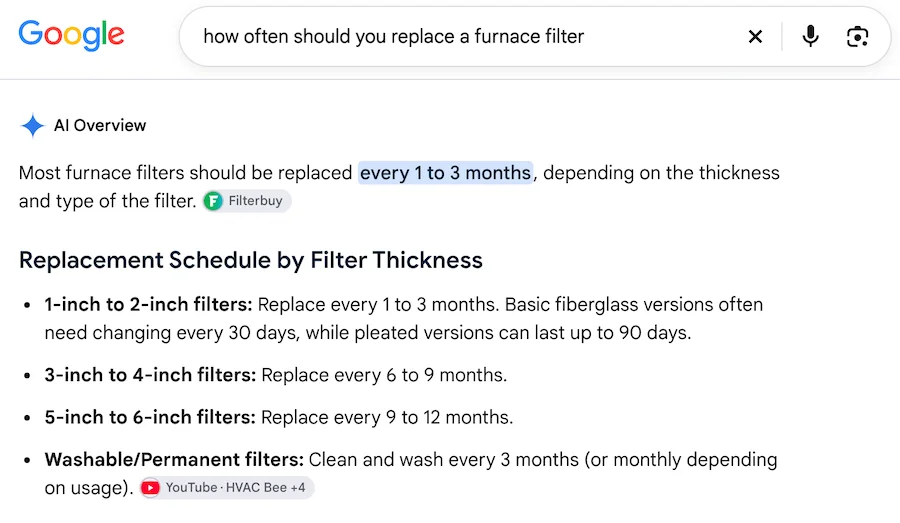
A company like Black Hills Inc., an HVAC and plumbing company serving Western Washington, might rank organically for “how often to service an HVAC system,” while an AI Overview above them answers the question word-for-word.
These were the top-of-funnel informational queries that once built authority and drove first visits.
Now, many of them resolve at the SERP level. The zero-click movement has basically eradicated the value behind optimizing content for informational queries.
🛠️ Get everything you need to know about showing up in AI search in our free guide: The AI Search Toolkit >>
2. Local Services Ads and the Map Pack occupy the real estate customers act on
For local intent queries like “HVAC repair near me” or “emergency plumber Chehalis WA,” the page a user sees on mobile is almost entirely occupied before organic results appear.
Local Services Ads sit at the very top, regular Google Ads appear under that, and the three-pack sits below them.
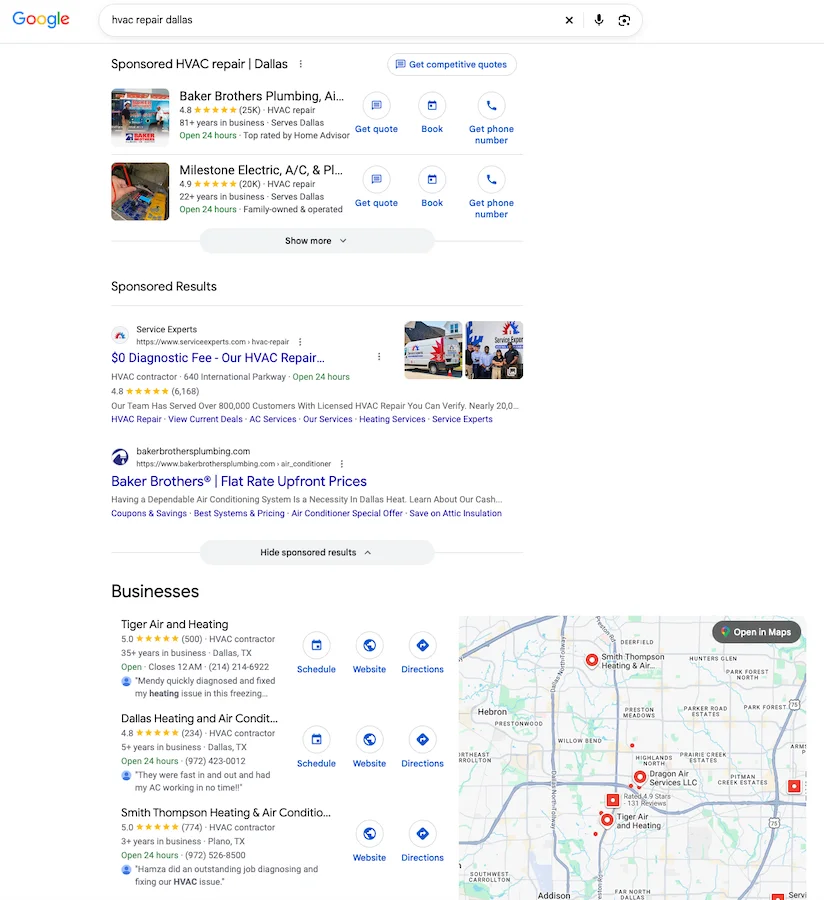
By the time organic position one shows up, a significant portion of users have already found what they need or tapped a call button.
This matters because local intent queries are the ones with the highest commercial value. Someone searching “organic lawn care near me” is not doing research. They want to hire someone. The business that captures that moment is usually the one in the Map Pack, not the one ranking first organically.
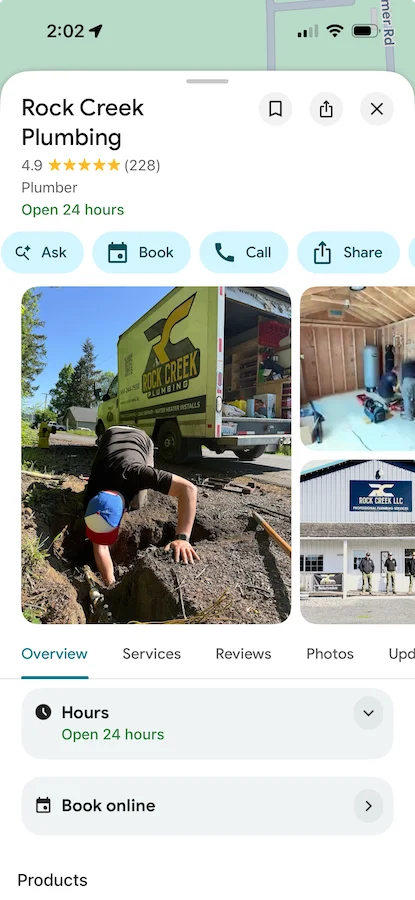
Rock Creek Plumbing LLC, a family-owned operation in Chehalis, WA, may see their best lead volume not from organic rank but from their Map Pack presence and the Google Business Profile (GBP) call button.
The organic ranking still plays a supporting role in overall authority. But the leads flow through the pack.
3. People Also Ask, rich results, and video carousels take up the rest
Even on the queries where users do scroll, the page is crowded.
Good Nature Organic Lawn Care ranks for organic lawn care questions, but their content shares the page with People Also Ask (PAA) boxes, video carousels, image results, and local ads.
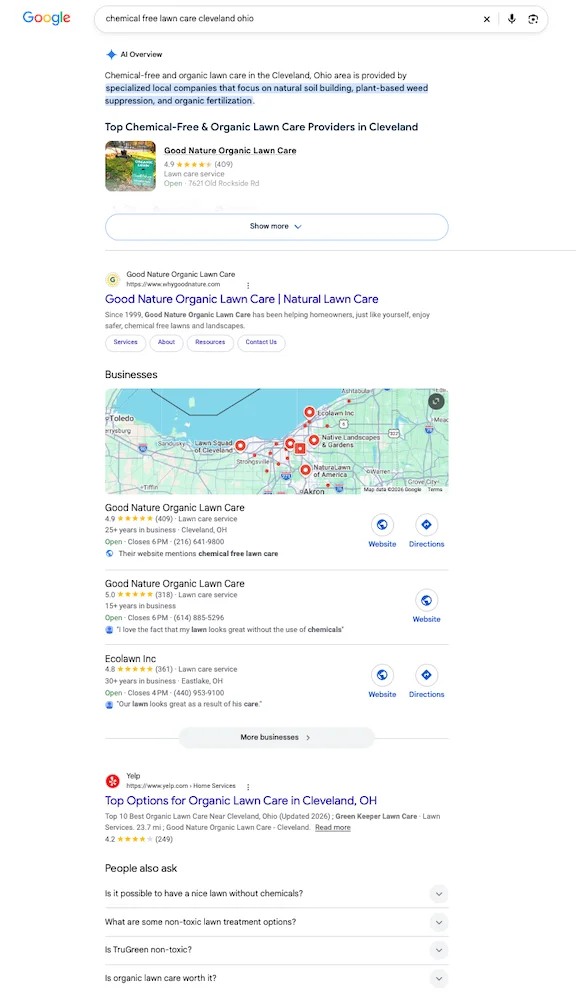
Each of those features is competing for the same limited attention.
The practical effect is that ranking position one no longer means what it used to.
- In a traditional 10-blue-links SERP, position one got a disproportionate share of clicks.
- On a modern SERP loaded with features, position one is just one of many things a user might interact with.
Your organic result can be technically first and still get passed over entirely.
4. User behavior is fragmenting beyond Google entirely
This one is slower-moving but worth paying attention to.
Younger homeowners increasingly start their search for local services on YouTube (“how to know if my AC needs replacing”), Nextdoor (“does anyone know a good dentist near me”), or with a direct query to ChatGPT or Perplexity.
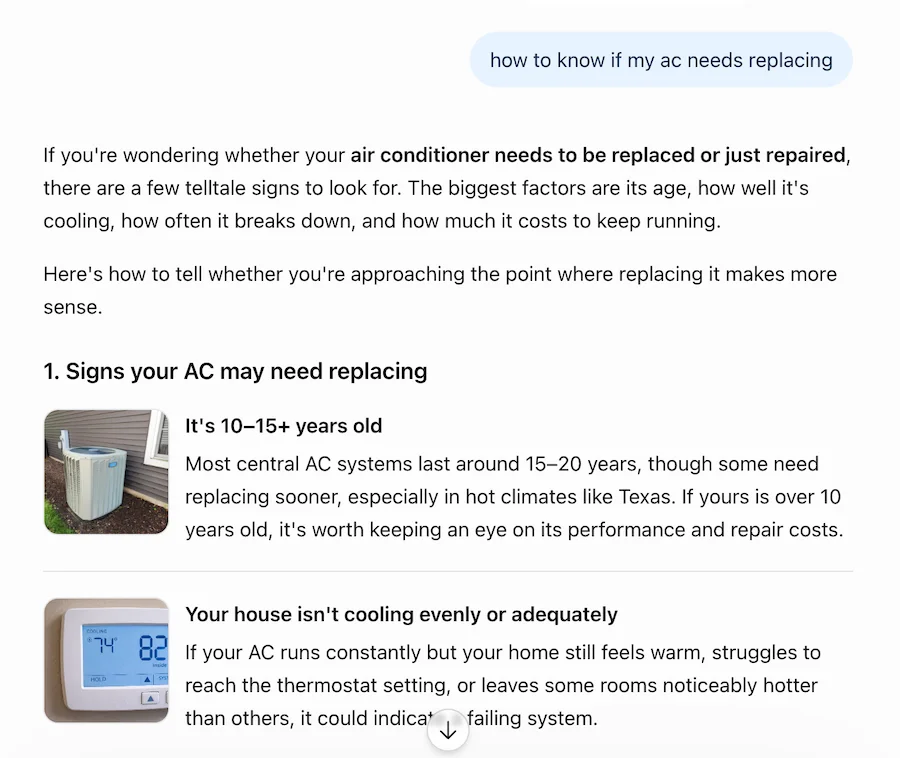
These platforms don’t send referral traffic that shows up in Google Search Console. They don’t register as organic sessions. And they are becoming a real part of how people find local businesses.
The Google organic result is still the dominant channel for most SMBs, but it’s no longer the only door. A business that is only measuring Google organic performance is already missing part of the picture.
What rankings still tell you (and what they don’t)
Rankings still signal three things worth paying attention to:
- Relevance (Google thinks your content answers the query)
- Authority (your site has enough trust to compete)
- Potential visibility (if you’re in the game at all)
What rankings no longer tell you on their own:
- Whether anyone saw your result
- Whether your brand is registered with the user who did
- Whether the traffic you do receive is converting
The above-mentioned Rock Creek Plumbing LLC holds a Local 3-Pack presence for plumbing queries in their area.
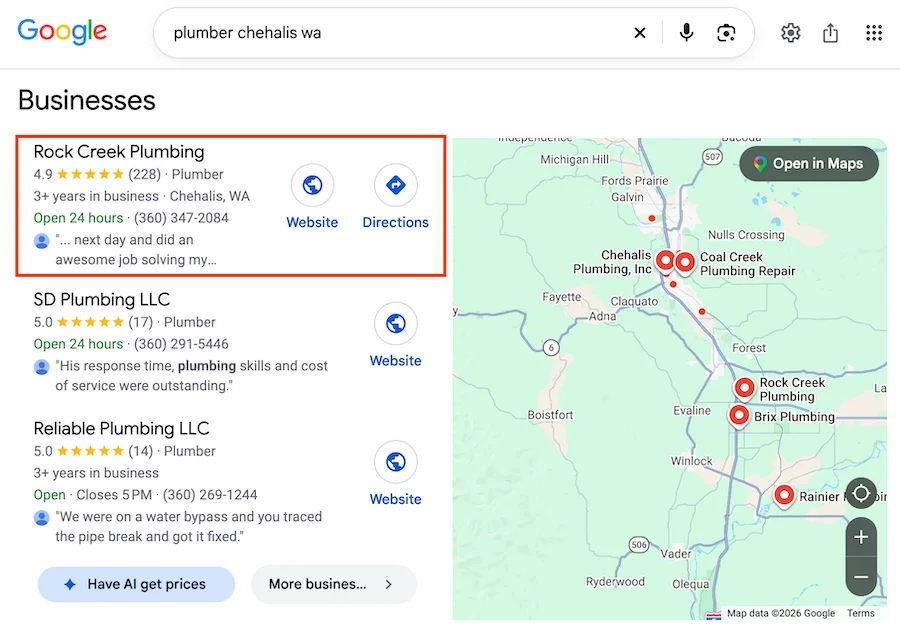
The organic ranking of their website pages matters far less to their lead volume than their GBP profile, their photo uploads, and how consistently they respond to reviews.
Simply put: the ranking got them in the room, but the GBP is what closes the deal.
Ranking is a prerequisite, not an outcome. The outcome is what happens to a user once your name appears somewhere on that page.
🔎 Need help understanding the modern rules for SEO? Download our free guide >> How to Do SEO Right—Right Now!
The new measures of SEO success
Here’s what to start watching.
1. Impressions, not just clicks
Google Search Console shows how many times your result appeared, regardless of whether anyone clicked.
For a business like Good Nature Organic Lawn Care, flat clicks alongside rising impressions year-over-year mean the brand is showing up more, even when users are resolving their query without visiting the site.
Impressions trending up while clicks stay flat means brand exposure that compounds.
If your SEO report shows declining clicks but your impressions are climbing, your content is surfacing in a search environment where fewer people are clicking through to anyone.
You are still winning the visibility game. The measurement tool just wasn’t built to show it.
2. Share of SERP features
A dental practice doesn’t need the organic click to benefit from a search if their name, review stars, and five-star average appear in the Map Pack every time someone searches “dentist near me [city].”
Tools like Google Search Console, Semrush, and Ahrefs let you track whether you are appearing in featured snippets, PAA boxes, the Map Pack, and AI Overviews.
Ask not just “where do I rank” but “how many places on this page does my name show up.”
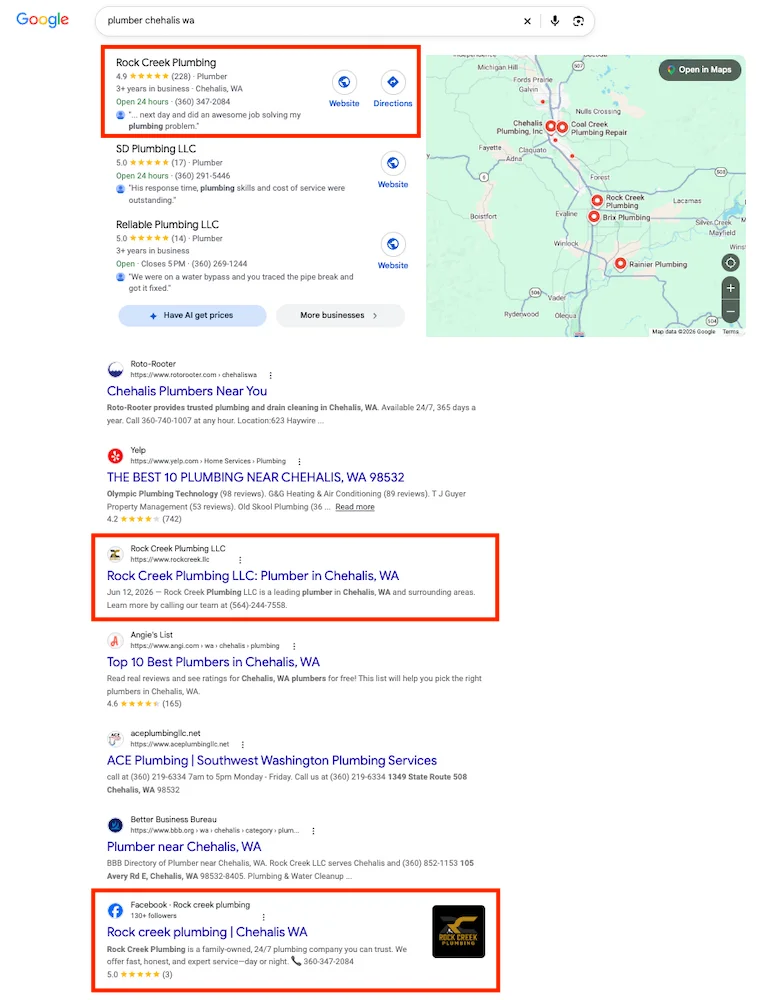
Rock Creek has a Map result, a result for their website, and a result for their Facebook page.
A business appearing in the Map Pack, a PAA answer, and an organic result for the same query has three separate chances to register with a user. A business sitting at organic position one and nowhere else has one. SERP footprint is a real competitive advantage, and most businesses aren’t tracking it.
Try our Local SEO & Map-Pack ROI Calculator to estimate what your current SERP footprint is worth.
3. Branded search volume
When people search your business name directly, that is a downstream signal that your entire search presence is working. Content, GBP, reviews, visibility across platforms—all of it feeds into whether people go looking for you by name.
In Google Search Console, filter by branded queries and watch the trend over six months. A dental practice in a competitive market whose branded search is climbing is building SEO value that doesn’t show up in a rank tracker. It shows up in their schedule.
Rising branded search is one of the most reliable indicators that your total search presence is doing what it’s supposed to do. It means your name is sticking.
4. Conversion rate on the traffic you do get
With less top-of-funnel traffic coming in from informational queries, every visit carries more weight. The question shifts from “how do we get more traffic” to “are we converting the traffic we have.”
Black Hills Inc. has built a content and GBP presence strong enough that when a user does click through, they are already primed to call, not browse.
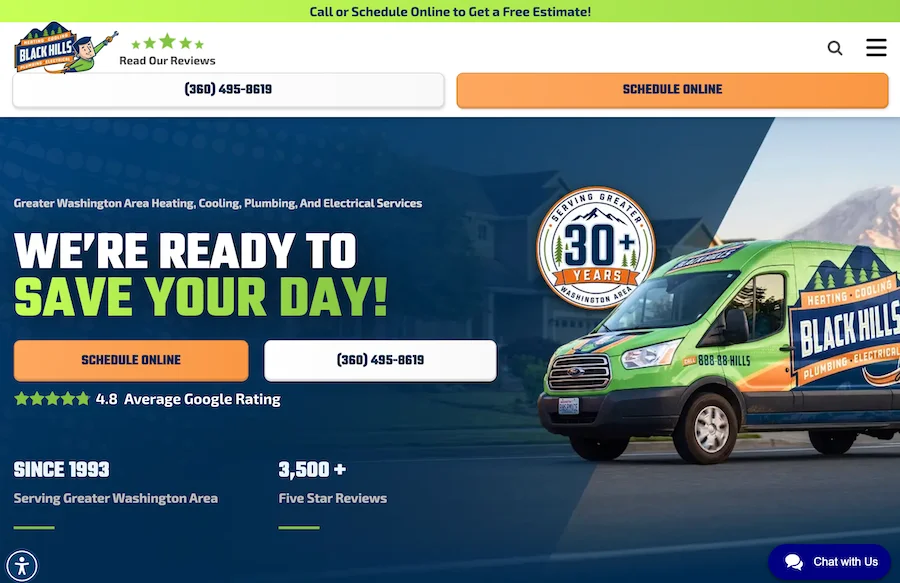
The informational content did its job earlier in the process, in the SERP, in the AI Overview. By the time someone visits the site, the trust is largely already there.
If your organic sessions dropped 20% but leads held steady, your SEO is working harder per visit than it was before. That is a different way to read the same data. A worse traffic number can mean better SEO, if conversion rate is the lens.
5. Google Business Profile actions
For local businesses, GBP Insights often tell a more complete performance story than website analytics. Calls, direction requests, website clicks, and message threads from a GBP all track the path from SERP to customer without a website visit ever occurring.
Rock Creek Plumbing LLC’s GBP is the primary channel through which emergency plumbing leads find them. Not their blog content. Not their organic page rankings. The homeowner with a burst pipe at 10 p.m. on a Tuesday is not reading a 1,500-word article about common plumbing failures in older homes. They are tapping the call button on the GBP listing that appeared when they searched “emergency plumber near me.”
GBP actions are real business signals. Treat them like it.
👀 Looking for ways to get more leads for your business (for free)? We’ve got you covered >> 14 Fast & Easy Ways to Get Free Leads (+Examples You Can Copy)
What to actually optimize for now
Stop treating position one as the only prize worth chasing. A few shifts in how you think about SEO will do more for your business than obsessing over moving from spot three to spot one.
Focus on your presence across the full SERP, not just position
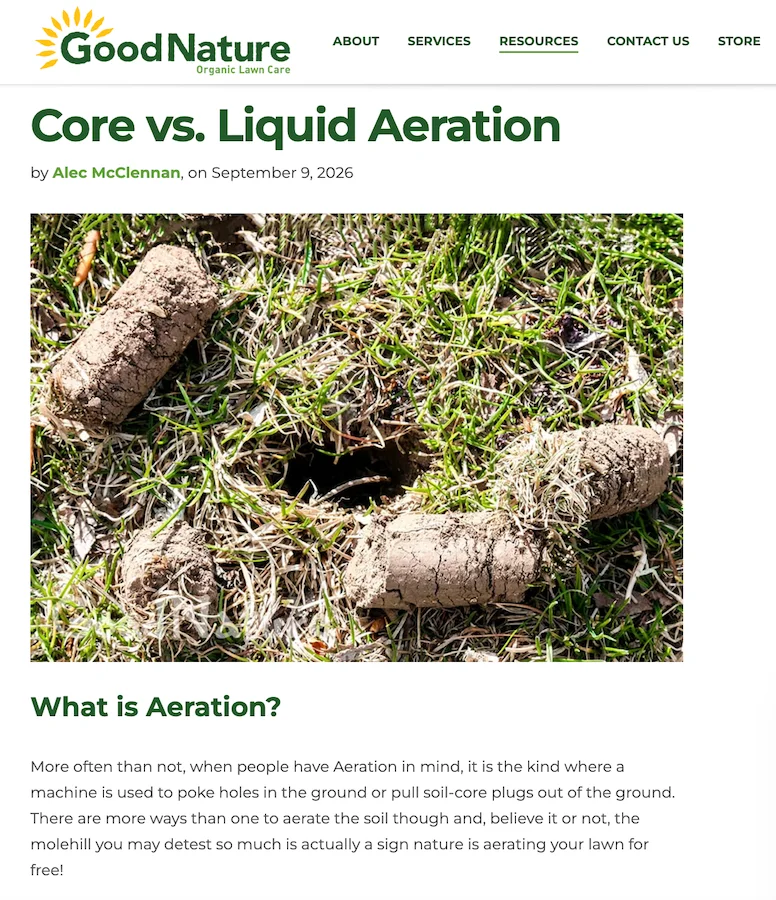
Schema markup, FAQ and HowTo schema in particular, helps pull content into PAA and rich result placements. Good Nature Organic Lawn Care’s structured blog content on topics like “core vs. liquid aeration” has the right format to earn SERP features, even when the organic position is not number one.
You do not need to rank first. You need to show up in enough places that your name becomes familiar before a user ever clicks anything.
Treat your Google Business Profile as a primary SEO asset
For most local businesses, the GBP is the result a customer actually acts on. Consistent posts, photo uploads, review responses, and service descriptions all influence GBP visibility and local pack ranking. Rock Creek Plumbing LLC’s GBP consistently surfaces in the Local 3-Pack for Chehalis plumbing queries, driven in part by active review management and job documentation through photo pins.
A neglected GBP is not a neutral thing. It is a competitive disadvantage. Every HVAC company, dental practice, or lawn care business that is actively managing theirs is pulling ahead of the ones that set it up once in 2019 and never touched it again.
Build content for trust, not just traffic
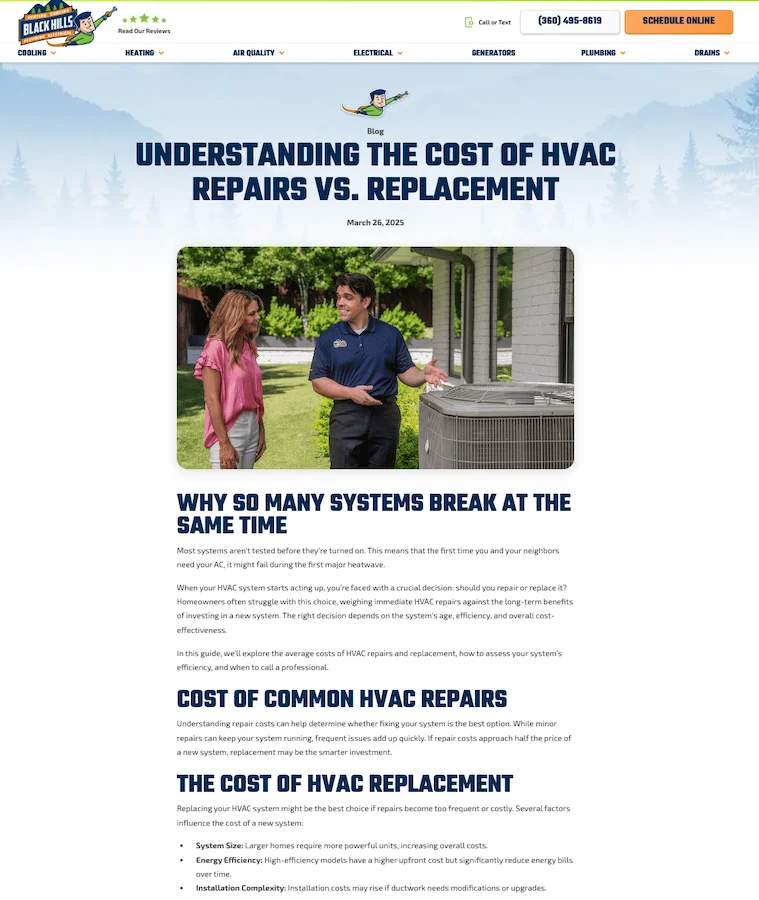
The content that earns citations in AI Overviews tends to be authoritative, specific, and original. For an HVAC company like Black Hills Inc., a detailed guide on “cost of hvac repairs vs. replacement” is far more likely to surface in AI-generated answers than a thin keyword page with the same title.
Original perspective, clear answers, and demonstrated expertise are what AI search rewards. That has always been good content advice. It is now also an AI visibility strategy.
Make informational content work for brand, not just clicks
If a user sees your name in an AI Overview for “how often should I have my AC serviced” and doesn’t click, they still saw your name. The accumulation of those impressions is brand-building through SEO. It has real downstream value even when it looks like zero-click dead weight in analytics.
Every time someone reads an AI answer that cites your content or sees your name in a PAA result they didn’t click, you are getting free brand exposure inside one of the highest-traffic channels on the internet. That exposure does not show up in sessions. It shows up in calls.
A quick self-audit for SEO in the zero-click era
Most SEO audits focus on what’s broken technically: crawl errors, missing meta descriptions, slow page speed. Those things matter. But for a business trying to understand whether their search presence is actually generating business, a different kind of audit is more useful. This one takes about 30 minutes and requires no paid tools.
1. Start with Google Search Console impressions
Open Search Console, go to the Performance report, and switch the primary metric from clicks to impressions.
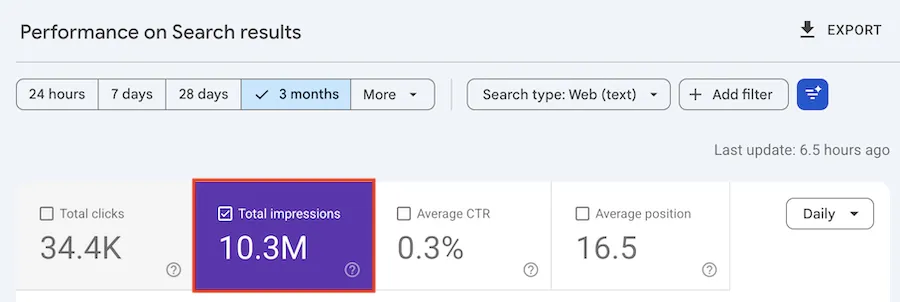
Look at your top 15-20 queries over the past six months. For each one, note whether impressions are trending up, flat, or down. If impressions are rising while clicks are flat or declining, you’re in a zero-click environment doing what it does, and your visibility within it is growing. The business that understands this distinction doesn’t cut their SEO budget based on a misleading traffic report.
2. Do a live SERP audit for your three most valuable queries
Open an incognito browser window, which removes your personalized search history from the results, and search each of your three highest-value queries as a customer would.
Look at every element on the page:
- Local Services Ads
- The Map Pack
- Featured snippets
- PAA boxes
- Video results
- Organic listings
- GBP panels
Write down every place your business name or content appears. This full-page footprint is your real SEO score, not your rank tracker position.
A business appearing three times on the same page has a fundamentally different presence than one appearing once, regardless of what the positions are.
3. Pull your GBP Insights and treat them like revenue data
Inside your Google Business Profile dashboard, the Performance section tracks calls placed directly from the listing, requests for directions, website clicks, and messages.
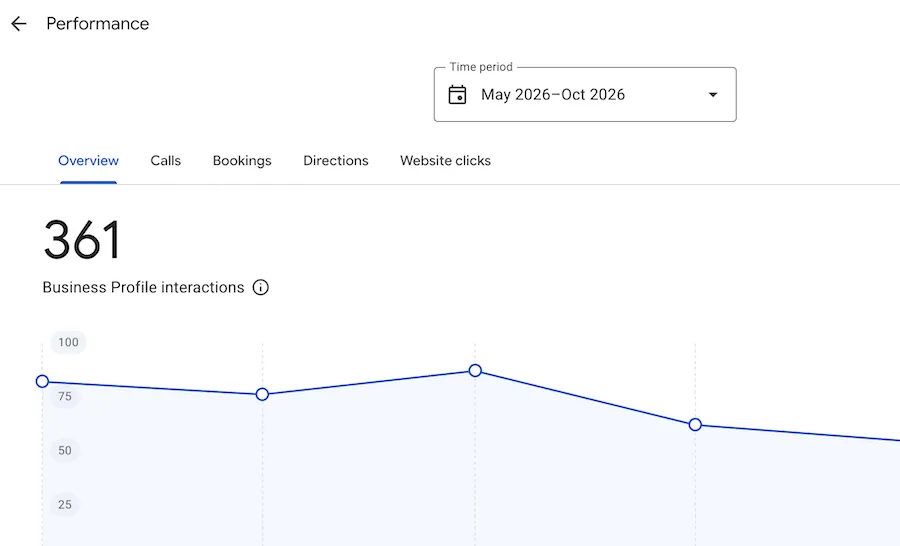
Pull this data for the past 90 days and compare it to the same period last year. For many local businesses, this report contains more evidence of SEO working than their entire website analytics dashboard.
Rock Creek Plumbing LLC’s GBP actions outpace their website visits by a wide margin. If yours do too, your customer is telling you how they prefer to find and contact you.
4. Filter Search Console for branded queries
In the Performance report, add a query filter and search for your business name and common variations of it. Look at the trend over six months and then 12 months:
- Is the number of branded searches growing?
- Is the click-through rate on branded queries high, which it should be since someone searching your name is almost certainly looking for you specifically?
Rising branded search volume means your total search presence, content, GBP activity, reviews, and visibility across features, is doing its job. People are seeing your name enough that they’re coming back for you by name.
5. Calculate your organic conversion rate
Take the number of leads or contacts you received from organic search over the past three months and divide it by the number of organic sessions in the same period.
This gives you a conversion rate. Now compare that rate to the same period last year. If organic sessions dropped but your conversion rate improved, you’re getting more efficient.
The visitors arriving now are higher intent, and your content is converting them at a better rate. That is a stronger business outcome than more traffic converting poorly, even if the session count looks worse on a dashboard.
6. Check how your GBP looks to a first-time visitor
Search your business name in an incognito browser and look at your GBP knowledge panel as a potential customer would:
- Are your photos recent and representative of actual work?
- Are your service descriptions specific enough to help someone understand what you do and who you serve?
- Are you responding to reviews, including the negative ones, in a way that builds confidence rather than eroding it?
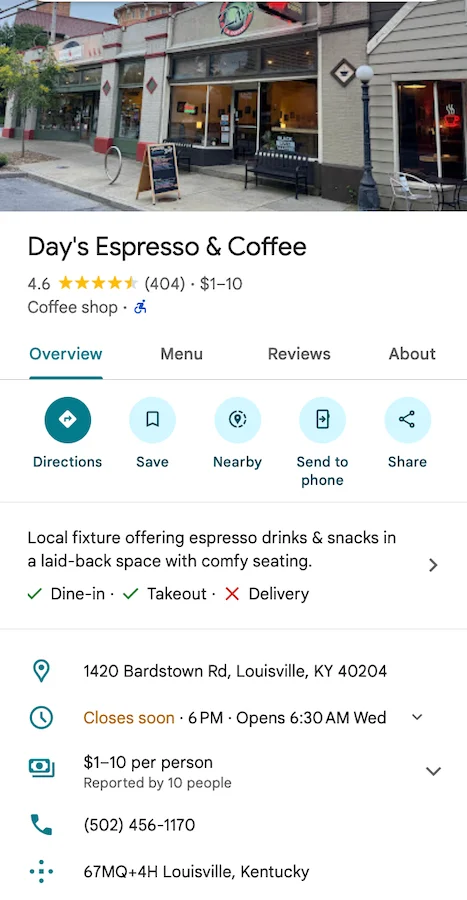
A GBP that looks abandoned or generic loses customers at the moment of highest intent, right when they’ve already found you and are deciding whether to call.
How to maintain and measure SEO when rankings are less important
Rankings haven’t become irrelevant. They’ve become one signal among many.
The businesses winning at SEO right now are not necessarily the ones sitting at number one for every keyword. They are the ones whose names appear in the Map Pack with 400 reviews, whose content surfaces in AI Overviews, whose GBP generates calls before a would-be customer ever visits a website.
The question has shifted from “where do I rank?” to “when someone in my city needs what I do, does my name come up somewhere they trust and act on?”
That’s the new measure of success.
About the WordStream Blog
We've been a trusted source of data, news, and strategy for over 15 years. All of our content is written and reviewed by real people: a dedicated team of professionals with decades of combined experience in marketing and advertising for businesses of all sizes.


Add us as a preferred source on Google


Meet The Author
Goran Mirkovic
Goran Mirković is a marketing leader with over a decade of experience in SaaS growth, SEO, content strategy, and demand creation, a freelance contributor for WordStream, and a 2x CMO. With a background spanning both agency and in-house leadership roles, he focuses on AI-era search, the evolution of content marketing, demand creation, and practical strategies that help businesses turn expertise into revenue. Outside of marketing, he is a dedicated cinephile with a particular obsession for horror films.