Global digital ad spend is projected to exceed $740 billion in 2026, and the channels keep multiplying faster than the average team can coordinate them.
Cross-channel marketing is the discipline that closes that gap. It’s a coordinated approach to reaching customers across paid, owned, and earned channels where data from each channel informs the messaging and timing of the others, so a single campaign feels continuous instead of repetitive.
As someone who has spent more than a decade working in and alongside marketing departments of varying shapes and sizes, I’m intimately familiar with the challenges and opportunities surrounding cross-channel marketing.
In this guide, I’ll cover the basics of cross-channel marketing, show you how to execute it, and share some examples to put it all in perspective.
Contents
- What is cross-channel marketing?
- Cross-channel vs. multichannel vs. omnichannel marketing
- The channels that go into a cross-channel mix
- What cross-channel marketing actually buys you
- How to build a cross-channel marketing strategy
- 3 cross-channel marketing examples
- How to measure cross-channel marketing
- Common cross-channel mistakes to avoid
- Cross-channel marketing FAQs
What is cross-channel marketing?
Cross-channel marketing is a coordinated approach to reaching customers across multiple connected channels (paid, owned, and earned), where data from each channel informs the messaging and timing of the others, so a single campaign feels continuous rather than repetitive.
In operational terms, a cross-channel campaign has three shared layers: one audience definition pushed to every platform, one creative system rendered natively per channel, and one measurement frame that treats all channel-level data as inputs to a single ROI question. Strip any of those three out, and you do not have cross-channel; you have multichannel with extra steps.
That is the multichannel trap: running ads on Google, Meta, and your email list does not make you a cross-channel marketer if those channels never share an audience or a signal. Multichannel is coverage. Cross-channel is coordination.
🛑 Do you know how your Google Ads are really performing? Find out with our Free Google Ads Grader
Cross-channel vs. multichannel vs. omnichannel marketing
There is often a lot of confusion about the difference between cross-channel, multichannel, and omnichannel.
A quick-and-dirty way to think about this is: multichannel = present; cross-channel = coordinated; omnichannel = all-encompassing (offline and online).
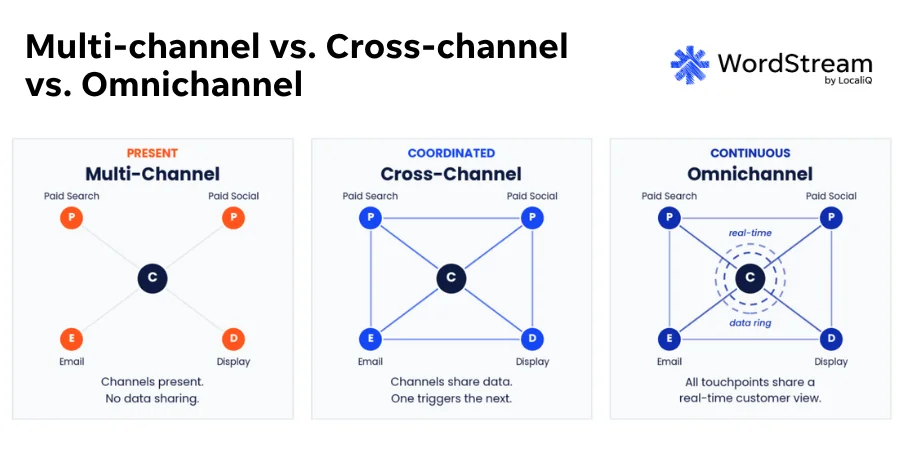
Here’s a more in-depth breakdown:
Multi-Channel vs Cross-Channel vs Omnichannel
Same channels, three levels of coordination. Match each row to where your team is today.
| Dimension | Multi-Channel | Cross-Channel RECOMMENDED | Omnichannel |
|---|---|---|---|
| Channels share data? | No | Yes (channel to channel) | Yes (every channel, in real time) |
| Customer view | Per-channel | Unified for campaign | Unified across all marketing, service, and commerce |
| Trigger logic | Channel-by-channel | One channel's behavior triggers another | Any touchpoint can trigger any other, including non-marketing (support, in-store) |
| Tech requirement | Ad platforms + email tool | Marketing automation + CDP-lite + shared audiences | Full CDP + identity resolution + service / commerce integration |
| Realistic for SMBs? | Yes | Yes THIS GUIDE | Aspirational for most SMBs |
| Example | Google Ads, Meta, and an email newsletter that don't talk to each other. | A search ad click triggers a Meta retargeting impression, then a triggered email at hour 24. | A retail customer browses the app, gets a push, walks into a store, and the associate sees their cart. |
Most SMB and mid-market teams should aim for cross-channel. Omnichannel often gets sold to teams that don't yet have the data infrastructure to support it.
Want to know what stage of marketing maturity (multi, cross, or omnichannel) your company is currently in? Answer a few questions, and our free tool will help you determine which stage you’re actually in:
Cross-Channel Maturity Assessment
Answer 7 questions about your current setup. We'll tell you whether you're actually running multi-channel, cross-channel, or omnichannel, and what to fix first.
The channels that go into a cross-channel mix
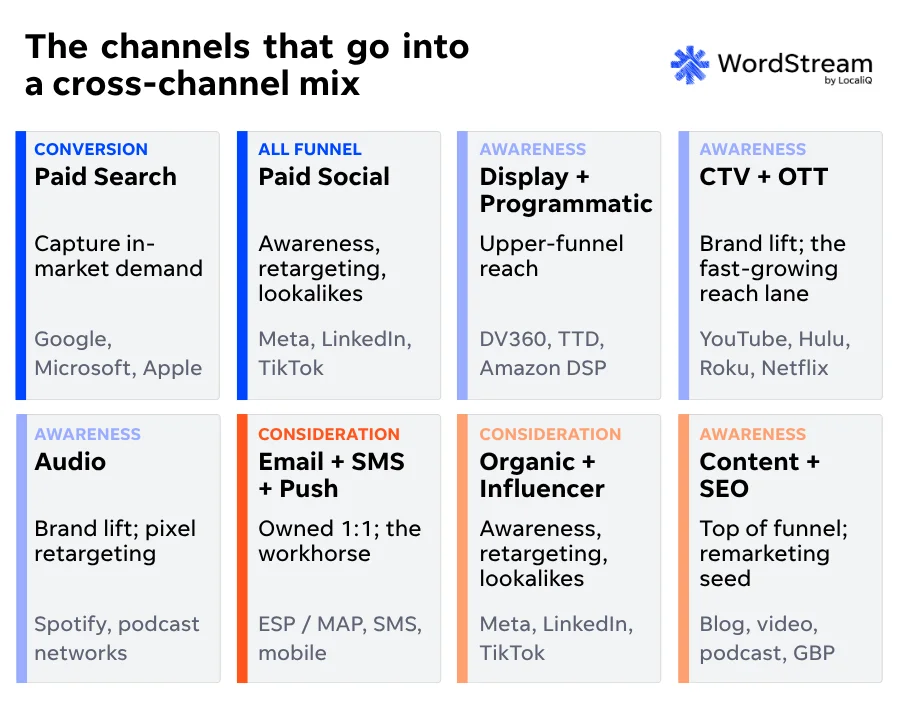
Your cross-channel marketing mix depends on your business: it’s a mix of multiple channels that share audiences and signals.
Marketers now use an average of 10 customer engagement channels in their mix, but high-performing marketers fully personalize experiences across only six of them, per Salesforce’s State of Marketing Report.
That four-channel gap between channels used and channels coordinated is the working definition of the cross-channel problem. The mix keeps growing, and the coordination is what lags.
Cross-channel marketing doesn’t require running all 10. It requires that the channels you do run share audiences, triggers, and measurement.
This is particularly true for a small business with limited resources. Your cross-channel mix could be just a couple of carefully coordinated channels.
The Channels That Go Into a Cross-Channel Mix
Eight buckets by funnel role. Cross-channel doesn't require all of them, just that the ones you run share audiences and signals.
| Bucket | Channels | Primary Cross-Channel Job |
|---|---|---|
|
Conversion
Paid Search / Shopping
|
Google Ads, Microsoft Ads, Apple Search Ads | Capture in-market demand; feed audiences downstream |
|
All Funnel
Paid Social
|
Meta, LinkedIn (B2B), TikTok, Pinterest, Reddit, X | Awareness + retargeting; lookalike seed |
|
Awareness
Display / Programmatic / CTV / OTT
|
DV360, The Trade Desk, Amazon DSP, retail media | Upper-funnel reach; CTV / OTT is the 2026 growth lane |
|
Awareness
Audio
|
Spotify, podcast networks, programmatic audio | Brand lift + retargeting via pixel-enabled hosts |
|
Owned
Email + SMS + Push
|
ESP / MAP, SMS platform, mobile app | Owned 1:1; the workhorse of the loop |
|
Earned
Organic Social + Influencer
|
Brand handles, creators, affiliates | Earned validation + retargeting pool |
|
Top of Funnel
Content / SEO
|
Blog, video, podcast | Top of the funnel; remarketing seed |
|
Offline
Offline
|
Direct mail, OOH / DOOH, events, in-store | Reach lift; measurable with QR, unique URLs, promo codes |
Pick the channels that match your funnel, not all of them. What makes the mix cross-channel is shared audiences and signal flow, not channel count.
What cross-channel marketing actually buys you
Cross-channel marketing requires some work to achieve. It’s important to understand what you will, and probably won’t, gain from it.
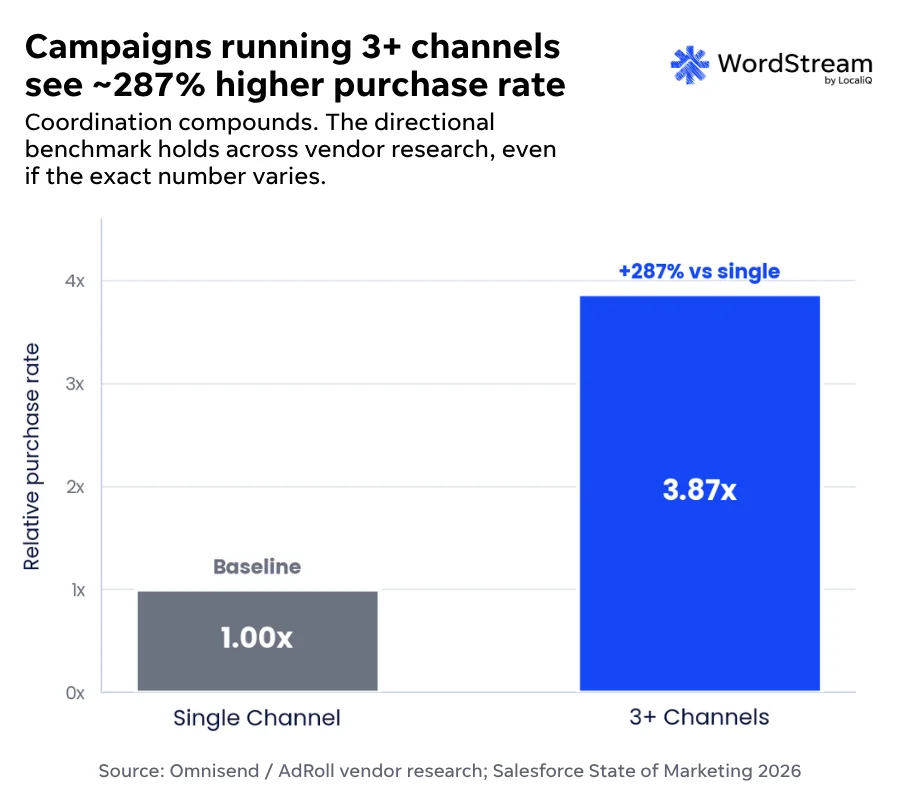
Cross-channel marketing has a few primary benefits:
- Campaigns using three or more channels see a 287% higher purchase rate than single-channel campaigns: Based on Omnisend customer data. It’s important to treat this as directional, not causal.
- Customers exposed to AI-powered personalization across three or more touchpoints show a 67% repeat-purchase rate: That’s with the average personalized customer generating 3.4X more lifetime revenue than a non-personalized counterpart.
- High-performing marketing teams are 12.8X more likely than underperformers to heavily coordinate marketing efforts across channels: That’s from a survey of ~4,500 marketers in Salesforce’s 10th Edition State of Marketing.
- 79% of customers expect consistent interactions across departments, yet 55% say it generally feels like they’re communicating with separate departments instead of one company.
If you’re looking to add raw incremental leads or sales, focusing on cross-channel coordination may not be the right area of focus. Better coordination across channels can get you better yield out of your current spend, but it’s ultimately about coordination more than increased reach.
🚀 Want more sure-fire tactics to drive more sales? Download 14 Super-Fast Ways to Boost Conversions
How to build a cross-channel marketing strategy
To build a cross-channel marketing strategy, you want to start with a target audience. From there, you determine the proper channels to leverage, map creative to those channels, and build a system of cross-channel management and tracking.
Define one audience, not per-channel audiences
Build the audience definition outside the ad platforms first. Your CRM (customer relationship management software), a CDP (customer data platform), or even a clean spreadsheet works as the source of truth. Then push that single definition into the appropriate platform, like Google Ads Customer Match, Meta Custom Audiences, your email service provider, or your demand-side platform.
Map the journey to channels, not channels to budget
Lay out the customer journey first: stage, then channel, then message, then next best action. Most teams do this backward. They look at last quarter’s marketing budget split, decide who is getting a raise, and stick the journey logic in later.
Set one creative system
You are looking for consistency across channels with your creative, offers, and brand experience. Build a single campaign-level promise with one offer and one proof point. Then translate it into channel-native executions.
Wire up identity and signal sharing
Every ad platform needs to know when someone buys, fills out a form, or calls your business. If that connection is broken, your reporting lies to you.
The two free fixes most small businesses skip are turning on Enhanced Conversions in Google Ads and the Conversions API in Meta. That is the single biggest data upgrade you can make in an afternoon.
If your developer or agency offers to set up “server-side tagging,” say yes. You do not need to know how it works. Skip any pitch for a “Customer Data Platform,” unless you are running four or more paid channels at real scale.
Set frequency caps across channels, not within
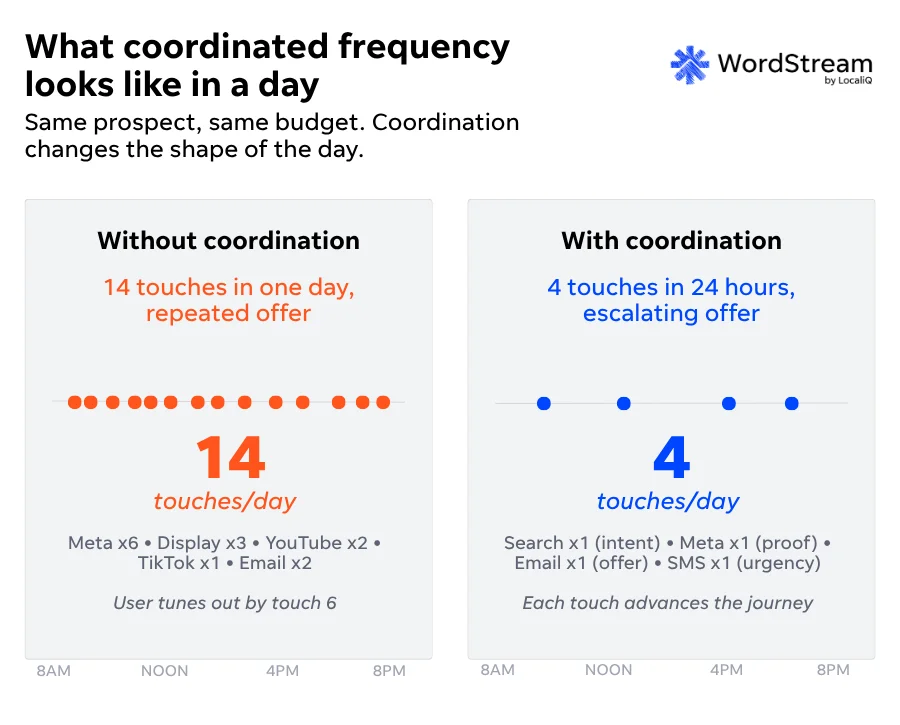
The most powerful budget argument for cross-channel is that you stop hitting one prospect with 14 ads when 4 would have done it.
Most teams cap frequency inside each platform. That is multi-channel capping. It does not account for what Meta is doing to the same user that YouTube is also doing.
This guide walks through implementing cross-channel frequency capping, which requires a unified user ID, which is what identity resolution is for.
Decide your measurement frame before you launch
Pick what “success” looks like before you start spending. Decide on the one or two marketing KPIs you’ll use to judge the campaign (cost per lead, return on ad spend, sales generated in the first 30 days) and write them down before launch.
Wait until the campaign is running, and you will find some metric on some dashboard that makes the work look good. That is not measurement. That is cherry-picking.
For a simple framework you can use this afternoon, use this guide to marketing objectives.
3 cross-channel marketing examples
Below is a series of cross-channel examples across different company types. The through-line for each example is that each has one audience, one signal, and three or more channels that talk to each other.
Example 1: B2C ecommerce
An apparel brand syncs its browse-abandon and cart-abandon audiences into Meta, Google Ads, and Klaviyo from a single customer data source. A browse on the site triggers a retargeting ad capped at three impressions across all three platforms combined. An email follows at hour 24. An SMS follows at hour 48 for opted-in users only.
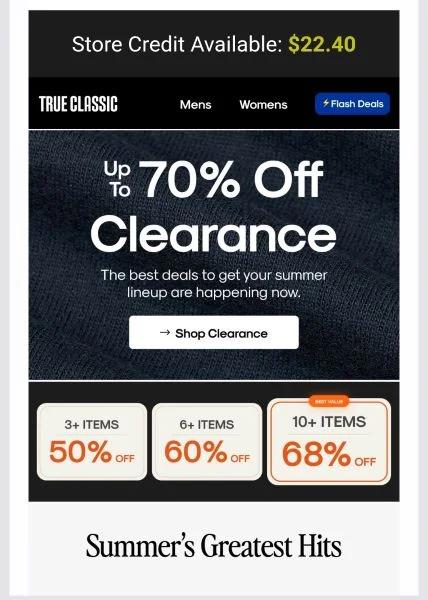
In a cross-channel marketing system, an ad like this could trigger after someone abandons their cart.
The mechanics that make it cross-channel: the brand identifies the same person across all three platforms, so the three-impression cap holds across the whole mix. Without that identity match, the same prospect would see three Meta ads, three Google ads, three reminder emails, and an SMS within 48 hours of a single browse session. The brand still spends the same budget. It just stops burning it on people it has already reached.
Example 2: B2B SaaS/ABM
In B2B deals, the buyer is usually a group, not a person. Gartner and Forrester research find that the average B2B buying group has six to 10 people who weigh in on a purchase, and each of them takes 15 to 20 marketing touches before the deal closes. That is the cross-channel problem in one number.
The mechanic that makes it cross-channel rather than multi-channel: the team uses one platform (an “account-based marketing” or ABM platform) that watches what people at each target company are doing across LinkedIn ads, display ads, and the company’s website. When someone at a target account starts paying more attention, the platform automatically ramps up direct mail to that account. When an account goes quiet, the platform tells the sales team to stop calling and focus on accounts that are actually warming up.
Every channel works off the same signal about what each target account is doing. None of them runs on its own schedule.
Example 3: Local and multi-location SMB
An auto-service shop runs Local Services Ads, Google Ads, Meta, organic Google Business Profile, and email. The mechanic that makes it cross-channel: phone-call conversions in Google Ads get pushed back into Meta as a custom conversion event. A searcher who called for a brake quote then gets a Meta retargeting ad for an oil-change offer, not the same generic “schedule service” ad they already ignored.

Cross-channel marketing helps you send more relevant ads to people who connect with your business.
The coordination layer is server-side tagging plus a marketing services partner, which is how most multi-location SMBs get there without a full data team. The shop is not running a CDP. It does not need one. It needs one event flowing cleanly between two ad platforms and an email tool. That is cross-channel at the SMB scale, and it works.
How to measure cross-channel marketing
Multi-touch attribution coverage has collapsed from over 90% to between 30% and 60% in post-cookie environments.
Additionally, customers and prospects are increasingly researching your brand in AI platforms and agents that may or may not link to your site, breaking the trackable funnel in another way.
This means that the measurement model most teams used for the last decade now misses 40-70% of the conversions it is supposed to count. You can combat some of this leakage by using multiple tools.
Cross-channel measurement tools and software
Determining your “cross-channel measurement stack” can be overwhelming. If you’re looking for help determining how your company should think about the specific stack that will best fit your needs, we built a free tool to help you make the right choice:
Cross-Channel Measurement Stack Builder
Five inputs. We'll recommend a layered measurement stack tailored to your scale and data maturity. Vendor-agnostic by design.
Here are the two areas to focus on:
- Server-side tracking and enhanced or server-side conversions: The plumbing that gets clean conversion data from your website into every ad platform. Set this up first. Everything else here depends on it. (See Step 4 above for the SMB version.)
- GA4 cross-channel reports and Data-Driven Attribution: Google Analytics 4 is the free analytics tool that ships with Google’s marketing stack. The cross-channel reports show you how Google Ads, organic search, social, email, and direct traffic combined to drive a conversion. Data-Driven Attribution (DDA) is Google’s automated model that splits credit across those touches based on what actually moved the needle.
Two things to note:
- Google’s April 2026 update changed how paid and organic search are grouped. Check “session_default_channel_group” in your reports so you are comparing the right things.
- DDA needs at least 400 conversions per 28-day window per event to model credibly. Below that threshold, use Position-Based attribution as a fallback.
This is useful for day-to-day optimization decisions.
- Media Mix Modeling (MMM): MMM works backward from what you spent on each channel each week and what came in as revenue to figure out which channels actually drove the result. It uses aggregated data only, so user-level tracking is not required.
This is useful to decide where your next budget dollar should go.
- Incrementality testing: Pause one channel in one geography for 30 days. Measure whether sales in that geography actually drop. That tells you what the channel was really delivering, separate from what the ad platform claims. Run one of these tests per quarter against your biggest channel. You can also use this same approach for other segmentations like day-parting.
This is useful to check whether the rest of your measurement is telling the truth.
- In-platform reporting: The numbers that each ad platform (Google, Meta, and so on) shows you about its own performance. This is useful for tuning campaigns inside that platform. Every ad platform over-credits itself, so do not use these numbers to compare platforms against each other or to decide how to split budget across the mix.
KPIs that actually matter for cross-channel marketing
These are the most useful KPIs to measure cross-channel marketing:
- Blended CAC (customer acquisition cost): Total marketing spend divided by new customers gained. This is the only cost-per-customer number that survives cross-channel measurement.
- Cohort LTV (lifetime value) at 30, 60, 90, and 180 days: How much new customers spend with you over their first six months. This tells you whether you are buying durable customers or one-time conversions.
- Marketing-influenced revenue percentage: The share of total revenue had a marketing touch somewhere in its path. This would be marketing-influenced pipeline if you are B2B.
- Cross-channel frequency: The average number of ad impressions each prospect sees across all your channels combined.
- New-to-file rate by channel mix: Which combinations of channels bring in new customers, versus which combinations just keep re-touching people who would have bought anyway.
What not to do when measuring cross-channel
Stop crediting “last paid touch.” Last-click attribution gives the final paid ad all the credit and ignores everything that came before it.
Stop adding up channel-by-channel ROAS (return on ad spend) from each platform’s own dashboard as if those numbers are comparable. Meta and Google each over-credit themselves. Summing their reported ROAS gives you a number that does not exist in the real world.
Not sure what your cross-channel cap should be? Use our free tool to get a specific recommendation:
Cross-Channel Frequency Cap Calculator
Enter your weekly frequency caps per channel. We'll estimate combined exposures on the prospects who appear in multiple channels, flag fatigue risk, and recommend a unified cross-channel cap.
Common cross-channel mistakes to avoid
These are the six mistakes that show up over and over in cross-channel marketing audits:
- Confusing channel coverage with channel coordination: Running ads on Google, Meta, and TikTok at the same time is not cross-channel marketing. If those channels do not share audiences or signals, that is multichannel with a bigger spreadsheet.
- Buying a CDP before fixing your tag setup and audience definitions: A Customer Data Platform will not save messy conversion data or vague audience rules. Fix the inputs first. Then decide whether you need the platform on top.
- Capping frequency per platform but not across the mix: Three impressions on Meta, plus three on YouTube, plus three on display is nine impressions to the same prospect. Cap the total, not the channel.
- Letting each channel manager pick their own audience definition: “High-intent shopper” on the Meta side and “high-intent shopper” on the Google side have to refer to the same list of people. If they don’t, every channel is optimizing for someone different.
- Building creative once for “the campaign” and reusing it everywhere unmodified: Coordination is not duplication. Same promise, same proof point, different format per channel.
- Trying to run cross-channel without server-side data, then being shocked when nothing reconciles: Every ad platform reports its own version of the truth. The only way to compare them is with clean first-party conversion data flowing into all of them from one source.
Cross-channel marketing FAQs
There’s a lot to discuss on this topic. Here are some of the most commonly asked questions about cross-channel marketing.
What is cross-channel marketing in simple terms?
Cross-channel marketing is a coordinated approach to reaching customers across multiple connected channels (paid search, social, email, SMS, display, CTV, and more) where data from one channel informs the next. A click on one channel can trigger a follow-up message on another, so the customer experience feels continuous instead of repetitive.
What’s the difference between cross-channel and multichannel marketing?
Multichannel means you’re present on multiple channels, but each one operates independently. Cross-channel means your channels share data and trigger each other. A browse on your site, for example, can trigger a retargeting ad, then an email, all coordinated. Multichannel is coverage; cross-channel is coordination.
Is cross-channel marketing the same as omnichannel?
No. Cross-channel coordinates marketing channels around a single campaign or journey. Omnichannel goes further: every brand touchpoint, including service, in-store, and commerce, shares a unified real-time customer view. Most SMB and mid-market teams are realistically doing cross-channel, even when vendors sell them “omnichannel” platforms.
What are examples of cross-channel marketing campaigns?
An ecommerce brand syncing browse-abandon audiences across Meta, Google, and email with shared frequency capping. A B2B team running coordinated LinkedIn ads, display, and direct mail against the same target account list, paused when intent signals fire. A local business retargeting Google Ads searchers with a Meta offer.
How do you measure cross-channel marketing in 2026?
With a layered stack: server-side tracking for clean inputs, GA4 data-driven attribution for day-to-day optimization (minimum 400 conversions per 28 days), media mix modeling (MMM) for budget allocation, and quarterly incrementality tests for causal validation. Single-touch attribution and platform-reported ROAS are no longer reliable as standalone measures.
Do SMBs need a customer data platform (CDP) for cross-channel marketing?
Not necessarily. If you’re running two to three channels with a single email tool and a CRM, a well-configured ESP plus server-side tagging and shared custom audiences can deliver most of the value. A CDP earns its cost when you’re operating four or more paid channels at scale and need real-time identity resolution.
Make cross-channel marketing your growth engine
Cross-channel marketing is a powerful driver of leads and conversions because it blends thoughtful creative, intentional use of technology, and buyer psychology to reach more people in an impactful way.
The best part is that it can be scaled up or down to fit just about any business. So whether you market a fast-growing, multi-location auto repair shop, an online retail outlet, or a local yoga studio, you can tailor the tactic to your goals.
And if you’d like some help coordinating and tracking your marketing channels, reach out, and we’ll show you how our digital marketing solutions can help.


Meet The Author
Tom Demers
Tom Demers is the co-founder and managing partner of Measured SEM. He has over a decade of experience helping businesses generate meaningful growth through SEO, PPC, content marketing, and online publishing. Formerly the Director of Marketing at WordStream, Tom has also worked as an in-house SEO specialist, SEO manager, agency consultant, and independent search marketing advisor. Through Measured SEM and his own publishing properties, he has driven millions of dollars in incremental pipeline and sales, generated millions of unique visitors, and built, monetized, and sold high-traffic sites. His insights have been featured in outlets including Search Engine Land, Search Engine Journal, USA Today, and Fox Business.
Recommended for you